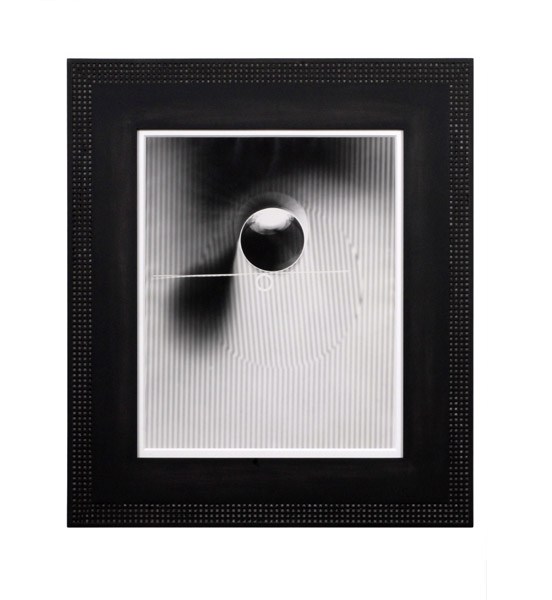
György Kepes, Abstraction, Gelatin silver print, 1942
GYÖRGY KEPES (1906-2001) Hungary/USA
Abstraction 1942
Silver gelatin print
Signed: 9 (in a circle, on back); Gyorgy Kepes 1942 (in ink on back)
György Kepes was a Hungarian-born painter, designer, educator and art theorist. After emigrating to the U.S. in 1937, he taught design at the New Bauhaus (later the School of Design, then Institute of Design, then Illinois Institute of Design or IIT) in Chicago. In 1947 He founded the Center for Advanced Visual Studies at the Massachusetts Institute of Technology (MIT) where he taught until his retirement in 1974.
Aram Gesar has been published internationally and has exhibited his photographic work in New York, San Francisco, Zurich and Geneva since 1977. As a producer, art director and photographer, Gesar created advertising campaigns for major corporations in the U.S. and Europe focusing on the fields of travel, banking, financial services, aerospace and motion pictures. He also created and produced documentaries on travel, aviation and yachting for national cable networks and the home video markets and television commercials and corporate programs for various U.S. and European corporations.
Gesar is currently one of the leading international experts on travel and air transport, and the founder and CEO of The Pyramid Media Group, which includes several magazines, newsletters, web sites, books, eBooks and other publications integrating a spectrum of business, travel and aviation content.
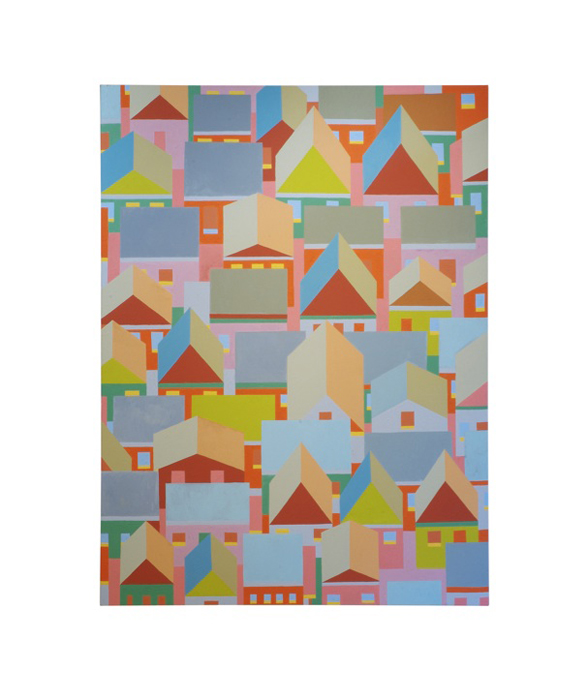
Hubert Schmalix “Mount Washington” Oil on Canvas 2005/2006
HUBERT SCHMALIX (1952-) Austria
Mount Washington 2005/06
Oil on canvas
Signed and dated on back: Schmalix 05 06
Provenance: Hubert Schmalix Vienna
For related works by Hubert Schmalix see: Hubert Schmalix, Lóránd Hegyi exhibition catalog (Museum moderner Kunst Stiftung Ludwig Wien) November 19, 1994 – January 1995.
H: 69” x W: 51”
Hubert Schmalix was born in Graz, Austria, on December 17, 1952 and studied at the Vienna Art Academy from 1971 to 1976. By 1979 Schmalix was showing work at the forward-looking exhibition ‘Europa 79 – Kunst der 80er Jahre’ in Stuttgart. In 1983 the London Tate Gallery invited Schmalix to present work at ‘New Art’, an important survey of contemporary art. Schmalix has become well-known world-wide as an exponent of ‘New Art’, working with a retrospective glance at both classical art history and modern art. Schmalix focuses on the world of things and the human figure. Although the expressive gesture was the dominant feature of his 1980s work, it yielded early in the 1990s to stringent tectonic composition. In 1984 Hubert Schmalix went to the Philippines and on to the US, moving to Los Angeles in 1987. In 1986-87 Schmalix taught at the Academy for the Decorative and Applied Arts in Vienna and from 1997 he has been a professor at the Vienna Art Academy. Schmalix is a visiting professor at the University of California Los Angeles (UCLA). In 1993 his work was featured at the Venice Biennale and in 1998 he was awarded the Fine Art Prize of the City of Vienna. Schmalix has done several large fresco cycles in Salzburg and his work has been shown extensively at numerous international solo and group shows and most recently at Art Basel 2006.





 @hd_jewels