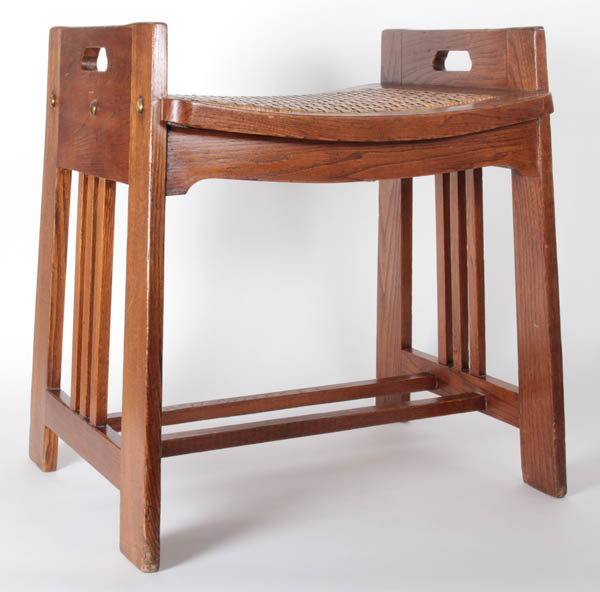
Wilhelm Schmidt / Prag Rudnicker Vienna Secession / Arts & Crafts stool c. 1902
More Information
Wilhelm Schmidt / Prag Rudnicker Vienna Secession / Arts & Crafts stool c. 1902
WILHELM SCHMIDT (b. 1880) Austria
PRAG-RUDNICKER KORBWAREN-FABRIKATION Austria
Vienna arts & crafts stool c. 1902
Oak, rattan
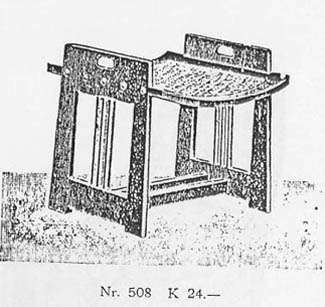
Illustrated: Das Interieure III “Wiener Kunst im Hause Exhibition”, Wien, 1902, p. 169; Prag-Rudnicker Korbwaren-Fabrikation Catalog, 1902/1903, No. 508. Korbmöbel, Eva B. Ottillinger (Salzburg: Residenz Verlag, 1990) p. 106, illus. no. 99, Moderne Vergangenheit Wien 1800-1900 (Vienna: Künstlerhaus, 1981) p. 271;
H: 19 1/2″ x W: 19″ x D: 17 5/8″
Price: $4,800
Wilhelm Schmidt was one of a number of avant-garde designers, along with M.H. Baillie Scott, Peter Behrens, and Henry van de Velde, who incorporated the traditional material of rattan, or wicker, into their furniture designs during the early part of the century. For this stool, the Viennese designer used rattan in the much same way that a furniture maker of his day would have used upholstery on seating furniture. It provides a supportive, yet yielding and therefore comfortable seat.
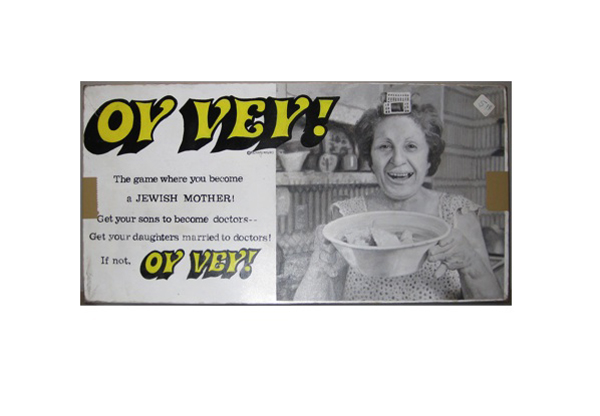
Tim Liddy Oy Vey (1979) The game where you become a JEWISH MOTHER! Get your sons to become doctors—Get your daughters married to doctors! If not, OY VEY! 2008 Oil and enamel on copper, plywood back
TIM LIDDY
“Oy Vey” (1979) The game where you become a JEWISH MOTHER! Get your sons to become doctors—Get your daughters married to doctors! If not, OY VEY! 2008
Oil and enamel on copper, plywood back
Signed in script: Tim Liddy, red circular ring, “circa 1979”, 2008
Provenance: William Shearburn Gallery, St. Louis, MO
H: 10 ¼” x W: 20 ½” x D: 1 ¾”
With his recent paintings, Liddy has both reasserted the construct of hyperrealist painting and developed a thoroughly unique advancement of that mode by extending the cultural reality of the indexed original. Based on the illustrated box lids of vintage board games, Liddy has recontextualized a subject, which evokes the underlying rules of life. Painted on copper or steel in the precise dimensions of the original, the metal is then manipulated to demonstrate the exact rips and tears from years of usage and includes trompe-l’oeil renditions of the scotch tape that might be holding the cardboard box together, the assorted stains, or the various graffiti of time. Liddy leaves no possibility of ambivalence, these works speak to a concurrent understanding of their original object identity and to themselves as works of art engaged in historical and psychological dialogue.
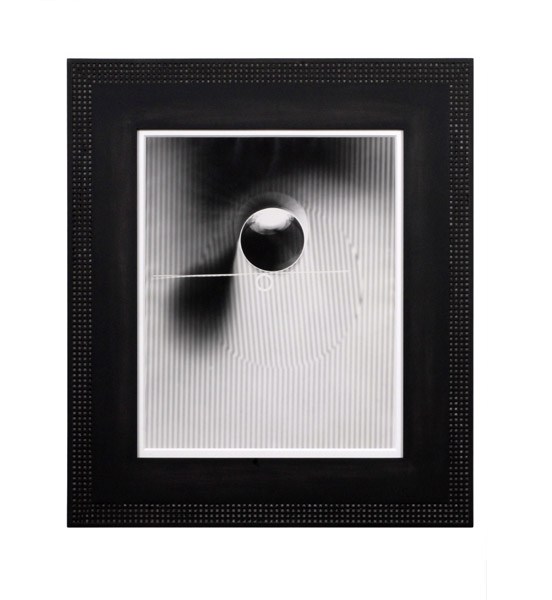
György Kepes, Abstraction, Gelatin silver print, 1942
GYÖRGY KEPES (1906-2001) Hungary/USA
Abstraction 1942
Silver gelatin print
Signed: 9 (in a circle, on back); Gyorgy Kepes 1942 (in ink on back)
György Kepes was a Hungarian-born painter, designer, educator and art theorist. After emigrating to the U.S. in 1937, he taught design at the New Bauhaus (later the School of Design, then Institute of Design, then Illinois Institute of Design or IIT) in Chicago. In 1947 He founded the Center for Advanced Visual Studies at the Massachusetts Institute of Technology (MIT) where he taught until his retirement in 1974.





 @hd_jewels