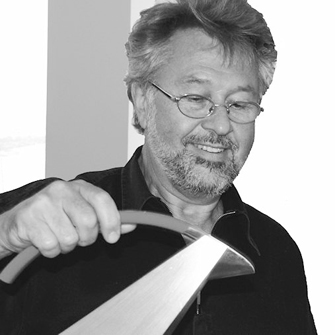
Wolfgang Gessl Unique sterling silver Arc pitcher with acrylic handle 1990
More Information
Wolfgang Gessl Unique sterling silver Arc pitcher with acrylic handle 1990
WOLFGANG GESSL (b. 1949) Austria
Arc pitcher – unique 1990
Hand wrought silver in a rounded arching form with a cylindrical luminous yellow-green acrylic handle
Marks: Wolfgang Gessl (script impressed signature), WO.GE (in a rectangle), Swedish assay mark for Stockholm, 925 (silver guarantee in a rectangle), Q10 (in a rectangle)
Illustrated: Gold and Silversmith Wolfgang Gessl: Exceeding Geometry, Kerstin Wickman, p. 17, cover.
H: 13 1/2″ x W: 10 ¼” x D: 4 ½”
Price: $27,500
Wolfgang Gessl was born in 1949 in Vienna, Austria and trained as a goldsmith with Professor Hans Angerbauer. Upon moving to Sweden, Gessl studied under the eminent silversmith Sigurd Persson at Konstfack, the National University of Art, Craft and Design in Stockholm, Sweden.
Wolfgang Gessl has had fifteen solo exhibitions including shows at The National Museum, Stockholm and The Royal College of Art in London. His metalwork has been widely exhibited in Sweden, Europe and the U.S and his pieces can be found in many private collections throughout the world. He has taught at Konstfack for more than twenty-four years, and continues to live and work in Stockholm.
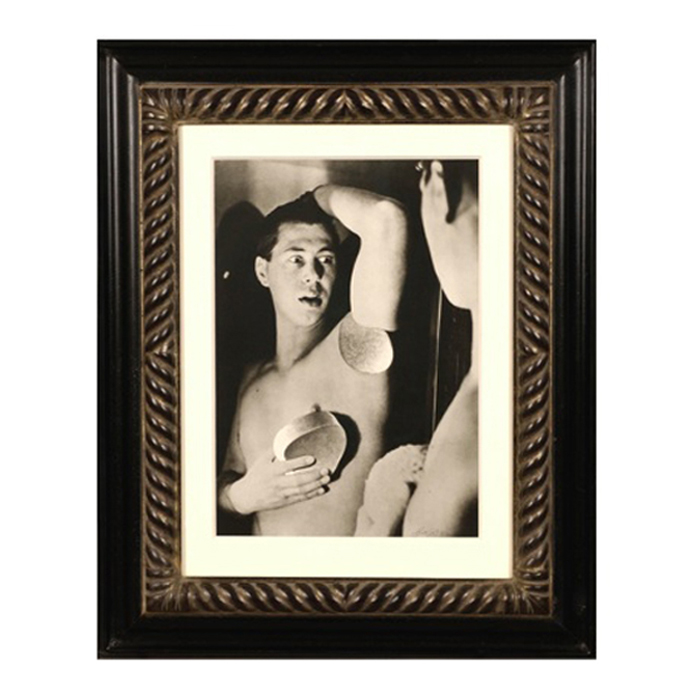
Herbert Bayer, Self Portrait, Gelatin silver print , 1932, printed later
HERBERT BAYER (1900-1985) Austria
Self portrait 1932 (printed later)
Silver gelatin print
Edition: 28/40
Signed: bayer 32 (in ink on bottom right corner)
Provenance: Kennedy Gallery, New York
H: 13 7/16” x W: 9 ½”
Framed size: H: 21 ½” x W: 17 ½”
Price: $16,000
Herbert Bayer (1900 – 1985) was an Austrian graphic designer, painter, photographer, and architect. Bayer apprenticed under the artist Georg Schmidthammer in Linz. Leaving the workshop to study at the Darmstadt Artists’ Colony, he became interested in Walter Gropius’s Bauhaus manifesto. After Bayer had studied for four years at the Bauhaus under such teachers as Wassily Kandinsky and László Moholy-Nagy, Gropius appointed Bayer director of printing and advertising. In the spirit of reductive minimalism, Bayer developed a crisp visual style and adopted use of all-lowercase, sans serif typefaces for most Bauhaus publications. Bayer is one of several typographers of the period including Kurt Schwitters and Jan Tschichold who experimented with the creation of a simplified more phonetic-based alphabet. Bayer designed the 1925 geometric sans-serif typeface, universal, now issued in digital form as Architype Bayer that bears comparison with the stylistically related typeface Architype Schwitters.
In 1928, Bayer left the Bauhaus to become art director of Vogue magazine’s Berlin office. He remained in Germany far later than most other progressives. In 1936 he designed a brochure for the Deutschland Ausstellung, an exhibition for tourists in Berlin during the 1936 Olympic Games. In 1938 he left Germany and settled in New York City where he had a long and distinguished career in nearly every aspect of the graphic arts. In 1946 Bayer relocated again. Hired by industrialist and visionary Walter Paepcke, Bayer moved to Aspen, Colorado as Paepcke promoted skiing as a popular sport. Bayer’s architectural work in the town included co-designing the Aspen Institute and restoring the Wheeler Opera House, but his production of promotional posters identified skiing with wit, excitement, and glamour. Bayer would remain associated with Aspen until the mid-1970s. Bayer gave the Denver Art Museum a collection of around 8,000 of his works. In 1959, he designed his “fonetik alfabet”, a phonetic alphabet, for English. It was sans-serif and without capital letters. He had special symbols for the endings -ed, -ory, -ing, and -ion, as well as the digraphs “ch”, “sh”, and “ng”. An underline indicated the doubling of a consonant in traditional orthography.
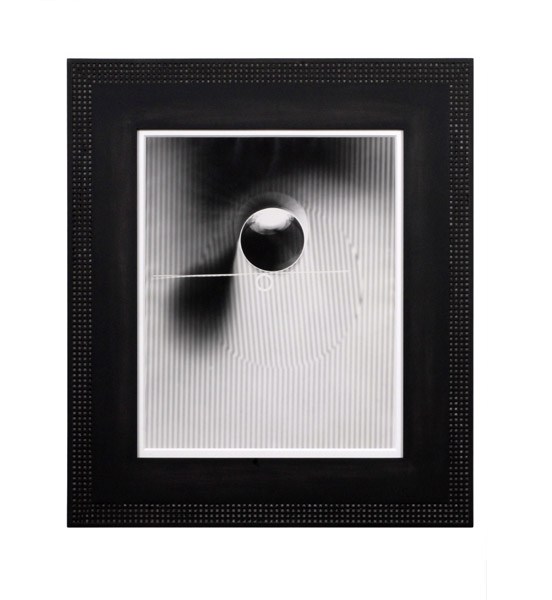
György Kepes, Abstraction, Gelatin silver print, 1942
GYÖRGY KEPES (1906-2001) Hungary/USA
Abstraction 1942
Silver gelatin print
Signed: 9 (in a circle, on back); Gyorgy Kepes 1942 (in ink on back)
György Kepes was a Hungarian-born painter, designer, educator and art theorist. After emigrating to the U.S. in 1937, he taught design at the New Bauhaus (later the School of Design, then Institute of Design, then Illinois Institute of Design or IIT) in Chicago. In 1947 He founded the Center for Advanced Visual Studies at the Massachusetts Institute of Technology (MIT) where he taught until his retirement in 1974.








 @hd_jewels