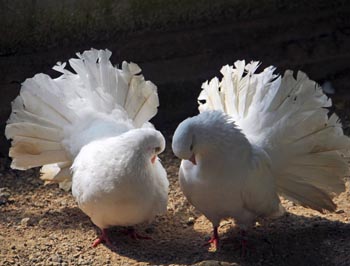
Jan et Joel Martel / Primavera French Art Deco Courting Fantail Pigeon Sculptures c.1930
More Information
Jan et Joel Martel / Primavera French Art Deco Courting Fantail Pigeon Sculptures c.1930
JAN ET JOËL MARTEL (1896-1966) France
PRIMAVERA Paris
Pair of courting Faintail Pigeon Sculptures c.1925-30
Black glazed earthenware with silver / platinum decorative dot motif.
Marks: PRIMAVERA FRANCE, 12684
For related model: The Art Deco Style in Household Objects, Architecture, Scupture, Graphics, Jewelry, Theodore Menten (New York: Dover, 1972), p. 179.
For more information see: Joël et Jan Martel: sculpteurs 1896-1966, Christophe Vital, et al. (Paris: Gallimard / Electa, 1996), pp. 127-9
H: 8 1/16” x L: 9” x D at tail: 5 1/4”
H: 7 1/8” x L: 10” x D at tail: 5 1/4”
Jan & Joël Martel (the Martel Brothers/Twins, born in Nantes on 5 April 1896, both died in 1966)
The twin Martel sculptors were among the founding members of Union des Artistes Modernes, and their original works include ornamental sculptures, statues, monuments and fountains displaying characteristics typical of the Art Déco and Cubist periods. The brothers took part in a number of Paris exhibitions including the Salon des Indépendants, Salon d’Automne, Salon des Tuileries and the Exposition des Arts Décoratifs in 1925. In 1932, they created the Claude Debussy monument which sits on the boulevard Lannes in Paris. Between 1924-1926, Robert Mallet-Stevens designed a studio for the Martel twins at 10 Rue Mallet-Stevens in Paris’ 16th Arrondissement.
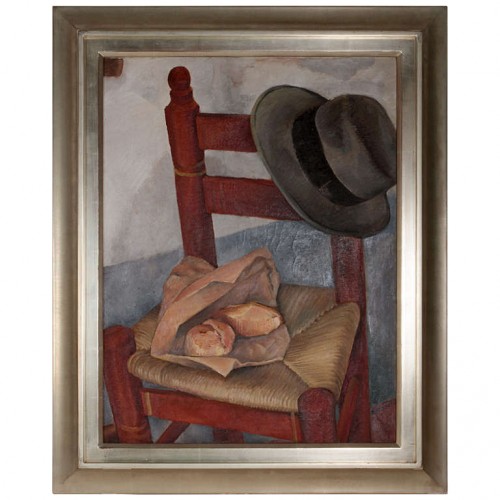
Victor Arnautoff, The Felt Hat, Oil on Canvas c. 1930
VICTOR ARNAUTOFF (1896-1979) USA
The Felt Hat c. 1930
Oil on canvas, white gold frame
Signed: V. Arnautoff, lower right
Exhibited: Art Center San Francisco, 1931 (see image of the review in the San Francisco Examiner, July 12th, 1931)
For more information see: The New Deal for Artists, Richard D. McKinzie (Princeton, NJ: Princeton University Press, 1973), Coit Tower, San Francisco : Its History and Art
Painting: H: 26” x W: 21”
Framed: H: 32 ½” x 27 ½”
Price: $60,000
Victor Arnautoff created paintings and watercolors, focusing on portraits, still lifes and rural landscapes in his early years, and moved to more socially conscious themes later in his career. Arnautoff was a native of Russia, to which he returned during the 1960s after thirty years in the United States. He came to San Francisco from Russia via China, bringing his wife and children with him, and studied at the California School of Fine Arts studying with Ralph Stackpole and Edgar Walter before going to Mexico. There he worked as an assistant to the famous Mexican muralist Diego Rivera. During the 1930s, Arnautoff worked as project director and one of the artists selected to create the famed Coit Tower murals, he played a key role in determining the political and social content of the frescoes painted in the San Francisco landmark. His own contribution, City Life, appears to be a lively, non-political melding of downtown San Francisco scenes; however, closer study reveals two leftist newspapers on the newsstand, while the city’s most mainstream daily, the San Francisco Chronicle, is strangely missing. Arnautoff also painted frescoes in the Military Chapel at San Francisco’s Presidio, in the Anne Bremer Library of the San Francisco Art Institute, and in high schools and other buildings in the Bay Area. He was a professor of art at Stanford University from 1939 until his retirement in 1963.
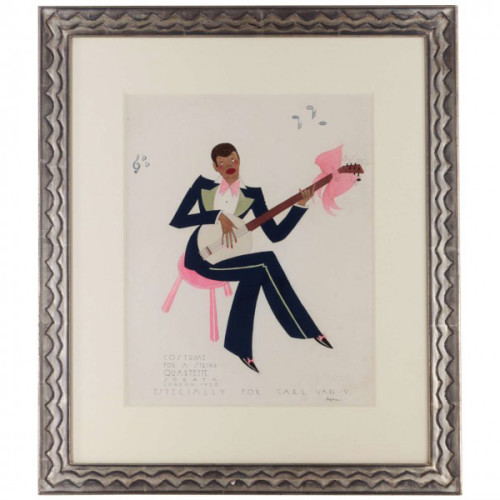
S O G A T A New York, NY, “Costume for a String Quartette” Watercolor and pencil on paper 1930
S O G A T A New York, NY
“Costume for a String Quartette” 1930
Watercolor and pencil on paper
Signed: COSTUME FOR A STRING QUARTETTE. SOGATA. LONDON: 1930. ESPECIALLY FOR CARL VAN V. with script signature (in pencil on lower left and beneath image)
For contextual history and similar art see: Rhapsodies in Black : Art of the Harlem Renaissance,(Berkeley: University of California Press, 1997); Harlem Renaissance Artists. Jordan, Denise (Chicago: Heinemann Library, 2003).
Paper H: 14 7/8″ x W: 10 7/8 ”
Image H: 14″ x W: 10 1/2″
Frame H: 20 1/2” x W: 17 1/4”
*This SOGATA New York Watercolor and pencil on paper has been gifted to The Wolfsonian – FIU, Miami Beach, FL.
Carl van Vechten (1880-1964), to whom this artwork is dedicated, was an influential novelist, critic, and photographer in New York during the 1920s, 30s, and 40s. His role in the Harlem Renaissance is well-documented. Van Vechten also introduced Miguel Covarrubias, a caricaturist and contemporary of Sogata, to prominent Manhattan artistic and society circles.
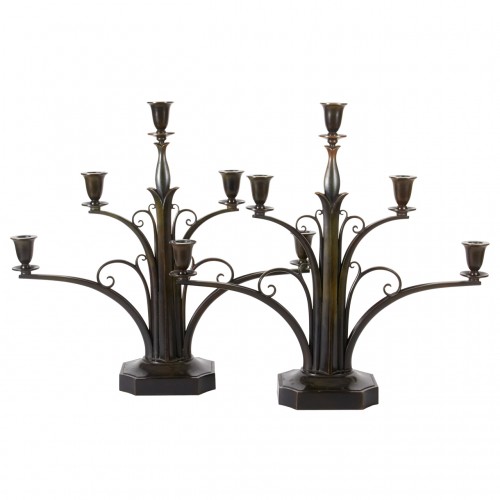
Just Andersen, Denmark Pair of Five-Branch Art Deco Candelabra c.1925
Just Andersen (1884-1943), Denmark.
Pair of five-branch Art Deco candelabra, circa 1925.
Cast and wrought bronze with original rich brown and green patina.
Marks: Denmark just in a triangular cartouche, No. B180.
For more information see: “Just Andersen: Manden og Vaerket” by Svend Rindholt in Samleren: Tidskrift for Kunst og Kunstindustri (Attende Aargang, 1941) pp. 171-194; Dansk Biografisk Leksikon. Første Bind (Copenhagen: Gyldendal, 1979) p. 199. The Design Encyclopedia. Mel Byars (New York: John Wiley & Sons, Inc., 1994) p. 23.
H: 17 5/16″ x W: 17 1/2″
By repute this pair of candelabra were exhibited in the Danish section at the Paris 1925 Exposition.
Just Andersen was a designer and craftsman for Georg Jensen until 1918 when he left to open his own studio. These candelabra are exquisite and remarkable examples of Danish Art Deco design and a testament to the artist’s consummate craftsmanship. Andersen’s bronzes are characterized by rich, deep patination and superlative casting quality and surfaces.
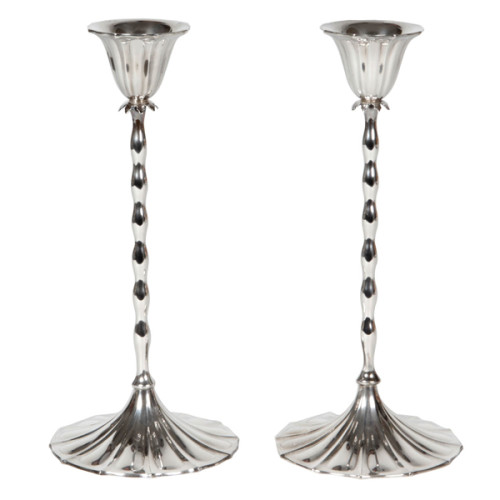
American Art Deco Reed & Barton Sterling candlesticks 1928
REED & BARTON (active 1824 – present) Taunton, MA
Candlesticks 1928
Sterling silver with Hoffmann-like fluted base and bobêches with undulating stem and palm leaf like terminating detail.
Marks: eagle R (in a shield) lion, Sterling, 1000, cement reinforced, eagle (date mark for 1928).
Model illustrated: Vanity Fair (Dec. 1928, Vol. 31), p. 120., Reed & Barton Vintage Catalog, p. 10, plate number 1000.
For more information on Reed & Barton see: Encyclopedia of American Silver Manufacturers, Dorothy T. Rainwater (West Chester, PA: Schiffer Publishing Ltd., 1986), p. 156-160.




 @hd_jewels