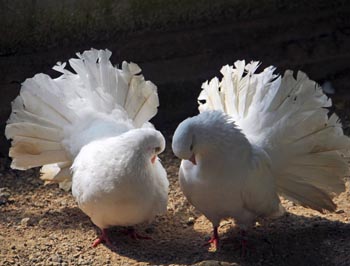
Jan et Joel Martel / Primavera French Art Deco Courting Fantail Pigeon Sculptures c.1930
More Information
Jan et Joel Martel / Primavera French Art Deco Courting Fantail Pigeon Sculptures c.1930
JAN ET JOËL MARTEL (1896-1966) France
PRIMAVERA Paris
Pair of courting Faintail Pigeon Sculptures c.1925-30
Black glazed earthenware with silver / platinum decorative dot motif.
Marks: PRIMAVERA FRANCE, 12684
For related model: The Art Deco Style in Household Objects, Architecture, Scupture, Graphics, Jewelry, Theodore Menten (New York: Dover, 1972), p. 179.
For more information see: Joël et Jan Martel: sculpteurs 1896-1966, Christophe Vital, et al. (Paris: Gallimard / Electa, 1996), pp. 127-9
H: 8 1/16” x L: 9” x D at tail: 5 1/4”
H: 7 1/8” x L: 10” x D at tail: 5 1/4”
Jan & Joël Martel (the Martel Brothers/Twins, born in Nantes on 5 April 1896, both died in 1966)
The twin Martel sculptors were among the founding members of Union des Artistes Modernes, and their original works include ornamental sculptures, statues, monuments and fountains displaying characteristics typical of the Art Déco and Cubist periods. The brothers took part in a number of Paris exhibitions including the Salon des Indépendants, Salon d’Automne, Salon des Tuileries and the Exposition des Arts Décoratifs in 1925. In 1932, they created the Claude Debussy monument which sits on the boulevard Lannes in Paris. Between 1924-1926, Robert Mallet-Stevens designed a studio for the Martel twins at 10 Rue Mallet-Stevens in Paris’ 16th Arrondissement.
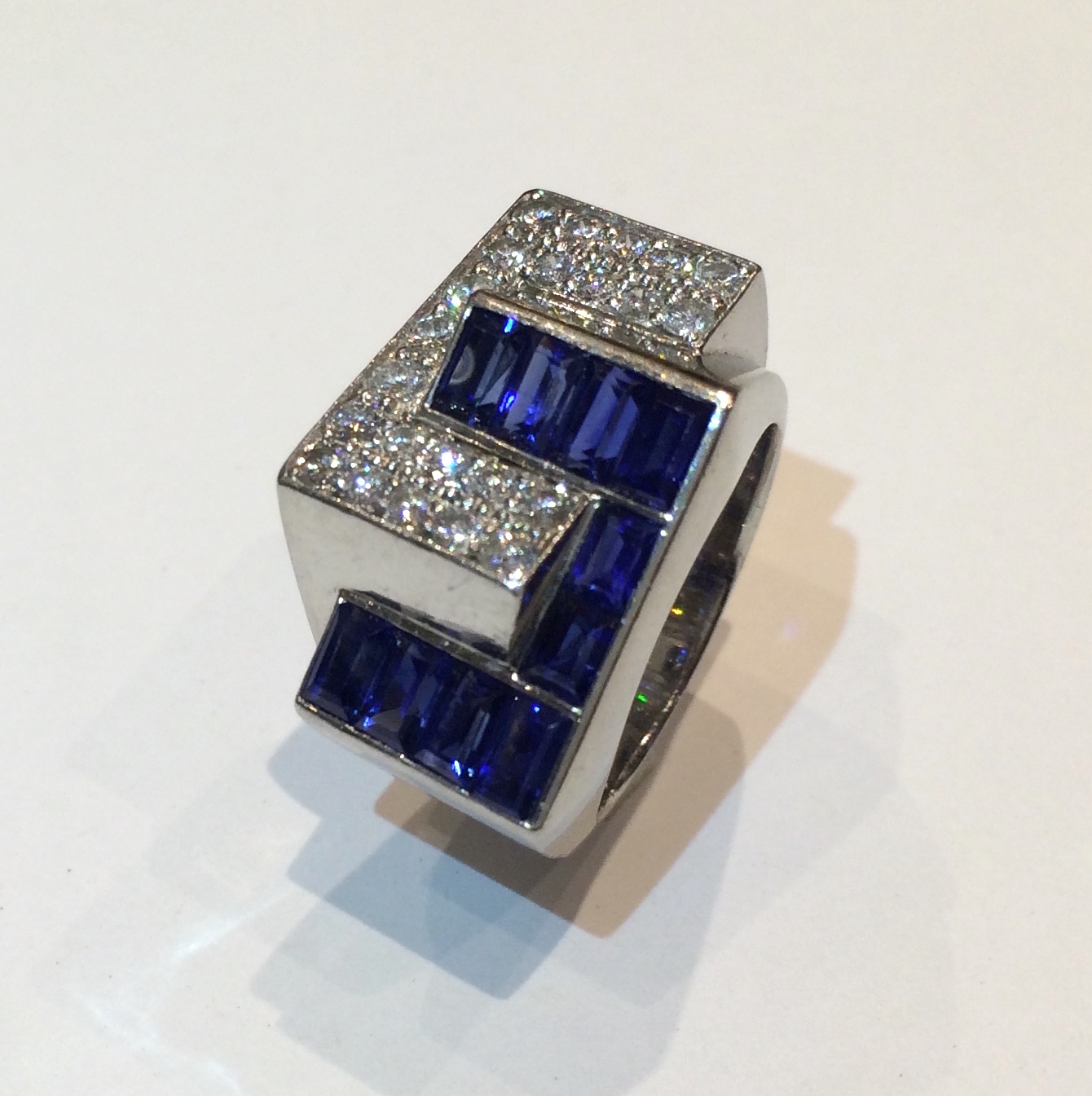
French Art Deco Interlocking ring, Invisibly set rectangular sapphires (10 count, approx. 2.50 carats TW), pave diamonds (approx. 2.50 carats TW) all set in a platinum mount, c. 1935
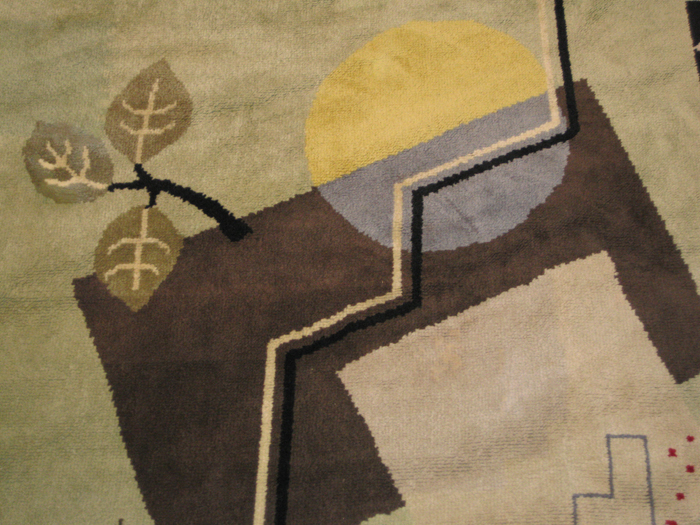
Ingegerd Torhamn Art Deco / Modernist rug c. 1930 (Exhibited: Stockholm Exhibition 1930)
INGEGERD TORHAMN (1898-1994) Sweden
Modernist rug c. 1930
Hand-knotted wool
Signed: it (Ingegerd Torhamn) lower left
Exhibited: Stockholm Exhibition 1930, Stockholmsutställningen 1930, Villa 42; V.I.P. in Swedish Design, Kalmar Konstmuseum 1996.
Illustrated: Katalog Över Bostadsavdelningen: Stockholms Utställningen 1930 (illustrated in situ) Stockholm Exhibition1930 (Stockholm: Tryckt Hos Bröderna Lagerström, Boktryckare, 1930) p. 149
Drawing illustrated: V.I.P. in Swedish Design: Axel Larsso, Ingegerd Torhamn, Inga Linden & Paula Sokolow, Arkiv for Svensk Formgivning, Kalmar Konstmuseum
For more information see: Svenska Textilier 1930, Stockholm 1930, Nils G. Wollin, plate nr. 50
Dimensions: 7’2” square
One of the ten rugs of her designs (including this rug as part of the music room) exhibited at the important Stockholm Exhibition of 1930 is now in the permanent collection of the Nationalmuseum in Stockholm.
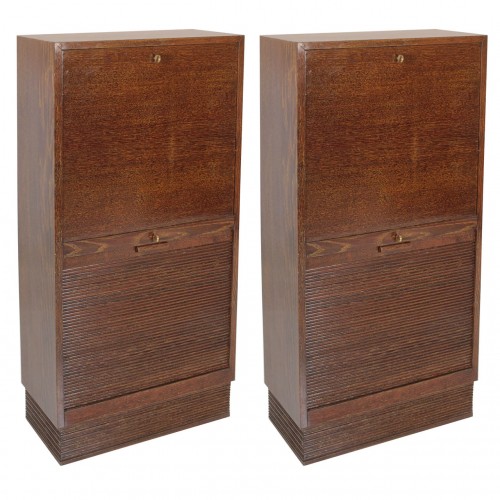
Pierre-Emile Legrain (attr.) Pair of French Art Deco drop and roll front cabinets c. 1927
PIERRE-EMILE LEGRAIN attr. (1889-1929) France
Matching Cabinets (pair) c. 1927
Golden cerused oak, roll-front and drop front doors,
original brass keys, reeded base
Provenance: Felix Marcilhac, Paris
For more information on Legrain see: Pierre-Emile Legrain 1889-1929 (Paris: exh. cat. Galerie Jacques de Vos,1996); Union des Artistes Modernes, Arlette Barré-Despond (Paris: Editions du Regard, 1986) 119-120.
H: 50 1/2 ” x W: 23 1/2” x D: 11 1/2”
The Art Deco movement centered in early 20th-century Paris sought to bridge the transition from academic art and craftsmanship to modern art and industrial production. Regarded by some as one of its founders, Pierre-Emile Legrain (1889-1929) worked at a time of great ferment in art, as well as in society. Legrain’s curiosity and receptiveness to these changes led him to adapt forms, materials and techniques from other cultures.
Legrain created two distinct bodies of work: an assemblage of approximately 1,200 bookbinding designs and a much smaller production of furniture made for couturiers in the French fashion trade. Both artistic endeavors shared fine craftsmanship, masterful use of rare and expensive materials, unusual combinations of textures and surfaces, and spare, geometrical forms. Nearly all of his creations were one-of-a-kind.




 @hd_jewels