Product Description
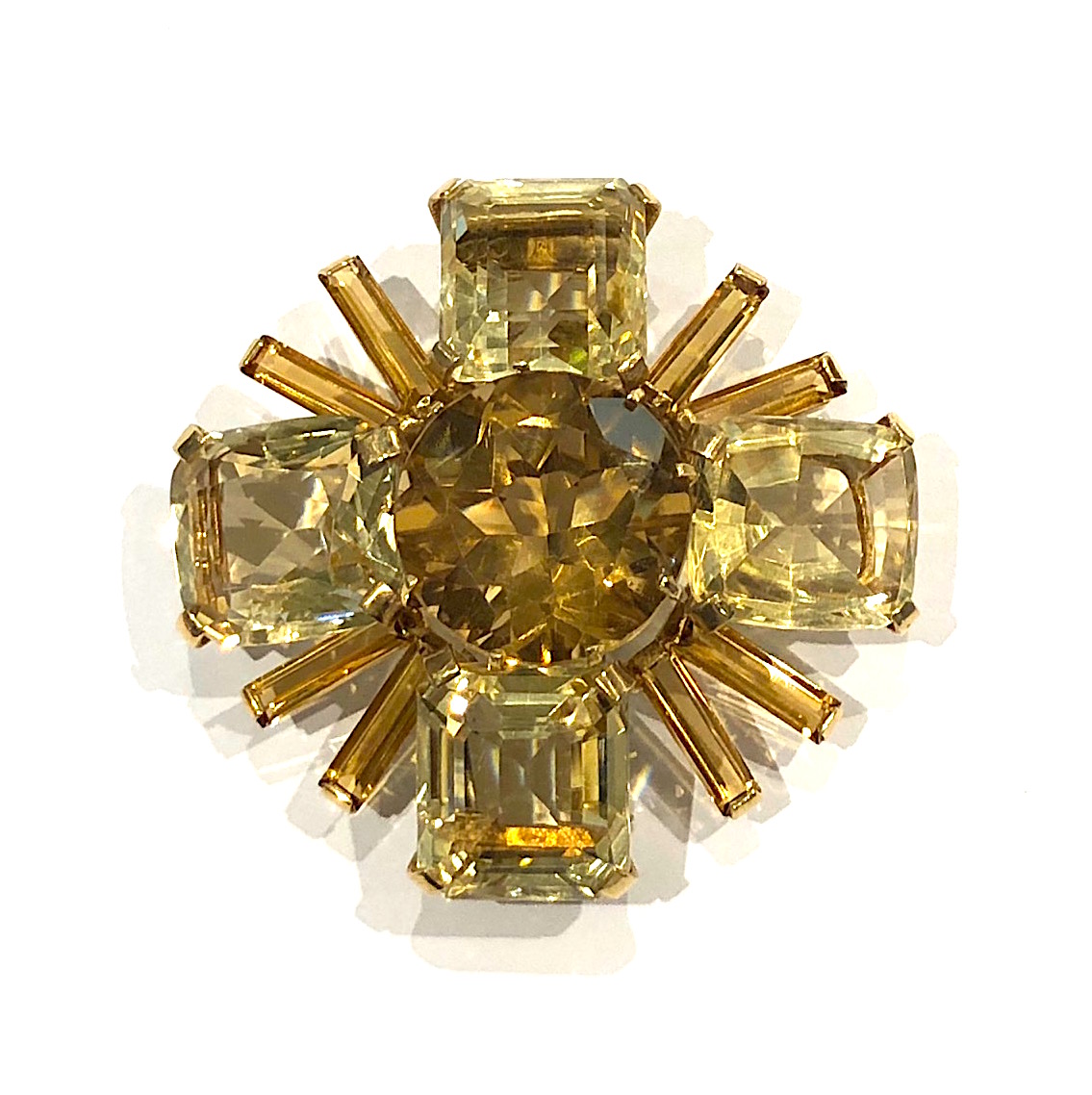
Seaman Schepps, New York “Maltese Cross” brooch, one large round cut central citrine set with four square step-cut citrines, four baguette citrines in a radiating pattern all set in 14K yellow gold, signed, c. 1940’s

An immigrant’s son, who grew up in the tenements of New York’s Lower East Side, Seaman Schepps rose to prominence in the 1930s with jewelry designs that challenged the status quo and defined a new style for the American woman. With his chunky brooches, “barbaric” bracelets and “bubble” earrings, Schepps pioneered a unique style of jewelry whose sense of splendor offered a new perspective to the world of fine jewelry.
Witty, over-the-top and flattering, Schepps’ jewelry embodied style and originality and was featured on the covers of Vogue, Harper’s Bazaar, Look and other magazines. It appealed to a myriad of clients from Katherine Hepburn to Andy Warhol to the Duchess of Windsor and greatly influenced his contemporaries. Today, some 50 years after his death, he continues to inspire modern jewelers.
Through the 1930s, and into the 40s and 50s, new clients flocked to him at his store on Madison Avenue. Often clients wanted a one-of-a-kind bauble and commissioned Schepps to incorporate their old jewelry into a fresh new design. Frequently this led to landmark decisions that helped distinguish Schepps as an extraordinary talent. His client list included Coco Chanel, Elsa Schiaparelli, the Duchess of Windsor, and members of the Du Pont, Mellon and Rockefeller families. By serving these most powerful and influential individuals, Schepps became known as “America’s Court Jeweler”.
Seaman Schepps, New York “Maltese Cross” brooch, one large round cut central citrine set with four square step-cut citrines, four baguette citrines in a radiating pattern all set in 14K yellow gold, signed, c. 1940’s
REINHOLD KLAUS (1881-1963) Vienna, Austria
CARL GEYLING ATELIER (founded 1841) Vienna, Austria
Man with tophat and flowers c. 1930
Window of stained and hand-painted leaded glass
Provenance: Estate of Carl Geyling (1814-1880), Vienna
H: 17 3/4″ x W: 14 1/2″
Reinhold Klaus studied from 1898-1902 with Alfred Roller at the Kaiserlich-Königliche Kunstgewerbeschule in Vienna. In 1914 Klaus married into the Carl Geyling family and became extensively involved with with stained glass painting. As early as 1918 Klaus worked on a stained glass window for the Siegestempel am Bisamberg in Vienna. In 1934 he became a professor of stained glass painting at the Kunstgewerbeschule, as well as creative director of the C. Geylings Erben glass painting company. Reinhold Klaus, a member of the Künstlerhaus since 1924 received many prizes and honors. He worked on commissions for the St. Veits cathedral in Prague, the St. Stephan cathedral in Vienna and many others.
Peter Canty received his BA in art from the Chouniard Art Institute, Los Angeles (now California Institute of the Arts) and an MA from the University of California, Santa Cruz in 1969. Heavily influenced by the Post-Impressionist masters Van Gogh, Gauguin and Cezanne, in his own he words he describes his interest in landscapes, believing they are, “the best vehicle for motion, force, and color dynamics.” Although his work reference realistic subjects, Canty’s imagery is drawn strictly from his own imagination.
KARL BENJAMIN (1925-2012) USA
Geometricized figure 1954
Oil on canvas
Signed: Benjamin 54 (lower left)
For more information see: Dictionnaire des Peintres, Sculpteurs, Dessinateurs et Graveurs, Vol. 1 to 10, E. Bénézit (Paris: Librairie Gründ, 1976).
Canvas: H: 17″ x W: 6″
Framed: H: 24 1/2″ x W: 13 1/2″
Karl Benjamin was born in Chicago, IL in 1925. He received his BA from the University of Redlands, CA and his MFA at Claremont Graduate School, CA. Benjamin belonged to the Hard Edge group of West Coast painters led by John McLaughlin during the 1950s, 60s and early 70s. He was awarded the National Endowment for the Arts Grant for Visual Arts in both 1983 and 1989. His work has been featured in numerous museum exhibitions and is included in the public collections of the Los Angeles County Museum of Art; Museum of Contemporary Art, Los Angeles; Museum of Modern Art, Israel; Oakland Museum, Oakland, CA; San Francisco Museum of Modern Art, CA; Seattle Art Museum, WA; and the Whitney Museum of American Art, NY, among others. For many years, Benjamin taught painting at Pomona College and Claremont Graduate School, and currently is Professor Emeritus. He lived in Claremont, CA.
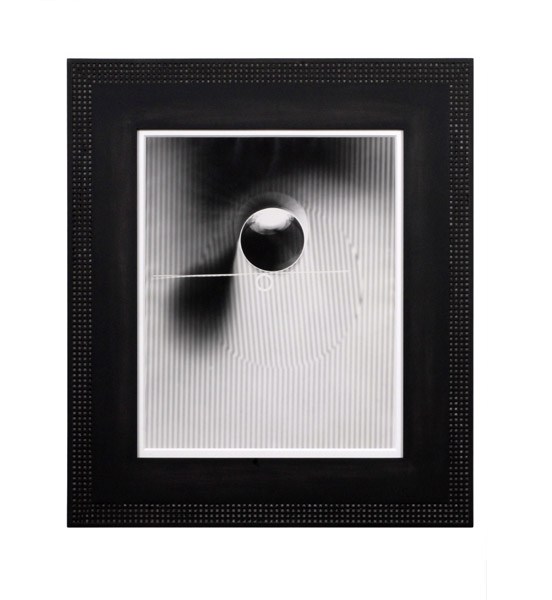
GYÖRGY KEPES (1906-2001) Hungary/USA
Abstraction 1942
Silver gelatin print
Signed: 9 (in a circle, on back); Gyorgy Kepes 1942 (in ink on back)
György Kepes was a Hungarian-born painter, designer, educator and art theorist. After emigrating to the U.S. in 1937, he taught design at the New Bauhaus (later the School of Design, then Institute of Design, then Illinois Institute of Design or IIT) in Chicago. In 1947 He founded the Center for Advanced Visual Studies at the Massachusetts Institute of Technology (MIT) where he taught until his retirement in 1974.
Framed size: H: 29 3/16” x W: 25 ¼”