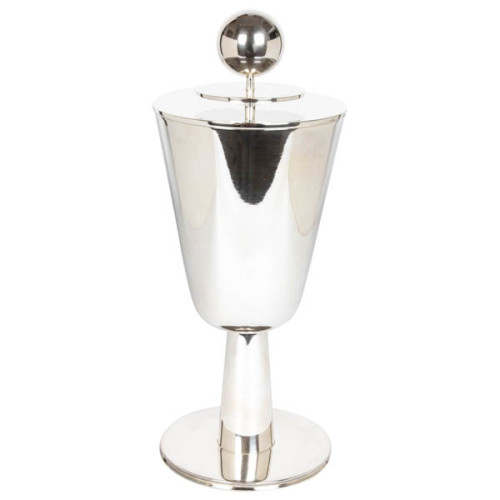
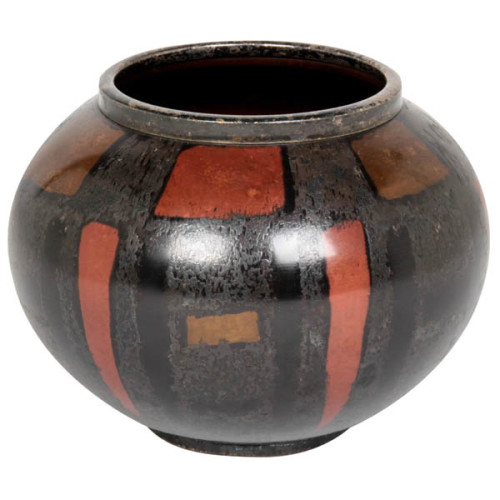
Breuhaus de Groot / WMF Ikora Germany Art Deco Rare “Pokal” Covered Footed Cup 1928
FRITZ AUGUST BREUHAUS DE GROOT (1883-1960) Germany
WMF [WÜRTTEMBERGISCHE METALLWARENFABRIK] Geislingen
“Pokal” Covered footed cup ( model no. Br 6 )1928
Silverplated brass, model no. Br 6
Marks: WMF insignia (touchmark), x/o
Illustrated: Goldschmiedekunst 49, (1928) m. Abb; Deutsche Kunst und Dekoration 63, (1928/29) Abb S 353; Metallkunst: Kunst vom Jugendstil zur Moderne (1889-1939), Karl H. Bröhan, Band IV (Berlin: Bröhan-Museum, 1990) n. 610, p. 571; WMF Ikora Metall / Metalwork, Carlo Burschel and Heinz Scheiffele (Stuttgart, Germany: ARNOLDSCHE, 2006) pp.12,19,34.
Silver-plated copper with with red patinated squares and rectangles on a black-patinated textured background
Marks: WMF castle mark, IKORA
Illustrated: WMF Ikora Metall / Metalwork, Carlo Burschel and Heinz Scheiffele (Stuttgart, Germany: ARNOLDSCHE, 2006), p. 142, 90/585.
For more information see: WMF Glas Keramik Metall 1925-1950, Jörg Schwandt, (Berlin: Kunstgewerbemuseum, Staatliche Museum Preussischer Kulturbesitz, 1981). Metallkunst, Band IV (Berlin: Bröhan-Museum, 1981) pp. 546-579.
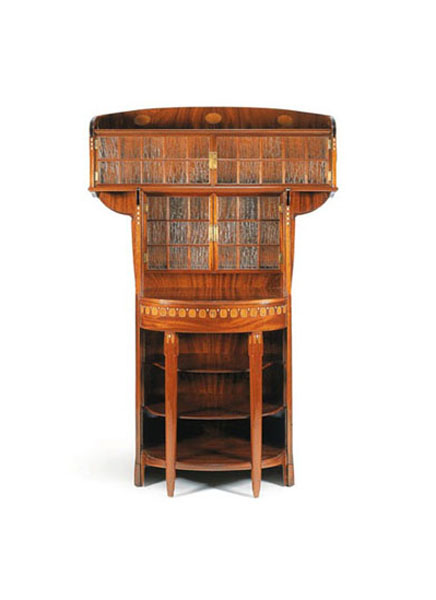
Alfred Grenander / W. Kummel 1904 St. Louis Exhibition cabinet, unique 1904
ALFRED GRENANDER (1863-1931) Sweden / Germany
W. KUMMEL Berlin, Germany (cabinetmaker)
Cabinet (unique) c. 1904
Flamed mahogany, ebony, ivory and fruitwood inlays, brass hardware and details, textured glass
Marks: American import label (from Germany) for the St. Louis exhibition
Exhibited: The 1904 St. Louis Exhibition, German Section in the Herrenzimmer
Illustration of Grenander room: Deutsches Kunstgewerbe St. Louis 1904, Hugo Nachtlicht, 1904, p. 80.
Commentary on Grenander’s display at St. Louis Exhibition: Deutsche Kunst und Dekoration, Band XV Oktober 1904-Marz 1905, “Die Wohnungskunst auf der Welt –Austellung in St. Louis”, Dr. Hermann Muthesius, p. 213-16.
Related bookcase-cabinet illustrated: Deutsche Kunst und Dekoration, Band XVI April-September 1905, p. 426.
For other works by Grenander see: Deutsche Kunst und Dekoration, Band XVI April-September 1905, p. 395-407, 426, 427, 671-73, 694, 695; Das Deutsche Kunstgewerbe 1906, 111. Deutsche Kunstgewerbe-Austellung Dresden 1906, (München, Verlagsanstalt P. Bruckmann A.G., 1906) p. 129-133, 232, 261
H: 79 1/2” x W: 57” x D: 23”
Price: $95,000
Alfred Grenander was born in June 1863 in Skövde, Sweden, and came to Berlin in 1885 to study. The city became his home, and he built his first buildings here together with his brother-in-law Otto Spalding. In 1897 Grenander began teaching at the Unterrichtsanstalt des Berliner Kunstgewerbemuseums (college attached to Berlin’s Museum of Arts and Crafts). His involvement with underground railway architecture began in 1900 and came to dominate his life’s work, with more than 80 buildings. He died on 14 July 1931 in Berlin.
From the turn of the century through the early 1930s, Alfred Grenander provided the emerging metropolis of Berlin with an extensive net of subway stations. He was an architect, draughtsman, and city planner; as well as a remarkable furniture designer. Grenander was the celebrated German representative at the 1904 World’s Fair in St. Louis, where he was being honored as “the renewer of German art.” This mahogany cabinet inlaid with pewter, ebony and ivory was exhibited in the elegant Herrenzimmer of the German pavilion at the Louisiana Purchase Exposition, St. Louis, Missouri, 1904, was bought in 1904 by a Kansas City, Missouri family and the piece descended in the family.
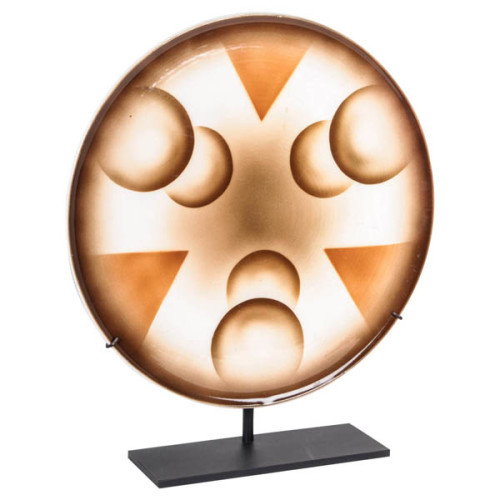
Wolfgang Kreidl / Max Roesler Jugendstil Keramik “Darmstadt” charger c. 1930
WOLFGANG KREIDL (1906-1972) Dresden, Germany
MAX ROESLER FEINSTEINGUTFABRIK A.G. Germany
“Darmstadt” charger c. 1930
Brown, orange and cream glazed earthenware with a triangle and circle airbrush design, on stand
Marks: Max Roesler Rodach (shield mark), 9, 2925, 6239 1 (under the glaze)
Model illustrated: Keramiken der Neuen Sammlung im Internationalen Keramik-Museum Weiden, Hans Wichmann, (Munich: Staatliches Museum für angewandte Kunst, 1990), cover image and p. 65; Design Contra Art Déco: 1927-1932 Jahrfünft der Wende, Hans Wichman (Munich: Prestel Verlag, 1993), p. 101.
For more information about Wolfgang Kreidel and other models with matching air brush design see: Max Roesler, Keramik zwischen Jugendstil und Art Deco, Rolf Peters (Darmstadt: Museum Künstlerkolonie Darmstadt, 1998), p. 98-102.


 @hd_jewels