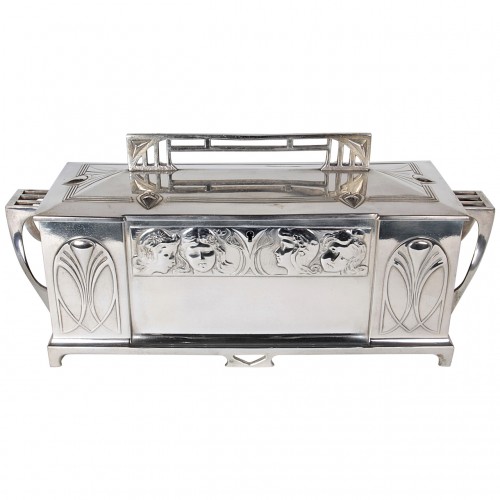
WMF Jugendstil Art Nouveau Four Seasons Jewelry box c. 1900
WMF [Württembergische Metallwarenfabrik] Germany
“Four Seasons” Art Nouveau Jewelry box c. 1900
Silver plate with Jugendstil design buttress handles and open work handle with a frieze of Art Nouveau maidens representing the four seasons, velvet lined with two original keys.
Marks: WMF mark, I/O (in a box), E
For more information see: WMF: Glas, Keramik, Metall, 1925-1950, Jörg Schwandt (Berlin: Kunstgewerbemuseum, Staatliches Museum Preussischer Kulturbesitz, 1981); Metallkunst, Band IV (Berlin: Brohan-Preussischer Kulturbesitz, 1981) pp. 546-579.
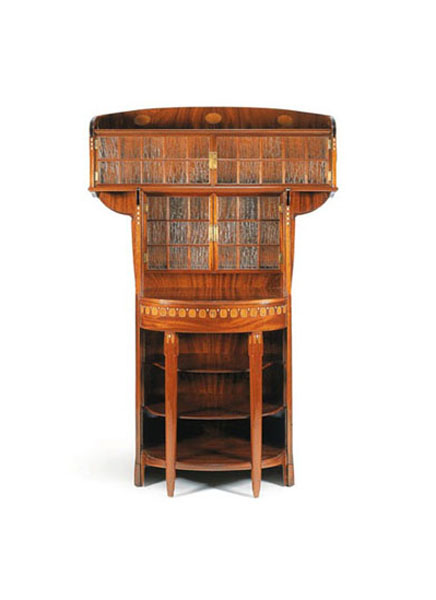
Alfred Grenander / W. Kummel 1904 St. Louis Exhibition cabinet, unique 1904
ALFRED GRENANDER (1863-1931) Sweden / Germany
W. KUMMEL Berlin, Germany (cabinetmaker)
Cabinet (unique) c. 1904
Flamed mahogany, ebony, ivory and fruitwood inlays, brass hardware and details, textured glass
Marks: American import label (from Germany) for the St. Louis exhibition
Exhibited: The 1904 St. Louis Exhibition, German Section in the Herrenzimmer
Illustration of Grenander room: Deutsches Kunstgewerbe St. Louis 1904, Hugo Nachtlicht, 1904, p. 80.
Commentary on Grenander’s display at St. Louis Exhibition: Deutsche Kunst und Dekoration, Band XV Oktober 1904-Marz 1905, “Die Wohnungskunst auf der Welt –Austellung in St. Louis”, Dr. Hermann Muthesius, p. 213-16.
Related bookcase-cabinet illustrated: Deutsche Kunst und Dekoration, Band XVI April-September 1905, p. 426.
For other works by Grenander see: Deutsche Kunst und Dekoration, Band XVI April-September 1905, p. 395-407, 426, 427, 671-73, 694, 695; Das Deutsche Kunstgewerbe 1906, 111. Deutsche Kunstgewerbe-Austellung Dresden 1906, (München, Verlagsanstalt P. Bruckmann A.G., 1906) p. 129-133, 232, 261
H: 79 1/2” x W: 57” x D: 23”
Price: $95,000
Alfred Grenander was born in June 1863 in Skövde, Sweden, and came to Berlin in 1885 to study. The city became his home, and he built his first buildings here together with his brother-in-law Otto Spalding. In 1897 Grenander began teaching at the Unterrichtsanstalt des Berliner Kunstgewerbemuseums (college attached to Berlin’s Museum of Arts and Crafts). His involvement with underground railway architecture began in 1900 and came to dominate his life’s work, with more than 80 buildings. He died on 14 July 1931 in Berlin.
From the turn of the century through the early 1930s, Alfred Grenander provided the emerging metropolis of Berlin with an extensive net of subway stations. He was an architect, draughtsman, and city planner; as well as a remarkable furniture designer. Grenander was the celebrated German representative at the 1904 World’s Fair in St. Louis, where he was being honored as “the renewer of German art.” This mahogany cabinet inlaid with pewter, ebony and ivory was exhibited in the elegant Herrenzimmer of the German pavilion at the Louisiana Purchase Exposition, St. Louis, Missouri, 1904, was bought in 1904 by a Kansas City, Missouri family and the piece descended in the family.
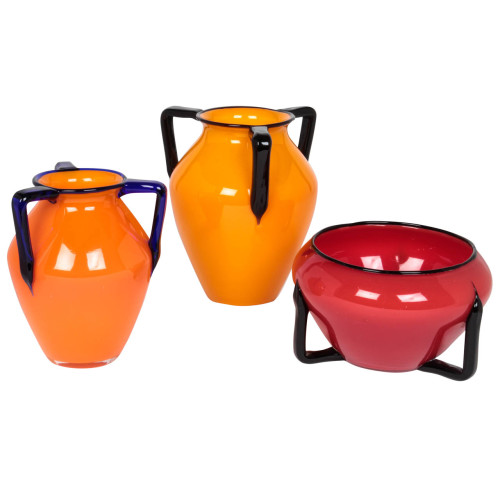
Michael Powolny / Lötz Witwe Glaswerks Jugendstil Set of Three “Tango” Glass Vases c. 1920
PROF. MICHAEL POWOLNY (1871-1954) Austria
LÖTZ WITWE GLASWERKS Klostermuhle
Set of three “Tango” glass vases c. 1920
Blown tall yellow glass with applied black handles, blown orange glass with applied cobalt blue handles, blown red glass with applied black handle-form feet
Marks: Cecho. Slovakia (acid etched in an oval) (red vase)
Yellow and black vase H: 6 1/2” x Dia: 6″
Orange and cobalt blue vase H: 5 1/2” x Dia: 6″
Red and black vase H: 3 1/2” x Dia: 6″
For more information see: Lötz: Böhmisches Glas 1880-1940, Band 1, Helmut Ricke and Ernst Ploil, (Munich: Prestel-Verlag, 1989) ; Glass of the Avant-Garde, From Vienna Secession to Bauhaus, The Torsten Bröhan Collection from the Museo Nacional de Artes Decorativas, Madrid, Torsten Bröhan, Martin Eidelberg (Munich, London, New York: Prestel Verlag, 2001).
Other Powolny works: Jugendstil Art Nouveau: floral und functional forms, Siegfried Wichmann (New York / Boston: Graphic Society, Little, Brown and Co., 1984), p. 226; Vienna 1900-1930: Art in the Home, Historical Design exhibition catalogue (New York: Historical Design, Inc., 1996), p. 45; Modernism:Modernist Design 1880-1940, The Norwest Collection, Norwest Corporation, Minneapolis, Alastair Duncan (Woodbridge, Suffolk, England: The Antique Collector’s Club, 1998).



 @hd_jewels