Product Description
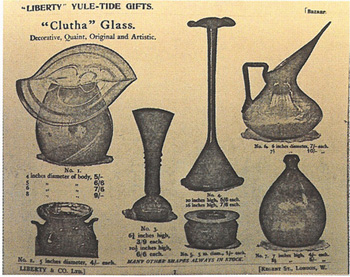
Christopher Dresser / James Couper & Sons Aventurine blown glass “Clutha” pitcher c. 1895

CHRISTOPHER DRESSER (1834-1904) UK
JAMES COUPER & SONS Glasgow, Scotland
“Clutha” pitcher c. 1895
Aventurine blown glass with iridescent gold streaks and internal bubbles
Illustrated: “Liberty & Co.” Yuletide Gifts catalogue, 1895, “Clutha” Glass; Truth, Beauty, Power: Dr. Christopher Dresser 1834-1904, exhib. cat. Historical Design, Inc. (New York, 1998) p. 72
H: 8 1/2” x 6 1/2”
Christopher Dresser / James Couper & Sons Aventurine blown glass “Clutha” pitcher c. 1895
CHRISTOPHER DRESSER (1834-1904) UK
LINTHORPE ART POTTERY, Middlesbrough
HENRY TOOTH Artistic Manager Linthorpe (1842-1918) UK
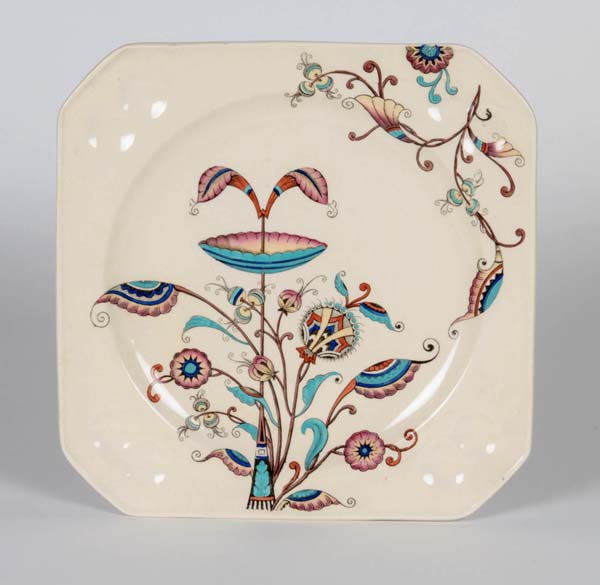
“Persian” jug 1879-1882
Glazed earthenware
Marks: LINTHORPE, Chr. Dresser (facsimile signature),
HT, no. 344
Illustrated: Truth, Beauty, Power: Dr. Christopher Dresser 1834-1904, exhibition catalogue Historical Design, Inc. (New York, 1998) p. 76.
H: 8 3/4″
Rare model.
The contrasts in Dresser’s designs for different materials showed how his approach to design was also shaped by the properties and nature of a material. In 1879 Dresser was appointed art director at the newly established Linthorpe pottery, near Middlesbrough. Founded by John Harrison, a local businessman, the pottery’s aim was to use local clay to provide jobs for local men. Dresser’s design for the moulds for the pottery were inspired by a wide range of cultures from Japan, Peru, Mexico, Morocco and Ancient British forms. These very striking pieces, with the metal oxides in the complex and innovative glazes providing the only decoration. All of his designs were impressed with a facsimile signature. When Linthorpe closed in 1889, its moulds were acquired by a rival, Ault Pottery in Derbyshire. In 1893, Dresser signed a contract with Ault for new designs specifying that each pot should be marked with his facsimile signature.
AMÉDÉE DE CARANZA (active 1875-1914) (b. Turkey / active France)
COPILLET ET CIE Noyon
Nasturtium vase 1903-1906
Blown glass with floral & foliate luster decoration handpainted on a muted iridescent ground.
Signed: A. de CARANZA (on the side near base)
Marks: Copillet et Cie, Noyon, 842 (twice)
For more information and related illustrations: European Art Glass (New York: Ray & Lee Grover, Charles E. Tuttle Publishers, Inc., 1970) pp. 69, 94-96; L’Art Du Verre En France 1860-1914, Janine Bloch-Dermant (Edita Denoel, 1974) pp. 36-37; Glass: Art Nouveau to Art Deco, Victor Arwas (New York: Abrams, 1987) pp. 56-58; L’Europe de L’Art Verrier, des Precurseurs de l’Art Nouveau a l’Art Actuel 1850-1990, Giuseppe Cappa (Liège: Mardaga, 1991) pp. 72-74.
H: 10″
Copillet, H.A. Thomas Henri Alfred Copillet was originally a printer, and produced a local newspaper in Paris. When he moved his works to 13 Fauburg de Paris he acquired a kiln in the process, and thus in 1903 was began a new glass works. His designers were Amedee de Caranza and Edouard de Neuville. They produced a whole range of Art Nouveau glassware, many with a dark iridescent finish. They also produced opaline glass, and glass panels for use in church windows. The company went bankrupt in 1906, although the new management (Lefevre and Lhomme) kept a little of the production going for a while, the factory was destroyed during the First World War.
CHRISTOPHER DRESSER (1834-1904) UK
JAMES DIXON & SONS Sheffield, England
“Gothic Arch” toast rack c.1881
Silver-plate
Marks: JD&S (stamped), EP, #72, “D”
Drawing illustrated: Christopher Dresser’s 1881 design and account book
For more information see: Truth, Beauty, Power: Dr. Christopher Dresser 1834-1904, exhib. cat. Historical Design, Inc. (New York, 1998); Charles Handley-Read, “High Victorian Design: An Illustrated Commentary” in ‘Design 1860-1960’ sixth conference report of the Victorian Society (London, 1968); Victorian and Edwardian Decorative Art: The Handley-Read Collection, ed. Simon Jervis (London: Diploma Galleries,1972); Christopher Dresser: pottery, glass, metalwork, (London: The Fine Arts Society Ltd., 1972); Isabelle Anscombe & Charlotte Gere, Arts & Crafts in Britain and America (New York: Rizzoli International Publications, Inc., 1978); Truth, Beauty and Design, Victorian, Edwardian and later Decorative Art (London: Fischer Fine Art Limited),; A Thing of Beauty: Art Nouveau, Art Deco, Arts & Crafts Movement and Aesthetic Movement Objects in Atlanta Collections (Atlanta, GA: The High Museum of Art, 1980), cat. no. M2; Widar Halén, Christopher Dresser (Oxford: Phaidon, 1990),; Judy Rudoe, Decorative Arts 1850-1950: A Catalogue of the British Museum Collection (London: Trustees of the British Museum, 1991),; Gerda Breuer, Von Morris bis Mackintosh – Reformbewegung zwischen Kunstgewerbe und Sozialutopie, Arts and Crafts (Darmstadt: Institut Mathildenhöhe, 1994/95); “The Silver Designs of Dr. Christopher Dresser,” Shirley Bury, Apollo (December, 1962)
H: 6″ x D: 4 1/8″ x W: 4 5/8″
CHRISTOPHER DRESSER (1834-1904) UK
JAMES DIXON & SONS Sheffield, England
“Triple Arch” square handle toast rack c.1881
Silver-plate
Marks: JD&S (stamped), Chr. Dresser (facsimile signature), EP, #67, diamond or clover touchmark
Illustrated: 1885 Dixon catalogue, p. 95
For more information see: Truth, Beauty, Power: Dr. Christopher Dresser 1834-1904, exhib. cat. Historical Design, Inc. (New York, 1998); Charles Handley-Read, “High Victorian Design: An Illustrated Commentary” in ‘Design 1860-1960’ sixth conference report of the Victorian Society (London, 1968); Victorian and Edwardian Decorative Art: The Handley-Read Collection, ed. Simon Jervis (London: Diploma Galleries,1972); Christopher Dresser: pottery, glass, metalwork, (London: The Fine Arts Society Ltd., 1972); Isabelle Anscombe & Charlotte Gere, Arts & Crafts in Britain and America (New York: Rizzoli International Publications, Inc., 1978); Truth, Beauty and Design, Victorian, Edwardian and later Decorative Art (London: Fischer Fine Art Limited),; A Thing of Beauty: Art Nouveau, Art Deco, Arts & Crafts Movement and Aesthetic Movement Objects in Atlanta Collections (Atlanta, GA: The High Museum of Art, 1980), cat. no. M2; Widar Halén, Christopher Dresser (Oxford: Phaidon, 1990),; Judy Rudoe, Decorative Arts 1850-1950: A Catalogue of the British Museum Collection (London: Trustees of the British Museum, 1991),; Gerda Breuer, Von Morris bis Mackintosh – Reformbewegung zwischen Kunstgewerbe und Sozialutopie, Arts and Crafts (Darmstadt: Institut Mathildenhöhe, 1994/95); “The Silver Designs of Dr. Christopher Dresser,” Shirley Bury, Apollo (December, 1962);
Extremely rare model
H: 4 1/2″ x D: 4 1/2″ x W: 6 1/2″