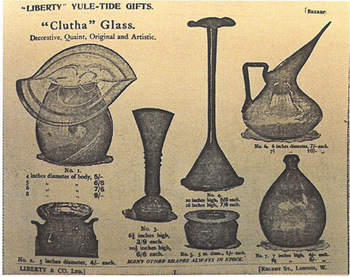
Christopher Dresser / James Couper & Sons Aventurine blown glass "Clutha" pitcher c. 1895
More Information
Christopher Dresser / James Couper & Sons Aventurine blown glass “Clutha” pitcher c. 1895
CHRISTOPHER DRESSER (1834-1904) UK
JAMES COUPER & SONS Glasgow, Scotland
“Clutha” pitcher c. 1895
Aventurine blown glass with iridescent gold streaks and internal bubbles
Illustrated: “Liberty & Co.” Yuletide Gifts catalogue, 1895, “Clutha” Glass; Truth, Beauty, Power: Dr. Christopher Dresser 1834-1904, exhib. cat. Historical Design, Inc. (New York, 1998) p. 72
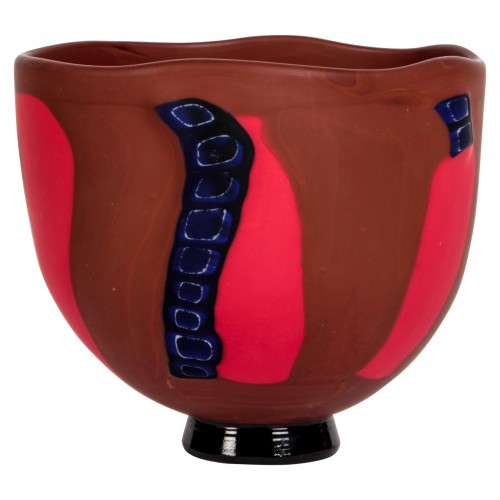
Overall matte finish art glass vase with an elaborate mosaic technique inset with red rectangular patchwork sections and blue murrina jewels all on a chocolate brown body with a black glass foot
Marks: Tsuchida Yasuhiko 99, 77
For more information see: Tsuchida Yasuhiko, exh. cat., Franco Schiavon (Murano, Italy: Palazzo del Vetro, 2000).
Provenance: Pauly & Co. Venice
H: 4 3/4″ x Dia: 5 1/8″
Price: $5,450
Yasuhiko Tsuchida was born in Osaka, Japan in 1969. In 1988, soon after graduating TSUJI Culinary Institute, he left Japan to explore food and art in Paris. Since 1992, he has lived in Venice, Italy. Tsuchida has been making glass work in Murano Island since 1995, and next year assumed the office of art director at Schiavone Glass Co. Ltd. In 1996 he presented a glass sculpture entitled “Bamboo Collection”
with Japanese motif of bamboo. The work was highly acclaimed, which gave him a chance to start to hold solo exhibitions around the world. In 2000, Tsuchida became a member of the board of directors at Venetian Glass Institute, and a chief director there in 2003. In 2004, he won Honorary Technique Prize in Düsseldorf, Germany, and in 2008, received Award of Contribution to Cultural
Promotion from Grosseto city, Toscana. In the same year, he
represented Japan at International Open Exhibition of Sculpture, and won the Grand-Prix. In 2010, Tsuchida was invited to the Issei Miyake “IM10” Project Competition, and held a solo exhibition at Lorusso Gallery, Andria, Italy. Tsuchida continues to exhibit in many solo shows around the world.
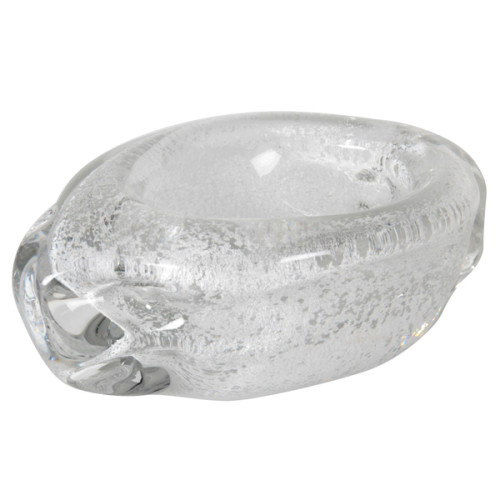
Andre Thuret French Art Deco Rare Handblown Art Glass Vase c. 1930
ANDRÉ THURET (1898-1965) France
“Organic” vase/bowl c. 1930
Handblown and formed clear glass with bubble technique encapsulating a frosty white oxide.
Signed: ANDRÉ THURET
H: 2 3/8″ x D: 4″ x W: 6 1/4″
Andre Thuret was one of the first modern French studio glass artists and a contemporary of Maurice Marinot. He was born on November 3, 1898 in Paris. It is by science that Andre Thuret came to art. It is in Thuret the engineer and the chemist who serve Thuret the vase artist. The scientist places at the disposal of the creator of forms, rates/rhythms and colors the fluid and transparent beauty of glass and the reactions of metallic oxides. He worked in a traditional glass blowing technique at a temperature often exceeding 1,000 degrees. Thuret exhibited at the Salon d’Automne in 1928 and 1932 and obtained his first plate of the Company of Encouragement to Art. He was invited to exhibit in the United States in 1929-1930. Andre Thuret received his Chevalier of the Legion of Honor in 1947.
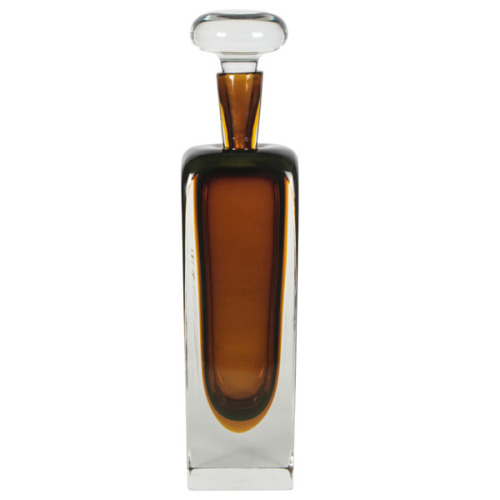
Flavio Poli for Seguso Large Murano Glass Bottle with Stopper c.1950’s
FLAVIO POLI (1900-1984) Italy
SEGUSO VETRI D’ARTE Italy
Bottle with stopper c. 1950’s
Spectacular large decanter or bottle with stopper with a golden cognac cased glass interior tear drop form suspended in a solid clear glass body by FLAVIO POLI (1900-1984) Italy for SEGUSO VETRI D’ARTE Italy
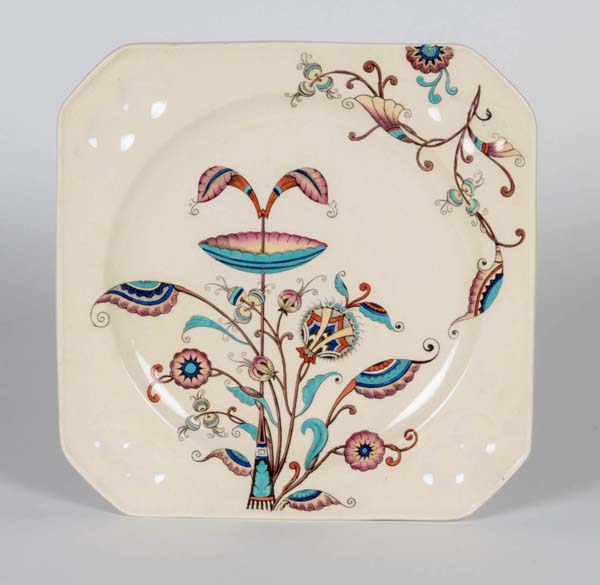
Christopher Dresser / Old Hall, Persia Pattern, Aesthetic Movement Dinner Plate c. 1861-1886
CHRISTOPHER DRESSER (1834-1904) UK
OLD HALL EARTHENWARE CO. (1861-1886) Staffordshire, UK
“Persia Pattern” dinner plate c. 1861-1886
Overall cream gloss glazed octagonal-shaped earthenware dinner plate from the “Persian” pattern with transfer-printed and over-glazed ornate foliate motif; each corner contains two shallow indentations for condiment use.
Marks: Old Hall and Persia Marks
W: 9 15/16″
The identical plate in the “Persia Pattern” can be found in the collection of the Wolfsonian. A soup plate in the identical “Persia Pattern” can be found in the collection of the Brooklyn Museum.




 @hd_jewels