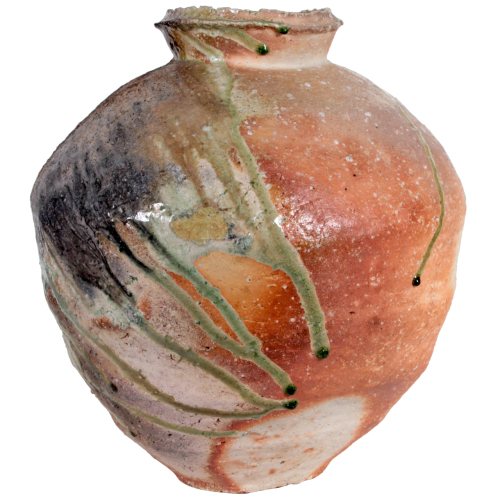
Kishimoto Kennin Japan Hand Thrown Monumental “Iga” Stoneware Vase, c. 1995
KISHIMOTO KENNIN (b. 1934), Japan.
Monumental “Iga” vase, circa 1995.
Hand thrown and handbuilt stoneware vase with a natural ash glaze in rich salmon rust, celadon, grey and black glaze
H: 20″ x Dia: 22″
Price: $20,000
1934 born in Nagoya 1953–1955 attends college in Nagoya 1960 moves to Mino, Gifu Prefecture 1965 establishes his own studio 1970 builds an anagama in Mikuni-Sanroku, where he lives and works until today 1976 appointed member of the Japan Crafts Association (Nihon kôgei-kai) Group exhibitions 1967 Asahi Ceramics Exhibition (Asahi tôgei-ten) 1968 Exhibition of Japanese Ceramics (Nihon tôgei-ten) 1970 International Exhibition of Chûnichi Ceramics (Chûnichi kokusai tôgei-ten) 1972–75 Japan Traditional Crafts Exhibition (Nihon dentô kôgei-ten)
One man shows:
1979 Takashimaya Gallery, Tôkyô; since then again in 1981, 1983, 1985, 1987, 1990.
1982 Hankyû Gallery, Ôsaka; since then again in 1983, 1984, 1985, 1986, 1987.
1984 Maru’ei Gallery, Nagoya; again in 1986.
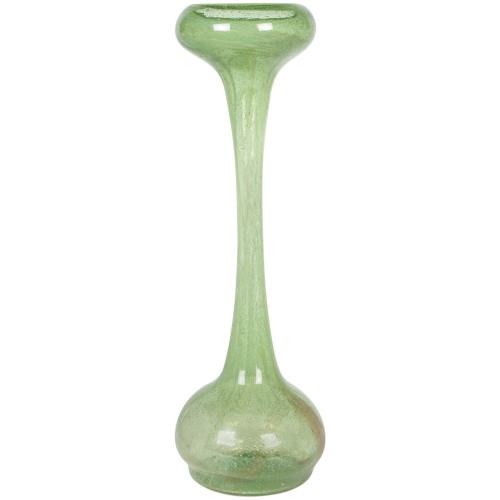
Christopher Dresser / James Couper & Sons Aventurine blown glass Clutha vase c. 1895
CHRISTOPHER DRESSER (1834-1904) UK
JAMES COUPER & SONS Glasgow
Clutha vase c. 1895
Aventurine blown glass with iridescent gold streaks and internal bubbles
Illustration: Christopher Dresser, Widar Halen (Oxford: Phaidon, Christies Limited, 1990) p. 196, illust. 228.
For more information: Liberty Style: the classic years, 1898-1910, Mervyn Levy (New York: Rizzoli International Publications, Inc., 1986); Christopher Dresser: the power of design, Christopher Wilk (New York: Zurland – Zabar, 1993).
Michael Powolny / Lötz Witwe Glaswerks Jugendstil Set of Three “Tango” Glass Vases c. 1920
PROF. MICHAEL POWOLNY (1871-1954) Austria
LÖTZ WITWE GLASWERKS Klostermuhle
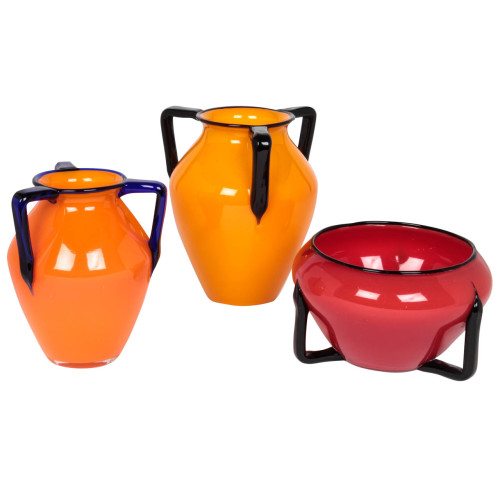
Set of three “Tango” glass vases c. 1920
Blown tall yellow glass with applied black handles, blown orange glass with applied cobalt blue handles, blown red glass with applied black handle-form feet
Marks: Cecho. Slovakia (acid etched in an oval) (red vase)
Yellow and black vase H: 6 1/2” x Dia: 6″
Orange and cobalt blue vase H: 5 1/2” x Dia: 6″
Red and black vase H: 3 1/2” x Dia: 6″
For more information see: Lötz: Böhmisches Glas 1880-1940, Band 1, Helmut Ricke and Ernst Ploil, (Munich: Prestel-Verlag, 1989) ; Glass of the Avant-Garde, From Vienna Secession to Bauhaus, The Torsten Bröhan Collection from the Museo Nacional de Artes Decorativas, Madrid, Torsten Bröhan, Martin Eidelberg (Munich, London, New York: Prestel Verlag, 2001).
Other Powolny works: Jugendstil Art Nouveau: floral und functional forms, Siegfried Wichmann (New York / Boston: Graphic Society, Little, Brown and Co., 1984), p. 226; Vienna 1900-1930: Art in the Home, Historical Design exhibition catalogue (New York: Historical Design, Inc., 1996), p. 45; Modernism:Modernist Design 1880-1940, The Norwest Collection, Norwest Corporation, Minneapolis, Alastair Duncan (Woodbridge, Suffolk, England: The Antique Collector’s Club, 1998).
Exhibited: The Twenty One (Millenium) Exhibition, Arzenal Gallery, Prague, 2000
For more information see: Sípek, Philippe Louguet, Dagmar Sedlická (Paris: Éditions Dis Voir, 1999); Borek Sipek and Christian Tortu: Collection Twentyone 2001 (Prague: Arzenal Edition, 2001)
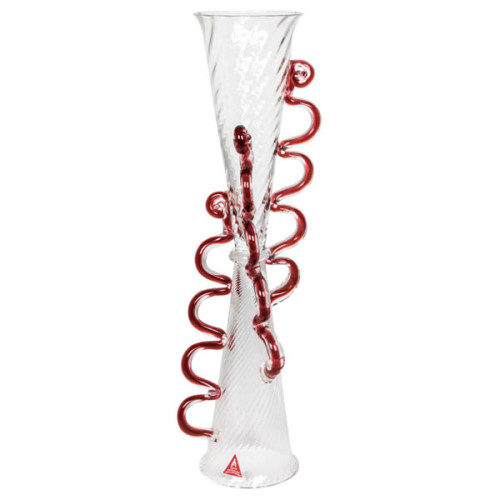
H: 13″ x Dia: 4″
Price: $1,050
The Czech architect, furniture designer, and glass artist Borek Sípek was born in Prague in 1949. From 1964 to 1968 Borek Sípek studied furniture design at the Prague School for the Applied Arts. In 1969 he began to study architecture at the Hochschule für bildende Künste in Hamburg. In 1973 he studied philosophy at Stuttgart University. From 1977 until 1979 he was an academic assistant at the Hannover University Institute of Industrial Design. Borek Sípek took his degree in architecture at Delft Technical University. Then he taught design theory at Essen University until 1983. In 1983 Borek Sípek also opened an architecture and design practice in Amsterdam. He founded Alterego, a design business, with David Palterer. In the 1980s, Borek Sípek designed Postmodern furniture and glass objects, which brought him international renown. Borek Sípek’s designs are formally distinctive, both ingeniously conceived and sumptuous, and are often executed in unconventional materials and combinations of materials. Borek Sípek views design as an interpretation of culture. For this reason, he rejects the functional and rational approach to design and does not want striving for technical perfection to lead to disregard of individuality. In 1983 Borek Sípek designed “Bambi”, a fragile-looking tubular steel chair with brass fittings and a back covered in silk. In 1991 Borek Sípek designed the “PCSS” table with blue glass legs and metal fittings. Borek Sípek’s superlative glass objects are executed by glassblowers in Murano and Novy Bor. Borek Sipek is also known worldwide as an architect and has received prestigious commissions. Between 1993-2002 Borek Sípek worked on the Het Kruithuis Museum in ‘s Hertogenbosch (the Netherlands). In 1994 Borek Sípek designed the Kyoto Opera Houseentsteht das Opernhaus in Kyoto. In 1995 Borek Sípek designed a Paris boutique for Karl Lagerfeld. In 1990 Borek Sípek became a professor of architecture at the Academy for the Applied Arts in Prague, where he taught until 1998. Since 1999 he has taught at the Universität for angewandte Kunst in Vienna.
His works are included in major international museum and private collections throughout the US and Europe including Museum of Modern Art, Stedelijjk Museum, Denver Art Museum, The Corning Museum of Art, The Hauge Municipal Museum, Kunstmuseum in Düsseldorf and Design Museum in London.





 @hd_jewels