Product Description
Theodor Fahrner “Jugendstil Planter” brooch, silver and enamel set with sodalite cabochons and pearls, signed c. 1905

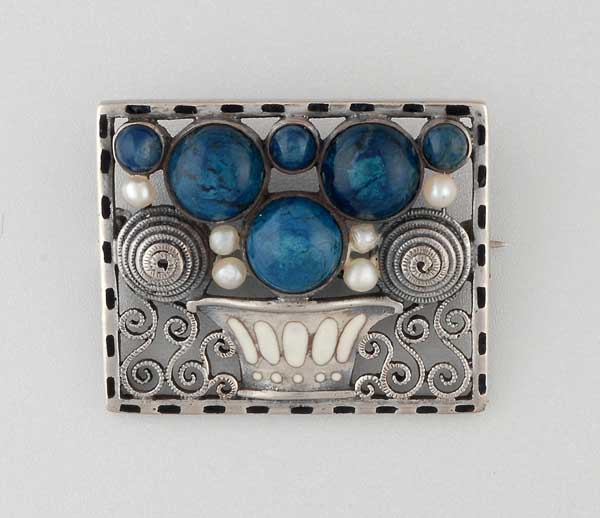
Theodor Fahrner “Jugendstil Planter” brooch, silver and enamel set with sodalite cabochons and pearls, signed c. 1905

WMF [Württembergische Metallwarenfabrik] Germany
“Four Seasons” Art Nouveau Jewelry box c. 1900
Silver plate with Jugendstil design buttress handles and open work handle with a frieze of Art Nouveau maidens representing the four seasons, velvet lined with two original keys.
Marks: WMF mark, I/O (in a box), E
For more information see: WMF: Glas, Keramik, Metall, 1925-1950, Jörg Schwandt (Berlin: Kunstgewerbemuseum, Staatliches Museum Preussischer Kulturbesitz, 1981); Metallkunst, Band IV (Berlin: Brohan-Preussischer Kulturbesitz, 1981) pp. 546-579.
H: 7 1/2″ x W: 17″ x D: 5 1/2″
Price: $3,500
Charles Darwin published his theory of evolution with compelling evidence in his 1859 book “On the Origin of Species” overcoming scientific rejection of earlier concepts of transmutation of specie. By the 1870s both the scientific community and much of the general public had accepted evolution as a fact and awakening the public to the diversity of life. The frog emerging from Darwin’s Pond was a symbol of the times and a favorite theme for jewelry of the era.
MARGARET DE PATTA (1903-1964) USA
Abstract brooch c. 1945
Sterling with both a smooth finish and a textured surface in a biomorphic design set with rondels of chrysoprase and carnelian
Marks: De Patta chevron insignia, STERLING
Illustrated: Design 1935 – 1965, What Modern Was: selections from the Liliane and David M. Stewart collection ed. Martin Eidelberg, (Montreal/New York: Le Musée des Arts Décoratifs de Montréal/Harry N. Abrams, 1991), p. 100, illus. 130.
Related designs illustrated: The Jewelry of Margaret de Patta: A Retrospective Exhibition, Oakes Gallery and The Oakland Museum (Oakland, Calif.: 1979); Messengers of Modernism: American Studio Jewelry 1940-1960, ed. Martin Eidelberg, (Montreal: The Lake St. Louis Historical Society, 1996).
L: 3 1/4”