Product Description
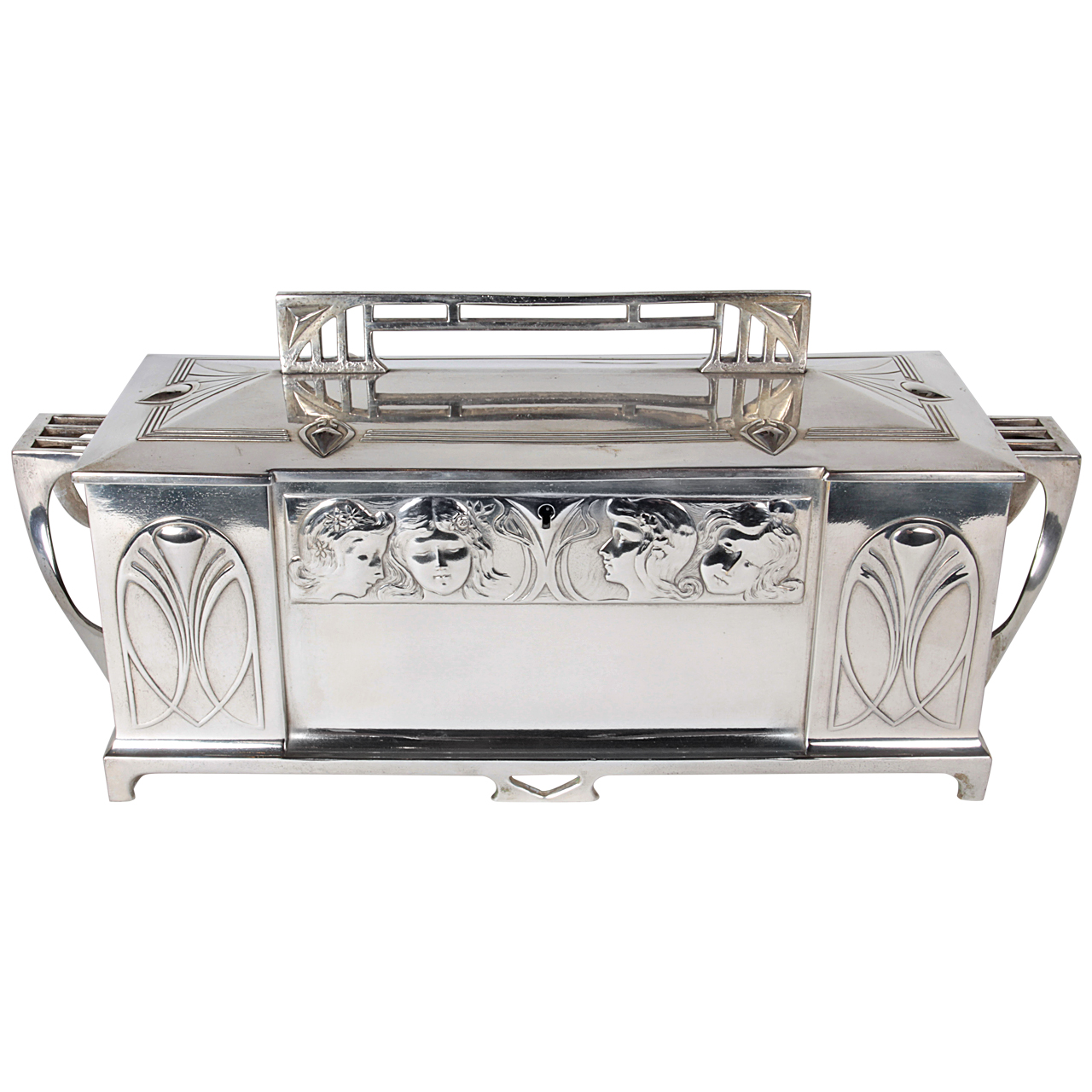
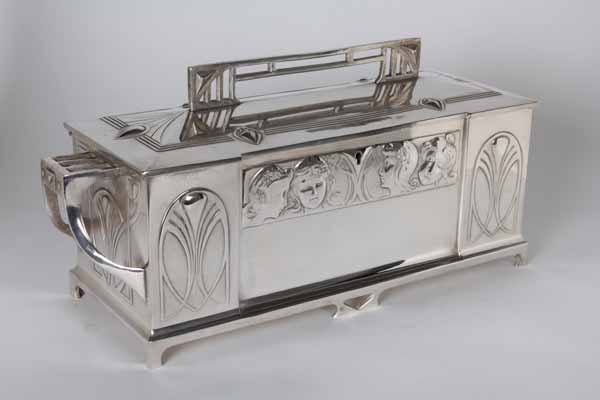
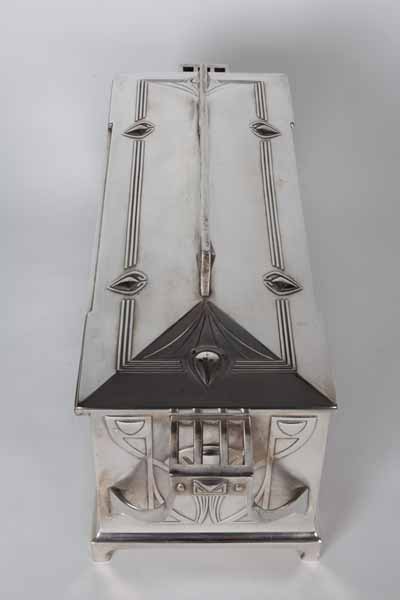
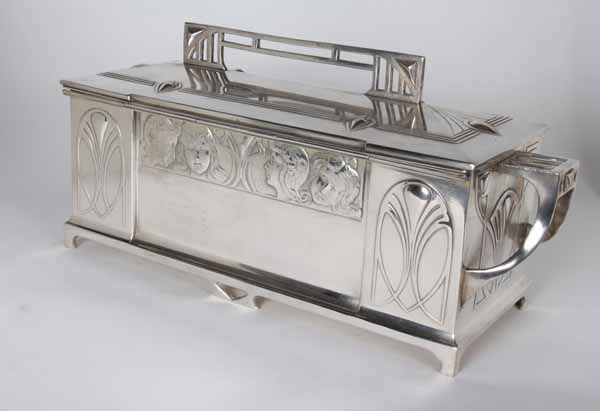
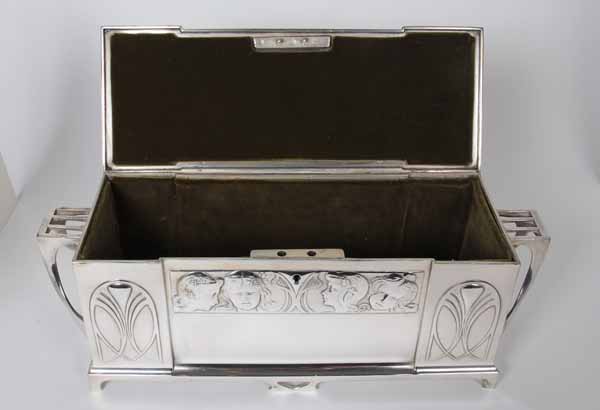
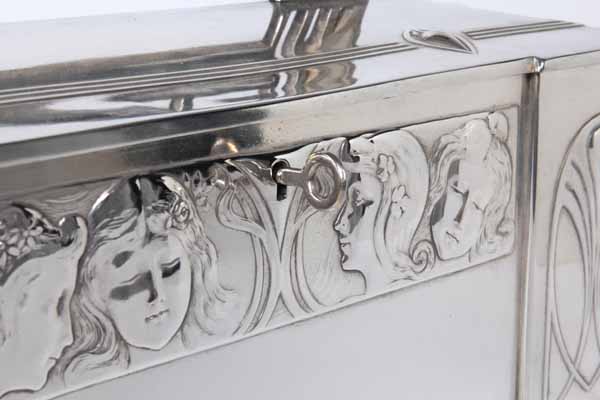
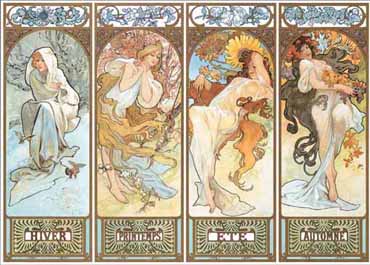
WMF Jugendstil Art Nouveau “Four Seasons” Jewelry box c. 1900

WMF [Württembergische Metallwarenfabrik] Germany
“Four Seasons” Art Nouveau Jewelry box c. 1900
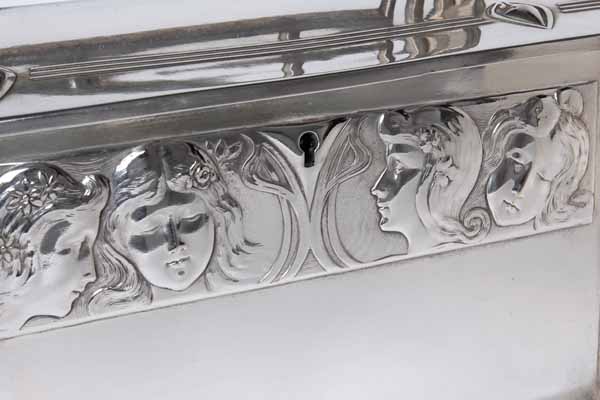
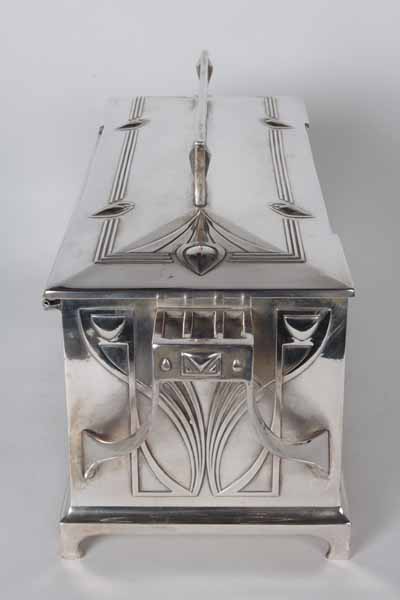
Silver plate with Jugendstil design buttress handles and open work handle with a frieze of Art Nouveau maidens representing the four seasons, velvet lined with two original keys.
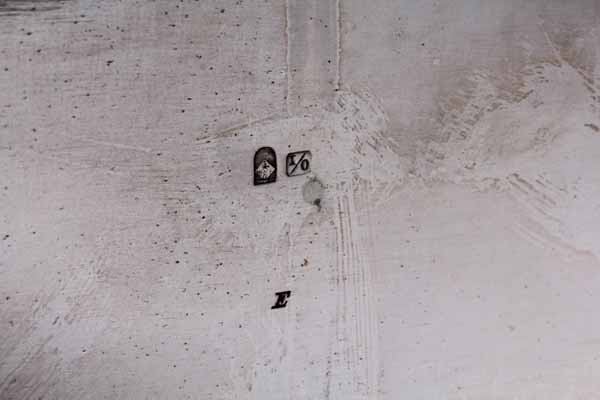
Marks: WMF mark, I/O (in a box), E
For more information see: WMF: Glas, Keramik, Metall, 1925-1950, Jörg Schwandt (Berlin: Kunstgewerbemuseum, Staatliches Museum Preussischer Kulturbesitz, 1981); Metallkunst, Band IV (Berlin: Brohan-Preussischer Kulturbesitz, 1981) pp. 546-579.
H: 7 1/2″ x W: 17″ x D: 5 1/2″
Price: $3,500
WMF Jugendstil Art Nouveau “Four Seasons” Jewelry box c. 1900
You must be logged in to post a comment.
PAUL FOLLOT Paris, France
LA MAISON MODERNE Paris, France
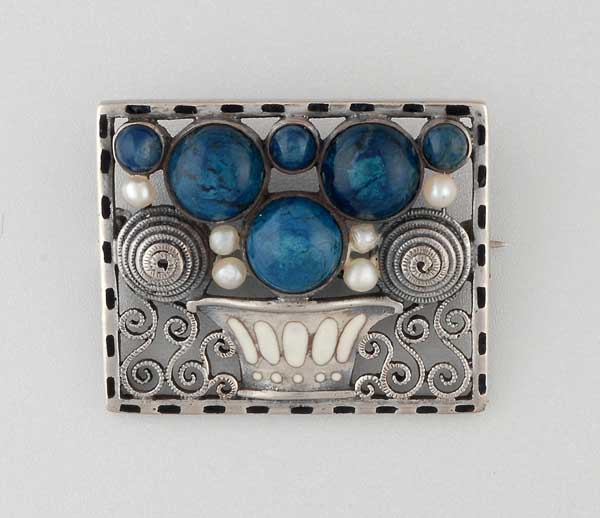
Art Nouveau waist clasp c.1900
Gilt silver with chased whiplash design set with 19 cabochons of chrysoprase.
Marks: P. FOLLOT, French swan mark (silver standard mark for small objects)
Illustrated: Documents sur l’Art Industriel au XXe Siecle (Paris: Edition de la Moderne) p. 20, plate 5, n. 53-11
PAUL FOLLOT (1877-1941) French
In the Late 1890’s, Follot studied under graphic designer Eugène Grasset at the Ecole Normale d’Enseignement du Dessin in Paris and later succeeded Grasset in that post. From 1901 to 1904, he designed metalwork, jewelry and textiles for La Maison Moderne, art critic Julius Meier-Graefe’s gallery in Paris. He became director of the interior design studio Pomone of the Paris department store Le Bon Marché in 1923, introducing the Art Deco style into many middle-class home.
PROF. MAX LÄUGER (1864-1952) Karlsruhe, Germany
Unique Jugendstil ceramic footed bowl inlaid with gold mosaic 1906
Light and dark green glazed earthenware inlaid with mosaic gold glass squares on four cylindrical feet.
Marks: ML, K (monogram)338 (incised), 4., MUSTER B.., GESCHTZ
For other mosaic inlaid works by Max Läuger see: Max Laeuger (1864-1952): sein graphisches, kunsthandwerkliches und keramisches Oeuvre, Elisabeth Kessler-Slotta (Saarbrücken: Saarbrücker Druckerei und Verlag, 1985) pp. 178/179; Europäisches Kunstgewerbe 1927, Stadtisches Kunstgewerbe-Museum zu Leipzig, (Leipzig: E.A. Seeman, 1928) p. 86; Deutsche Kunst und Dekoration vol. XII “Professor Max Laeuger Karlsruhe”, pp. 221-237; Modernism: Modernist Design 1880-1940 (The Norwest Collection, Norwest Corporation, Minneapolis), Alastair Duncan (Woodbridge, Suffolk, England: The Antique Collector’s Club, 1998), p. 86.
H: 5 3/4″ x Dia: 7 1/4″
Max Laeuger (or Läuger) was born in Lörrach on September 30, 1864. Laeuger was a self taught ceramicist, studied at the Karlsruhe Polytechnic a hundred miles to the north-west of Lörrach (now Karlsruhe University) and eventually became a professor at the university. In 1895 after travelling throughout Europe visiting the major cultural centers to study art he was appointed director of the art pottery department of Tonwerke Kanderne close to his home town. He stayed there until 1913 and later took up a similar position at Majolika-Manufaktur in Karlsruhe.
From 1921 he had his own workshop on the premises formerly owned by the company and produced designs there. The work produced fell into three categories, slip decorated wares designed by Laeuger but produced entirely by the factory, pieces made at the factory but decorated and glazed by Laeuger and one-off pieces by the professor made from beginning to end in his own workshop. All were marketed by Majolika-Manufaktur. Laeuger’s one-off pieces had the brushed initials ‘ML’ and the other works were marked ‘LAEUGER’ or ‘PROF. MAX LAEUGER’
Through the thirties and into the Second World War he worked on his own, but after his workshop was destroyed in 1944 he returned to Lörrach where he died on December 12, 1952. Laeuger was a major figure in German ceramics. His designs and his glazes had ‘organic’ characteristics that are his signature design and his work is much sought-after by collectors. Examples of Laeuger pieces are on display at the Badisches Landesmuseum in Karlsruhe.
ALFRED GRENANDER (1863-1931) Sweden / Germany
W. KUMMEL Berlin, Germany (cabinetmaker)
Cabinet (unique) c. 1904
Flamed mahogany, ebony, ivory and fruitwood inlays, brass hardware and details, textured glass
Marks: American import label (from Germany) for the St. Louis exhibition
Exhibited: The 1904 St. Louis Exhibition, German Section in the Herrenzimmer
Illustration of Grenander room: Deutsches Kunstgewerbe St. Louis 1904, Hugo Nachtlicht, 1904, p. 80.
Commentary on Grenander’s display at St. Louis Exhibition: Deutsche Kunst und Dekoration, Band XV Oktober 1904-Marz 1905, “Die Wohnungskunst auf der Welt –Austellung in St. Louis”, Dr. Hermann Muthesius, p. 213-16.
Related bookcase-cabinet illustrated: Deutsche Kunst und Dekoration, Band XVI April-September 1905, p. 426.
For other works by Grenander see: Deutsche Kunst und Dekoration, Band XVI April-September 1905, p. 395-407, 426, 427, 671-73, 694, 695; Das Deutsche Kunstgewerbe 1906, 111. Deutsche Kunstgewerbe-Austellung Dresden 1906, (München, Verlagsanstalt P. Bruckmann A.G., 1906) p. 129-133, 232, 261
H: 79 1/2” x W: 57” x D: 23”
Price: $95,000
Alfred Grenander was born in June 1863 in Skövde, Sweden, and came to Berlin in 1885 to study. The city became his home, and he built his first buildings here together with his brother-in-law Otto Spalding. In 1897 Grenander began teaching at the Unterrichtsanstalt des Berliner Kunstgewerbemuseums (college attached to Berlin’s Museum of Arts and Crafts). His involvement with underground railway architecture began in 1900 and came to dominate his life’s work, with more than 80 buildings. He died on 14 July 1931 in Berlin.
From the turn of the century through the early 1930s, Alfred Grenander provided the emerging metropolis of Berlin with an extensive net of subway stations. He was an architect, draughtsman, and city planner; as well as a remarkable furniture designer. Grenander was the celebrated German representative at the 1904 World’s Fair in St. Louis, where he was being honored as “the renewer of German art.” This mahogany cabinet inlaid with pewter, ebony and ivory was exhibited in the elegant Herrenzimmer of the German pavilion at the Louisiana Purchase Exposition, St. Louis, Missouri, 1904, was bought in 1904 by a Kansas City, Missouri family and the piece descended in the family.
W. P. HARTGRING
ROZENBURG POTTERY The Hague, The Netherlands
Blackbird mantle clock 1904
Handpainted earthenware with exotic foliage and a bird, porcelain face, gilt bronze surround, original clock mechanism.
Marks: H (artist’s monogram) 534, Rozenburg den Haag trademark, date mark symbol for 1904
For more information see: Art et Décoration, vol. 8 (1900) 193, illus. p. 189 (A. Sandier, La ceramique à l’Exposition); Kunst und Kunsthandwerk, vol. 3. (1900) 395, illus. p. 392; Art et Décoration, vol. 9 (1901) 56 Abb. S. 54 (A. Sandier, La Ceramique à l’Exposition II); Der Moderne Stil, Julius Hoffmann, Vol. 3, (1901) Taf. 53.; La Kunstgewerbeblatt Neue Folge, Vol. 12. (1901) p. 95, Abb. S. 82,89; “The International Exhibition of Modern Decorative Art at Turin – The Dutch Section,” Enrico Thovez in The Studio, vol. 26 (1902), pp. 204-6; Kunst und Kunsthandwerk, Vol. 7 (1904), p. 568, Abb. S. 574-5, (K. Ruge, Kunst und Kunstgewerbe auf der Weltausstellung zu St. Louis); Art et Décoration, vol. 17 (1905) p.86 Abb. S. 77, 88 (G. Mourey, L’Art Decoratif Hollandais); Sprechsaal, Vol. 38, (1905) p. 517 (W.H. Zimmer, Die Weltausstellung in St. Louis; Rozenburg, Monographie einer Manufaktur 1883-1917, Marjan Boot et al. (Munich: Verlag Künst & Antiquitäten, 1984); Sammlung Bröhan: Kunsthandwerk 1-Jugendstil, Werkbund, Art Deco, Glas, Holz, Keramik, (Berlin: Karl H. Brohan, 1976) p. 367-380.
H: 15″ x W: 10″ x D: 5 1/8″
Reviews
There are no reviews yet, would you like to submit yours?