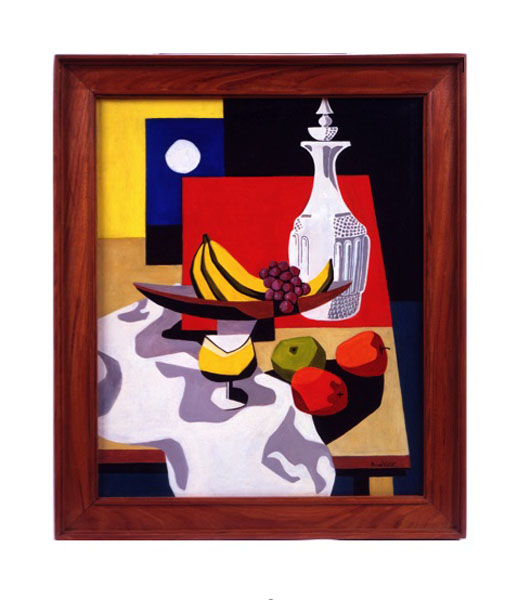
Duval Eliot "Still life", Oil on canvas, wood frame c. 1945
More Information
Duval Eliot “Still life”, Oil on canvas, wood frame c. 1945
DUVAL ELIOT (1909-1990) USA
Still life c. 1945
Oil on canvas, wood frame
Signed: Duval Eliot (lower right)
Painting H: 30” x W: 24”
Frame H: 38” x W: 32”
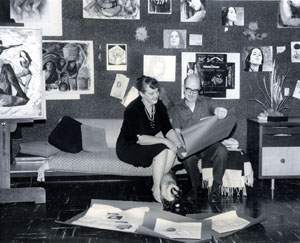
Duval Eliot, nee’ Ruby Duval Bearden, was born in Arkansas, and at a young age moved with her family to California. After going to Hollywood High School, she attended The Los Angeles Trade Technical College (then known as Frank Wiggins Trade School), studying Commercial Art and Design. While there, she began her art career as a men’s fashion illustrator. Then, because of her immense interest in art, immediately enrolled in Art Center School in Los Angeles, being one of their first students. She studied landscape painting (watercolor and oil), portrait, life drawing and illustration with Barse Miller and with Joseph Henniger, life drawing. At Art Center she continued studying all facets of commercial art and simultaneously worked at the Columbia Advertising Agency designing newspaper layouts and fashion illustrations for the major Los Angeles department stores such as I. Magnin, The Broadway, I. Miller, Wetherby Kayser, and Sak’s in Beverly Hills.
Throughout the 1940’s, Duval continued to create watercolor landscapes of Southern California and the West, while illustrating for J.J. Hagarty. Commercially, her prime focus was free-lance illustration, which could be created with a young child in tow, finding interesting work at the “Western Family Magazine,” for whom she did illustrations for over ten years. She also illustrated children’s storybooks and textbooks for MacMillian and L.W. Stinger publishing houses, meanwhile creating Fashion Advertisements and billboards in full color for Phelps & Terkel for several years and billboards for Silverwoods Department Store. For this work, Duval received the Western Art Directors Award in 1946.
During the post World War II years, Duval honed her fine art techniques. She studied with such notable artists as: Barse Miller, Hardy Gramatky and Ejnar Hansen (watercolor) and also with Hansen, (landscape & portrait painting in oil). In 1948, in The Fourth Annual Los Angeles Exhibition at The Greek Theater in Griffith Park, she won 1st Prize for her watercolor entitled “End of the Trail” among her peers of 326 entrants for painting, including Francis De Erdely, Lorser Feitelson, Conrad Buff, James Couper Wright, Frode N. Dann, Joshua Meador, Dan Lutz, and Chas. Payzant. She also studied painting with Conrad Buff, J.C.Wright, Design and Abstract Painting with Leonard Edmonson, and later, painting in acrylic with 2 years of intensive color with Guy MacCoy and silk-screen Serigraphy with Mario De Perentes. Duval also became close friends with Milford Zornes.
Duval became active in “The Southern California Designer Craftsmen” (S.C.D.C.) She won many awards and exhibited extensively throughout the 1950’s and 1960’s at Barnsdall Municipal Art Gallery, Pasadena Art Museum (paintings and enamels}, Gallery 333 on La Cienega. In the 1940s, she turned towards more formal subject matter including landscape and still life and honed her fine art techniques in watercolor, oil, acrylic, and printmaking.
She participated in several group exhibitions in the Los Angeles area in the late 50s and early 60s. Her work was featured in solo exhibitions at the Jack Carr Gallery in Pasadena in 1976 and the Brand Library Gallery in Glendale in 1988.
Duval was also an active member and on the boards of “The Pasadena Society of Artists”, ”The Los Angeles Art Association”, “Women Painters of the West”, as well as S.C.D.C., participating in numerous group (Design 6, 7, 8, and 9 at the Pasadena Art Museum) and one man shows in the vicinities of Pasadena, Glendale, Santa Barbara and Claremont. She was represented in Paris by two silk screen serigraphs at The Exposicion Internacionale des Federacion Femenine at The Museum des Arts Decoratifs in 1971.
Duval Eliot was also represented in The Los Angeles County Art Museum’s show “MADE IN CALIF” in 2001 with “Chavez Ravine” and “3rd St. Traffic”.
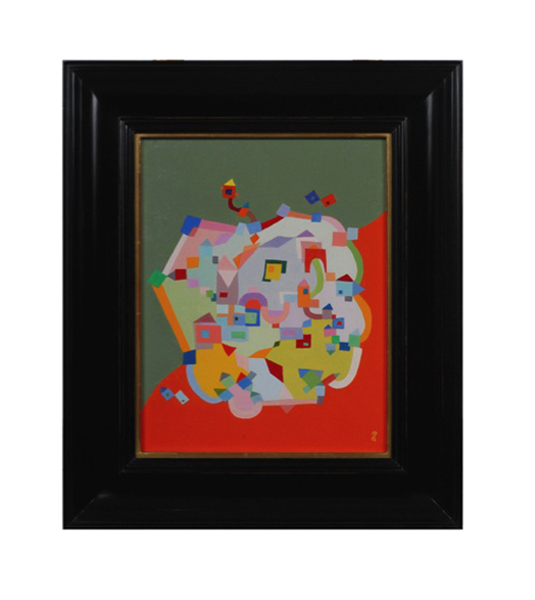
Michiel Gloeckner “Old Town No. 2”, Oil on Canvas 1960
MICHIEL GLOECKNER (1915-1989) Germany / USA
Old Town No. 2 1960
Oil on Canvas
Signed: MG (lower right corner)
Canvas: H: 14 1/16” x W: 11 1/16”
Framed: H: 19 9/16” x W: 16 9/16”
Price: 32,000
Michiel Gloeckner, known for his highly refined, balanced abstract, geometric style derived from natural forms, was the son of a well-known art collector. He graduated from the University of Dresden with a degree in mathematics and art history. He received a degree from the Royal Academy of Dresden where he studied under Otto Dix. Paul Klee also influenced Gloeckner’s work. After WWII Gloeckner moved to New York City. He continued to maintain a studio in New York at 115 East 70th Street, even after he moved to West Cornwall, Connecticut where he spent the later years of his life.
EXHIBITIONS
Gallery Seventy-Five, New York 1955, 1956, 1958
Jacques Seligman Galleries, New York 1960, 1961, 1962
Wadsworth Atheneum 1960
Wesleyan University 1961
Philadelphia Art Alliance 1962
Philadelphia Academy of Fine Arts 1963
World House Galleries, New York 1963, 1962, 1965, 1966
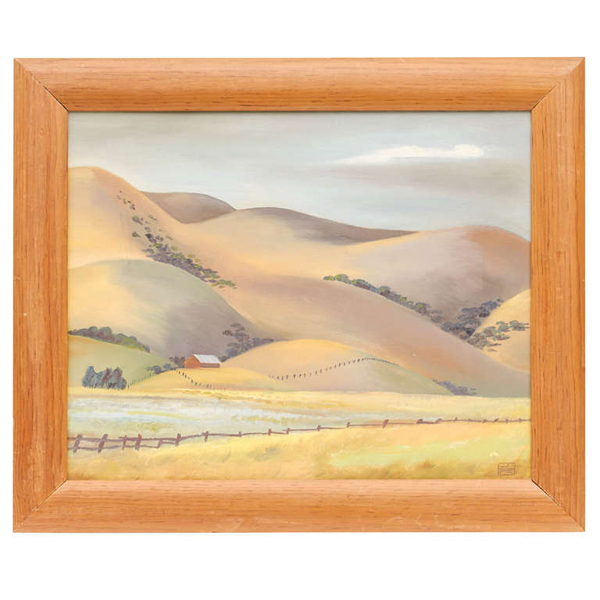
Jean Marion Gates Hall, “Napa Valley” Oil on canvas 1940
JEAN MARION GATES HALL (1911-2001) USA
Napa Valley 1940
Oil on canvas, original wood frame
Signed: with her monogram initials JGH (lower right)
Marked on back: Jean Gates Hall, June 18, 1940, Napa Valley
Canvas: H: 14″ x W: 17 1/4″
Framed: H: 17 1/2″ x W: 20 1/2″
Price: $4,250
Born in Memphis, TN on May 19, 1911. Jean Gates studied at the Cummings School of Art in Des Moines. At age 14 she moved to Los Angeles with her family. There she continued at the Chouinard Art School while working for Warner Bros, Walt Disney, and Mintz Studios. Upon moving to San Francisco, she married writer James D. Hall in 1938. Her illustrations were used in her husband’s children’s books. She established a studio in the “Monkey Block” (now the Transamerica Pyramid) and was active in the local art scene. She later earned her B.A. degree at San Jose State University (1955) and M.A. degree at UC Davis (1966). Working in oil and watercolor, her painting style and subject matter evolved with the years from descriptive realism to linear pictures, and finally an entirely new medium called Magpage. Mrs. Hall was a resident of Oakland in the 1980s and died in Cedar Ridge, CA on June 23, 2001.
Exhibitions: Iowa State Fair, 1926; California State Fair, 1937; GGIE, 1939; Paul Elder Gallery (SF), 1939 (solo); NMAA, 1941; SFMA, 1942 (solo); De Young Museum, 1944 (solo); California WC Society, 1945-53; UC Davis, 1946, 1965 (solos); Kingsley Art Club (Sacramento), 1965.
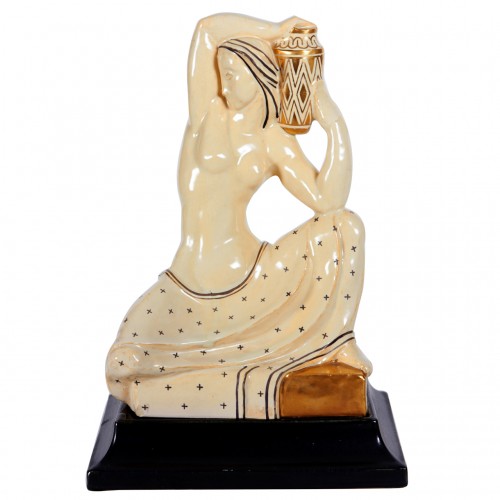
Walter Paul Suter, American Art Deco glazed pottery sculpture 1929
WALTER PAUL SUTER USA
AMERICAN ENCAUSTING TILING CO. New York, NY
Art Deco Seated Female Figure with Draped Skirt and Holding an Art Deco Vase 1929
Hand-modeled and molded cream glazed earthenware figure with gold and silver details on a separate, but matching black glazed earthenware base.
Signed: SUTER ‘29 (under glaze on back right hand corner)
H: 13″ x D: 7 1/2″ x W: 9″
Price: $14,500
Walter Paul Suter was born inBasel, Switzerland in 1902 and studied there at the School of Fine and Applied Arts. He moved to the United States in 1924 and settled in New York. He was a member of the American Ceramic Society, as well as the Society of Swiss Painters, Sculptors & Architects. In 1932 Suter won first prize in the Robineau Member Exhibition in Syracuse. He was a member of the American Encaustic Tiling Company in NYC.



 @hd_jewels