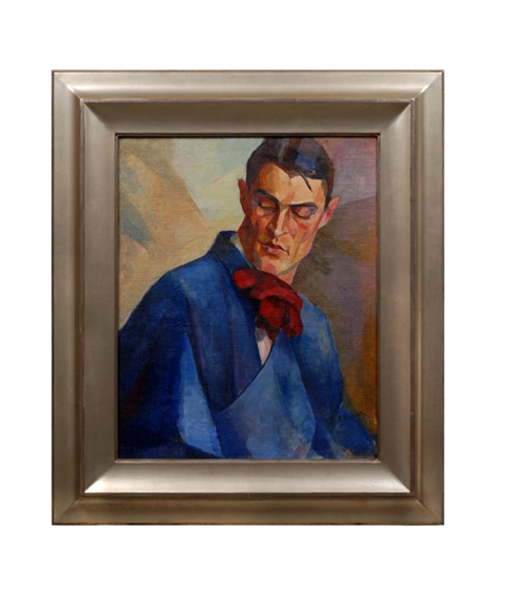
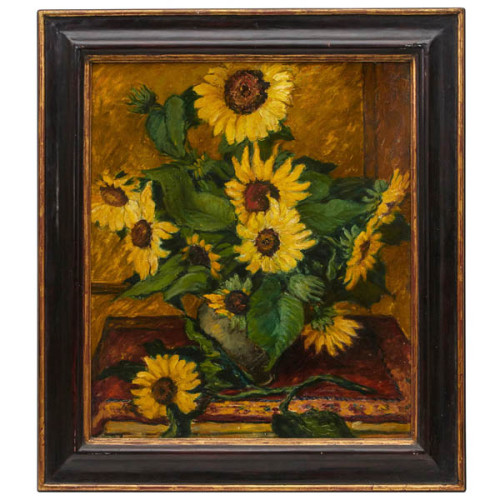
Zygmund Sazevich "Portrait of Victor Arnautoff" Oil on canvas 1925
More Information
Zygmund Sazevich “Portrait of Victor Arnautoff” Oil on canvas 1925
ZYGMUND SAZEVICH (1899-1968)
Portrait of Victor Arnautoff 1925
Oil on canvas
Signed: Z. Sazevich 1925 (lower right)
Framed: H: 34 5/16” x W: 29 9/16”
Price: $65,000
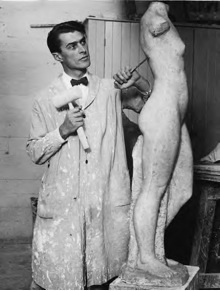
Zygmund Sazevich was born in Russia in 1899, and studied briefly at the University in Kazan in 1917, before traveling to Manchuria where he lived and worked as an actor and stage scenery painter. He emigrated to the U.S. via Japan in the early 1920s and entered the School of Architecture at the University of California, Berkeley, supporting himself by working as a house painter and helping stage plays for a local Russian theater company. Sazevich met Russian artist Eugene Ivanoff, and together they shared living quarters and studied at the California School of Fine Arts in San Francisco. Sazevich was awarded two scholarships, one in painting and one in sculpture. During the 1920’s Sazevich exhibited with the San Francisco Art Association, and in 1929 won first prize at their annual exhibit, followed by several sculpture commissions. That same year Sazevich and Ivanoff traveled to live and work in Paris. Back in San Francisco in 1931, his work was included in a show of garden sculptures at the California Palace of the Legion of Honor, along with works by Adaline Kent, Ruth Cravath, and others. By 1935 he was working as a W.P.A. muralist. Sazevich and his wife Zena, a decorator, purchased a home in the City, which they filled with Sazevich’s sculptures, woodcarvings, and hand-made furniture. In 1939 Sazevich exhibited at San Francisco’s Golden Gate International Exposition. His cast terrazzo sculpture Mississippi won the 1940 purchase prize at the annual San Francisco Art Association exhibition, and he had a one-man show at the San Francisco Museum of Art in 1941. During World War II, Sazevich worked in a shipyard creating wood patterns, and in later years he designed and made hand-blocked Christmas cards that were in great demand. His clients included celebrities such as Greer Garson, Joan Fontaine, and Red Skelton. From the late 1940s until the 1960s, Sazevich taught art classes, both at the California School of Fine Arts and at Mills College in Oakland. He continued to exhibit at the San Francisco Museum of Art through the 1950s, and in 1953 was featured in the museum’s Four Sculptors of the West show. Sazevich also had two solo shows at Mills College in 1950 and 1954, and a show at Raymond & Raymond in San Francisco in 1951. Zygmund Sazevich passed away in San Francisco in 1968. In 1982 his work was included in The Oakland Museum’s seminal exhibition 100 Years of California Sculpture.
Though his works are rare today, Zygmund Sazevich was a prolific, versatile and highly-regarded San Francisco Bay Area artist and instructor whose passion for his medium was evident not only in his sculptures and carvings, but also in his drawings and paintings. Sazevich believed that the two-dimensional rendering of the subject was integral to the process of sculpture, along with the necessity for the artist to have a feeling for the material with which he worked. His convictions were reflected in the great variety of woods, metals, and stone he used to create his sculptures, as well as in his paintings.
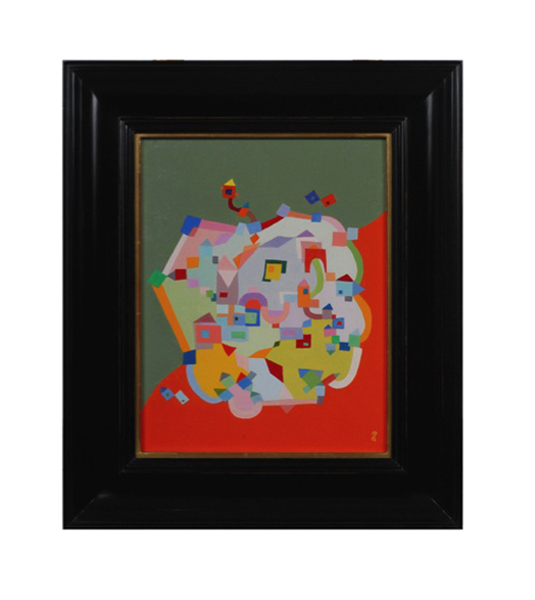
Michiel Gloeckner “Old Town No. 2”, Oil on Canvas 1960
MICHIEL GLOECKNER (1915-1989) Germany / USA
Old Town No. 2 1960
Oil on Canvas
Signed: MG (lower right corner)
Canvas: H: 14 1/16” x W: 11 1/16”
Framed: H: 19 9/16” x W: 16 9/16”
Price: 32,000
Michiel Gloeckner, known for his highly refined, balanced abstract, geometric style derived from natural forms, was the son of a well-known art collector. He graduated from the University of Dresden with a degree in mathematics and art history. He received a degree from the Royal Academy of Dresden where he studied under Otto Dix. Paul Klee also influenced Gloeckner’s work. After WWII Gloeckner moved to New York City. He continued to maintain a studio in New York at 115 East 70th Street, even after he moved to West Cornwall, Connecticut where he spent the later years of his life.
EXHIBITIONS
Gallery Seventy-Five, New York 1955, 1956, 1958
Jacques Seligman Galleries, New York 1960, 1961, 1962
Wadsworth Atheneum 1960
Wesleyan University 1961
Philadelphia Art Alliance 1962
Philadelphia Academy of Fine Arts 1963
World House Galleries, New York 1963, 1962, 1965, 1966
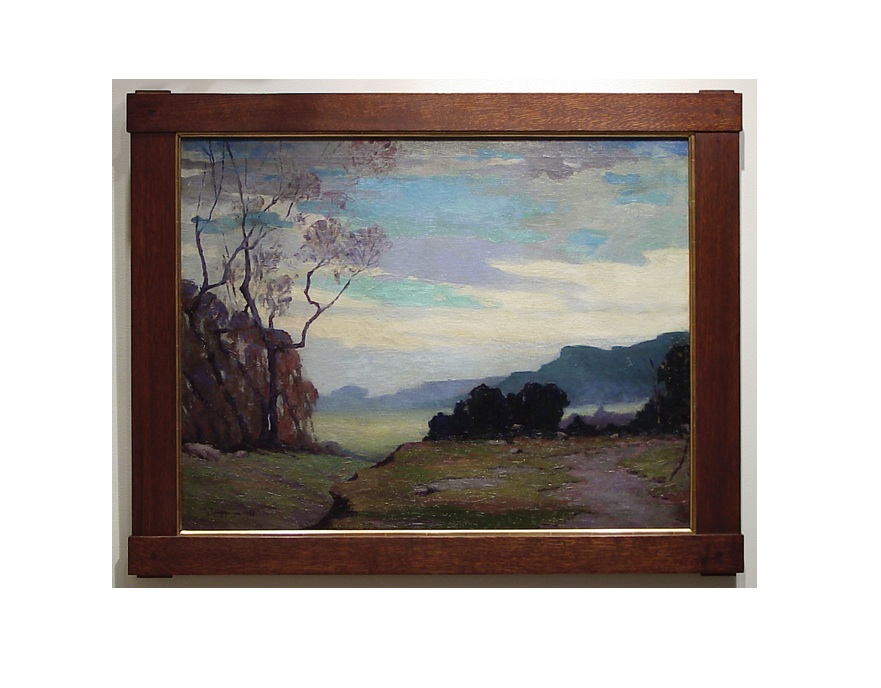
Gianni L. Cilfone “After the Rain” Oil on canvas 1928
GIANNI L. CILFONE (1908-1990) USA
“After the Rain” 1928
Oil on canvas, contemporary quarter sawn oak pegged frame with yellow gold filet.
Signed: Cilfone, 1928 (lower left corner)
Marks: Illinois Academy of Fine Arts, Second Annual Exhibition 1928, Gianni L. Clifone, 905 South Ashland Boulevard, “After the Rain,” $500 (paper label).
Exhibited: Illinois Academy of Fine Arts, Second Annual Exhibition 1928, Art Institute of Chicago 1928
For more information see: Who Was Who in American Art (Madison, Conn.: Sound View Press, 1985) p. 115.
Canvas: H: 30” x W: 40”
Framed: H: 38” x W: 48”
Gianni Cilfone emigrated with his family from San Marco, Italy to Chicago at the age of five. After studying at the Art Institute of Chicago, Cilfone took lessons from Hugh Breckenridge and John F. Carlson. His consistently won many prizes from the Chicago Gallery Association throughout the 1930s and 40s. He exhibited at the Hoosier Salon between 1949 and 1958, at the North Shore Arts Association, at the Association of Chicago Painters and Sculptors, and at the Art Institute of Chicago in 1919 and 1928.
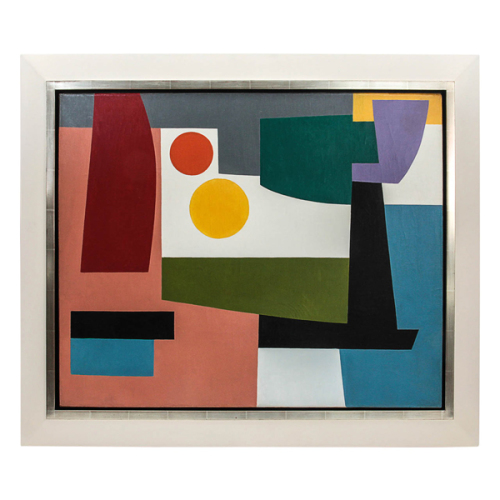
Marks: Untitled, 1950, Robert Breer, 26×32, No. 29 in a circle (paper label)
Provenance: Robert Breer, Private Collection, Chicago
Canvas: H: 25 3/4” x W: 32”
Framed: H: 32 1/4” x W: 39″
“Breer acknowledges his respect for this purist, “cubist” cinema, which uses geometric shapes moving in time and space”
Robert Breer’s career as an artist and animator spans 50 years and his creative explorations have made him an international figure. He began his artistic pursuits as a painter while living in Paris from 1949-59. Using an old Bolex 16mm camera, his first films, such as “Form Phases”, were simple stop-motion studies based on his abstract paintings.
Breer has always been fascinated by the mechanics of film. Perhaps it was his father’s fascination with 3-D work that inspired Breer to tinker with early mechanical cinematic devices. His father was an engineer and designer of the legendary Chrysler Airflow automobile in 1934 and built a 3-D camera to film all the family vacations. After studying engineering at Stanford, Breer changed his focus toward handcrafted arts and began experimenting with flip books. These animations, done on ordinary 4″ by 6″ file cards have become the standard for all of Breer’s work in fim.
Like many of his generation, Breer did early work influenced by the various European modern art movements of the early 20th century, ranging from the abstract forms of the Russian Constructivists and the structuralist formulas of the Bauhaus, to the nonsensical universe of the Dadaists. As a result of his association with the Denise René Gallery, which specialized in geometric art, he saw the abstract films of such pioneers as Hans Richter, Viking Eggeling, Walter Ruttmann and Fernand Léger. Breer acknowledges his respect for this purist, “cubist” cinema, which uses geometric shapes moving in time and space.
In 1955, he helped organize and exhibited in a show in Paris entitled “Le Mouvement” (The Movement), which paved the way for new cinema aesthetics. During this period, Breer also met the poet Allen Ginsberg and introduced him to his film “Recreation” (1956), which made use of frame-by-frame experiments in a non-narrative structure. Although Breer resisted being labeled a beatnik, the film does capture some aspects of beat poetry and music.
When Breer returned to the United States in the late 1950s, the American avant-garde was thriving and films by Kenneth Anger, Stan Brakhage, Peter Kubelka and Maria Menken were creating a new visionary movement. Breer found kindred spirits within the New York experimental scene. As Pop Art emerged as a phenomenon in the 1960s, Breer befriended Claes Oldenburg and others. He worked on the TV show, “David Brinkley’s Journal”, filming pieces on art shows in Europe; at the same time, he made his debut documentary on the sculptor Jean Tinguely in 1961.

 @hd_jewels