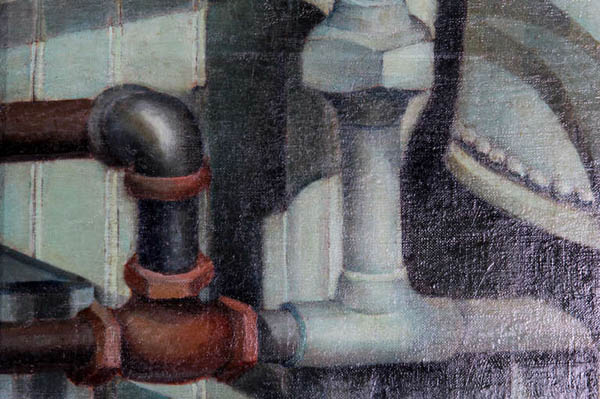
Otis Oldfield "Water Pipes and Shadows" Oil on Canvas c. 1920
More Information
Otis Oldfield, Water Pipes and Shadows, Oil on Canvas c. 1920
OTIS OLDFIELD (1890-1969) USA
“Water pipes and shadows” c. 1920
Oil on canvas, walnut frame
Signed: Otis Oldfield (lower left)
For more information see: Otis Oldfield 1890-1990, Centennial retrospective exhibition (San Francisco, CA: Inkwell Publishing, 1990).
Painting: H: 16 1/8” x W: 13”
Framed: H: 28 ¼” x W: 25 1/8”
Price: $42,500
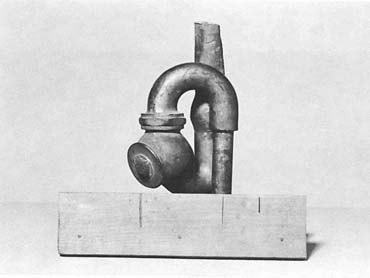
***The Metropolitan Museum of Art in New York owns a famous Gelatin silver print photograph by Morton Schamberg from 1916 entitled “God”. This image is akin to Duchamp’s “Fountain” and is an iconic Dadaist assemblage of plumbing pipes mounted on a miter box. The “Water Pipes and Shadows” painting by Otis Oldfield similarly brings a certain animation and personality to an under sink composition of mundane drain pipes in a sophisticated “Rayonist” or “Cubist” stylization. Otis Oldfield was born in Sacramento, California in 1890. He enrolled in the Best Art School in San Francisco in 1909 and continued his studies at the Academie Julian in Paris. Returning to the U.S., Oldfield settled briefly Sacramento before returning to San Francisco to accept a post as a teacher at the California School of Fine Art. Oldfield developed a bold modernist style, which caused some controversy among critics covering his exhibits. In 1936 Oldfield was one of a group of San Francisco artists chosen for a WPA project to paint murals in San Francisco’s Coit Tower. Following WW II, Oldfield taught at the California College of Arts and Crafts in Oakland. He died in San Francisco in 1969.
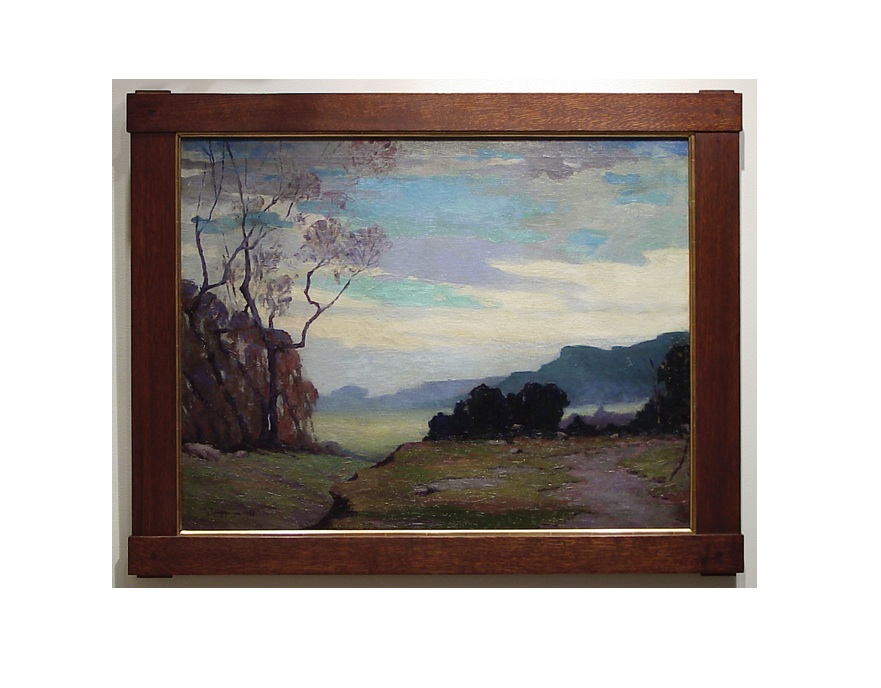
Gianni L. Cilfone “After the Rain” Oil on canvas 1928
GIANNI L. CILFONE (1908-1990) USA
“After the Rain” 1928
Oil on canvas, contemporary quarter sawn oak pegged frame with yellow gold filet.
Signed: Cilfone, 1928 (lower left corner)
Marks: Illinois Academy of Fine Arts, Second Annual Exhibition 1928, Gianni L. Clifone, 905 South Ashland Boulevard, “After the Rain,” $500 (paper label).
Exhibited: Illinois Academy of Fine Arts, Second Annual Exhibition 1928, Art Institute of Chicago 1928
For more information see: Who Was Who in American Art (Madison, Conn.: Sound View Press, 1985) p. 115.
Canvas: H: 30” x W: 40”
Framed: H: 38” x W: 48”
Gianni Cilfone emigrated with his family from San Marco, Italy to Chicago at the age of five. After studying at the Art Institute of Chicago, Cilfone took lessons from Hugh Breckenridge and John F. Carlson. His consistently won many prizes from the Chicago Gallery Association throughout the 1930s and 40s. He exhibited at the Hoosier Salon between 1949 and 1958, at the North Shore Arts Association, at the Association of Chicago Painters and Sculptors, and at the Art Institute of Chicago in 1919 and 1928.
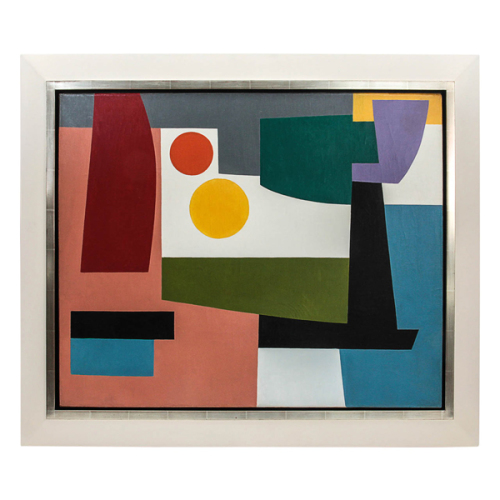
Marks: Untitled, 1950, Robert Breer, 26×32, No. 29 in a circle (paper label)
Provenance: Robert Breer, Private Collection, Chicago
Canvas: H: 25 3/4” x W: 32”
Framed: H: 32 1/4” x W: 39″
“Breer acknowledges his respect for this purist, “cubist” cinema, which uses geometric shapes moving in time and space”
Robert Breer’s career as an artist and animator spans 50 years and his creative explorations have made him an international figure. He began his artistic pursuits as a painter while living in Paris from 1949-59. Using an old Bolex 16mm camera, his first films, such as “Form Phases”, were simple stop-motion studies based on his abstract paintings.
Breer has always been fascinated by the mechanics of film. Perhaps it was his father’s fascination with 3-D work that inspired Breer to tinker with early mechanical cinematic devices. His father was an engineer and designer of the legendary Chrysler Airflow automobile in 1934 and built a 3-D camera to film all the family vacations. After studying engineering at Stanford, Breer changed his focus toward handcrafted arts and began experimenting with flip books. These animations, done on ordinary 4″ by 6″ file cards have become the standard for all of Breer’s work in fim.
Like many of his generation, Breer did early work influenced by the various European modern art movements of the early 20th century, ranging from the abstract forms of the Russian Constructivists and the structuralist formulas of the Bauhaus, to the nonsensical universe of the Dadaists. As a result of his association with the Denise René Gallery, which specialized in geometric art, he saw the abstract films of such pioneers as Hans Richter, Viking Eggeling, Walter Ruttmann and Fernand Léger. Breer acknowledges his respect for this purist, “cubist” cinema, which uses geometric shapes moving in time and space.
In 1955, he helped organize and exhibited in a show in Paris entitled “Le Mouvement” (The Movement), which paved the way for new cinema aesthetics. During this period, Breer also met the poet Allen Ginsberg and introduced him to his film “Recreation” (1956), which made use of frame-by-frame experiments in a non-narrative structure. Although Breer resisted being labeled a beatnik, the film does capture some aspects of beat poetry and music.
When Breer returned to the United States in the late 1950s, the American avant-garde was thriving and films by Kenneth Anger, Stan Brakhage, Peter Kubelka and Maria Menken were creating a new visionary movement. Breer found kindred spirits within the New York experimental scene. As Pop Art emerged as a phenomenon in the 1960s, Breer befriended Claes Oldenburg and others. He worked on the TV show, “David Brinkley’s Journal”, filming pieces on art shows in Europe; at the same time, he made his debut documentary on the sculptor Jean Tinguely in 1961.
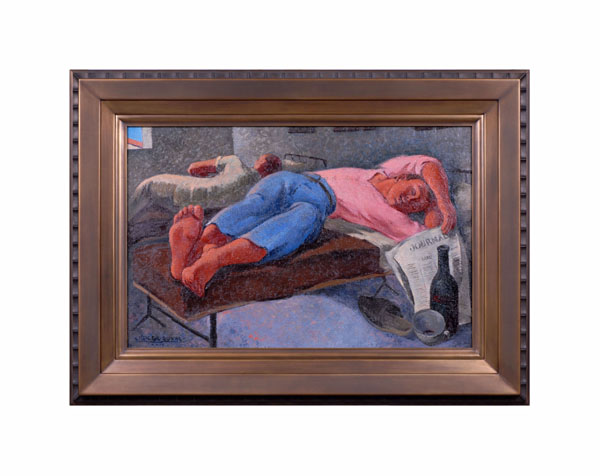
Roger Georges Andre Duval, “La Chambré” Oil on canvas 1924
ROGER GEORGES ANDRÈ DUVAL (1901-?) Meudon (Seine-et-Oise), France
La Chambré 1924
Oil on canvas
Signed and dated: ROGER DUVAL XXIV(lower left)
Exhbited: Paris, Salon des Indépendants, 1926, no. 1122
For more information see: Dictionnaire des Peintres, Sculpteurs, Dessinateurs et Graveurs, Vol. 4, E. Bénézit (Paris: Librairie Gründ, 1976).
Painting: H: 23 2/3” x W: 36 1/5”
Framed: H: 35” x 47 5/8”
Roger Duval painted in a modernist figurative style and beginning in 1920 regularly exhibited at the Salon d’Automne and the Salon des Indépendants in Paris. In 1925 he was awarded a prize by Paul Poiret for a painting entitled Conversation and again in 1926 for another painting entitled Bal Musette. Also in 1926, La Chambrée (1924) was exhibited in Paris at the Salon des Indépendants. By 1928 Duval’s technique had evolved into a moderninst/cubist style and a group of his paintings were featured in an Exposition of Painting and Sculpture in Boston, MA.
It is interesting to note Duval’s shared vision with Picasso in their depiction of peasant figures in repose. Their full-bodied, voluptuous and sensual forms illustrate both artists’ sculptural approach to painting in the early 1920s. However by the mid-1920s Duval and Picasso’s painting styles evolved from these softer, rounded shapes into more angular, abstracted forms.
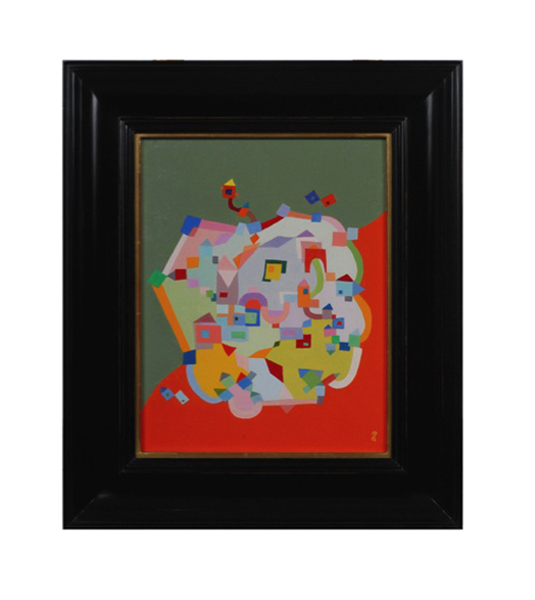
Michiel Gloeckner “Old Town No. 2”, Oil on Canvas 1960
MICHIEL GLOECKNER (1915-1989) Germany / USA
Old Town No. 2 1960
Oil on Canvas
Signed: MG (lower right corner)
Canvas: H: 14 1/16” x W: 11 1/16”
Framed: H: 19 9/16” x W: 16 9/16”
Price: 32,000
Michiel Gloeckner, known for his highly refined, balanced abstract, geometric style derived from natural forms, was the son of a well-known art collector. He graduated from the University of Dresden with a degree in mathematics and art history. He received a degree from the Royal Academy of Dresden where he studied under Otto Dix. Paul Klee also influenced Gloeckner’s work. After WWII Gloeckner moved to New York City. He continued to maintain a studio in New York at 115 East 70th Street, even after he moved to West Cornwall, Connecticut where he spent the later years of his life.
EXHIBITIONS
Gallery Seventy-Five, New York 1955, 1956, 1958
Jacques Seligman Galleries, New York 1960, 1961, 1962
Wadsworth Atheneum 1960
Wesleyan University 1961
Philadelphia Art Alliance 1962
Philadelphia Academy of Fine Arts 1963
World House Galleries, New York 1963, 1962, 1965, 1966




 @hd_jewels
Reviews
There are no reviews yet, would you like to submit yours?