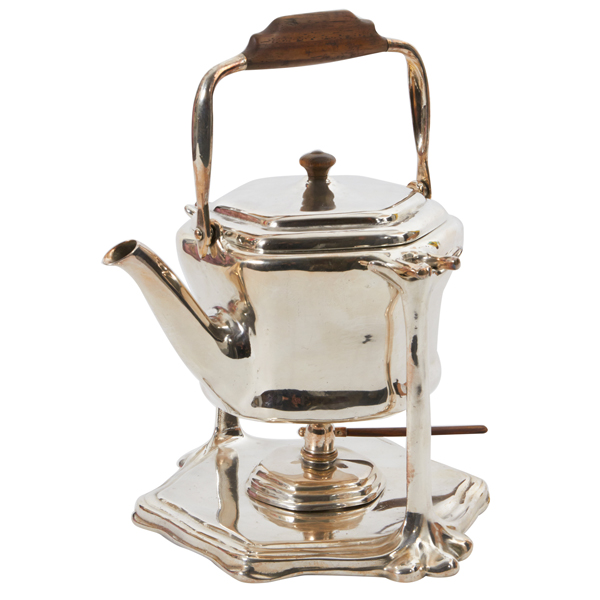
Louis C. Tiffany / Tiffany Studios Rare Kettle-on-Stand c. 1902
More Information
Louis C. Tiffany / Tiffany Studios Rare Kettle-on-Stand c. 1902
LOUIS C. TIFFANY (1848-1933) USA
TIFFANY STUDIOS New York
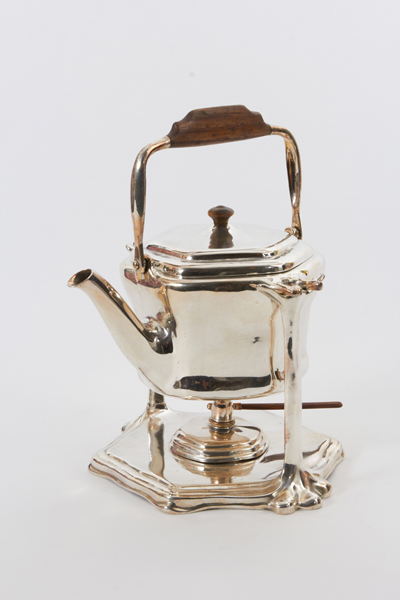
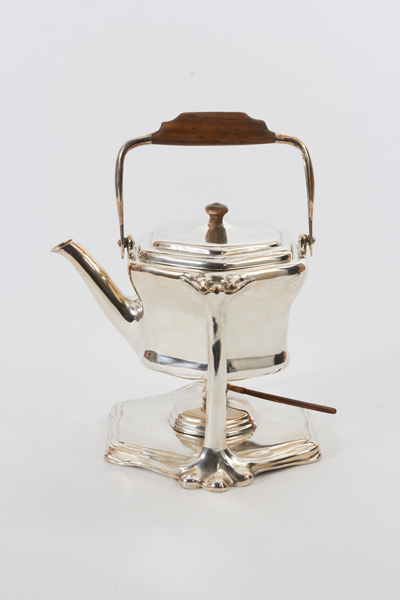
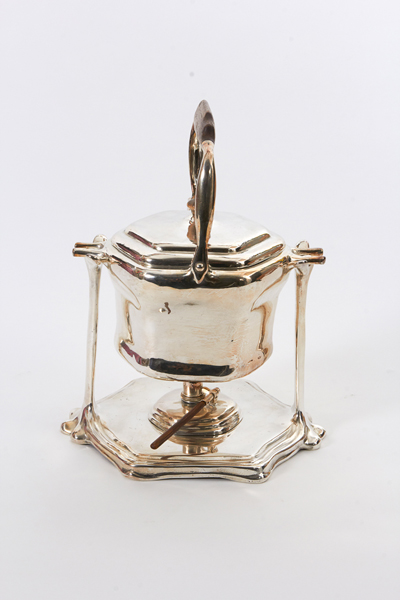
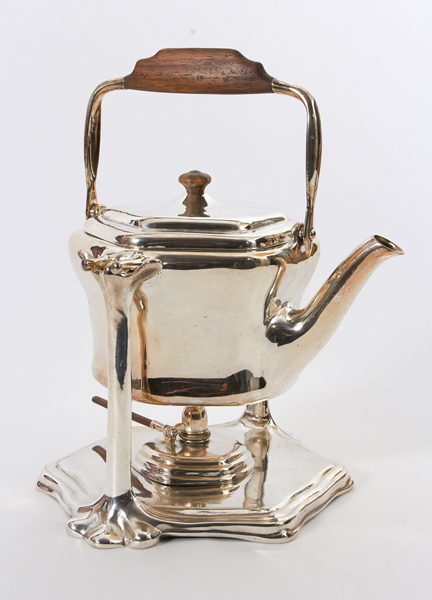
Kettle-on-Stand c.1902
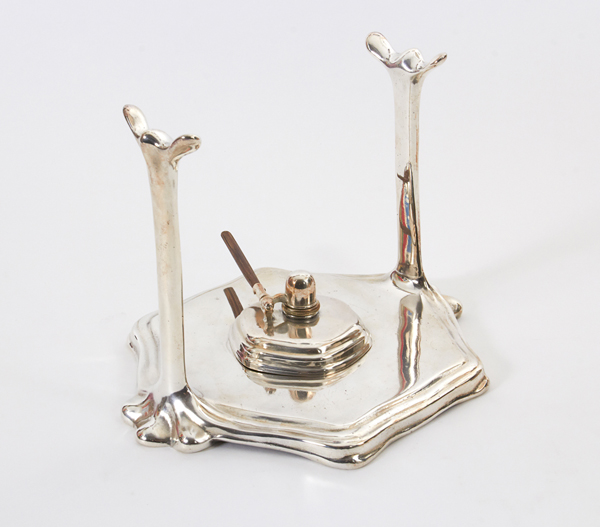
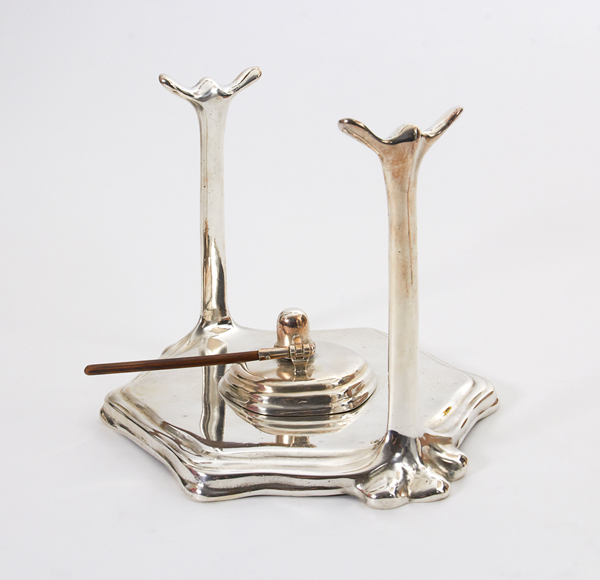
Silver on copper with carved teak wood handles and finial in an organic-form and hexagonal shaped kettle-on-stand with burner
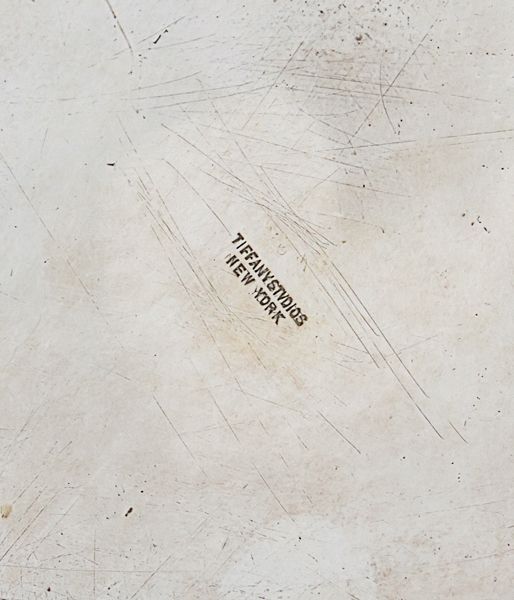
Marks: Tiffany Studios, New York (on all three pieces)
Illustrated: The Art of Louis Comfort Tiffany, Donald L. Stover (The Fine Arts Museums of San Francisco, 1981), p. 88, illus. 189 (description on p. 96); Tiffany at Auction, Alastair Duncan (New York: Rizzoli International Publications, 1981) p. 50, pl. 137.
A rare example of a subtle organic-form and hexagonal shaped kettle-on-stand emulating pooling water in a Japanese influenced design by Louis Comfort Tiffany and made by Tiffany Studios
Andre Thuret French Art Deco Rare Handblown Art Glass Vase c. 1930
ANDRÉ THURET (1898-1965) France
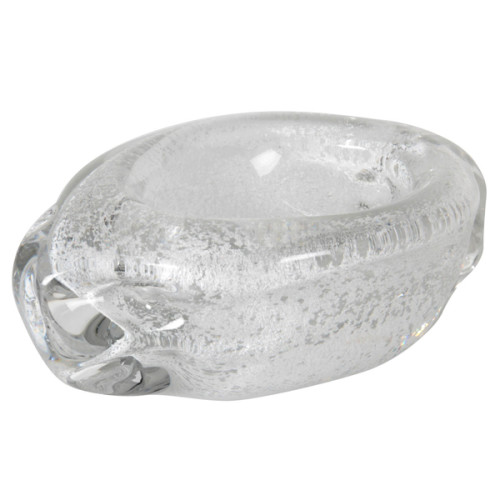
“Organic” vase/bowl c. 1930
Handblown and formed clear glass with bubble technique encapsulating a frosty white oxide.
Signed: ANDRÉ THURET
H: 2 3/8″ x D: 4″ x W: 6 1/4″
Andre Thuret was one of the first modern French studio glass artists and a contemporary of Maurice Marinot. He was born on November 3, 1898 in Paris. It is by science that Andre Thuret came to art. It is in Thuret the engineer and the chemist who serve Thuret the vase artist. The scientist places at the disposal of the creator of forms, rates/rhythms and colors the fluid and transparent beauty of glass and the reactions of metallic oxides. He worked in a traditional glass blowing technique at a temperature often exceeding 1,000 degrees. Thuret exhibited at the Salon d’Automne in 1928 and 1932 and obtained his first plate of the Company of Encouragement to Art. He was invited to exhibit in the United States in 1929-1930. Andre Thuret received his Chevalier of the Legion of Honor in 1947.
Karl Berghof / Kayserzinn Extremely Rare German Jugendstil Art Nouveau Pewter Vase 1904
KARL BERGHOF Germany
J. P. KAYSER SOHN Krefeld, Germany
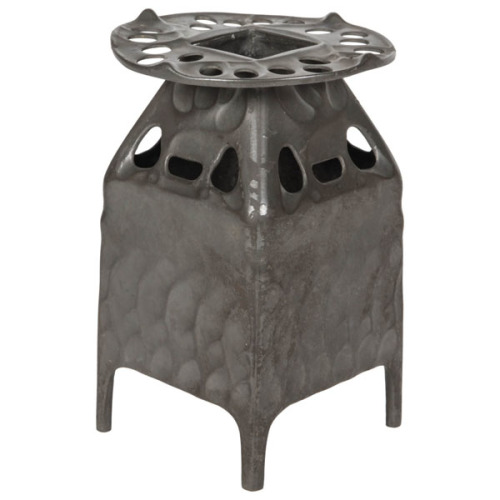
Vase 1904
Pewter squared vase with round flange top, open work details
Marks: Kayserzinn 4541 7 (in a raised oval)
Illustrated: Zinn des Jugendstils, Eckard Wagner (Cologne: Rheinland-Verlag, 1978), p. 63, cat. no. 148; J. P. Kayser Sohn Krefeld: Fabrik kunstgewerblicher Metallgegenstände, Musterbuch 1907 (Munich: Verlag Dry, 1982) p. 46.
***This is an extremely rare, other worldly Kayserzinn form.
Archibald Knox / Liberty & Co. Important and Rare Tudric Clock 1902
ARCHIBALD KNOX (1864-1933) UK
LIBERTY & CO. London
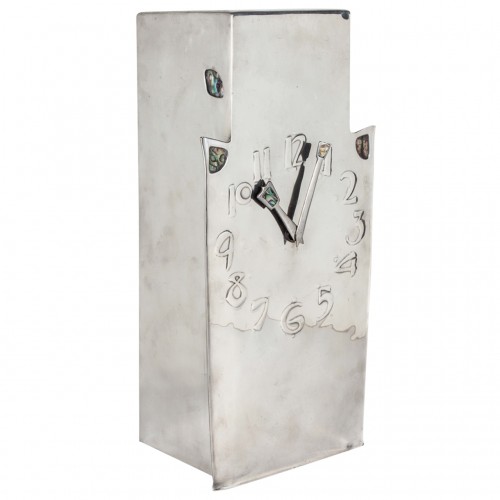
Extremely rare and important grand clock by Archibald Knox for Liberty & Co. This is the largest of all of the Tudric models designed and is inset with abalone shell on the sides, the front corners and on the hands of the clock.
Marks: TUDRIC, 098
Illustrated: The Designs of Archibald Knox for Liberty & Co., A..J. Tilbrook (London: Ornament Press Ltd., 1976) pg. 88; The Liberty Style, (Japan: Hida Takayama Museum of Arts, 1999) fig. 168, p 114; Archibald Knox, ed. by Stephen A. Martin (London: Academy Editions, 1995) p. 88.
H: 15″ x W: 7″ x D: 5″
***This is the largest clock designed by Archibald Knox for
Liberty & Co. and one of only three models known.
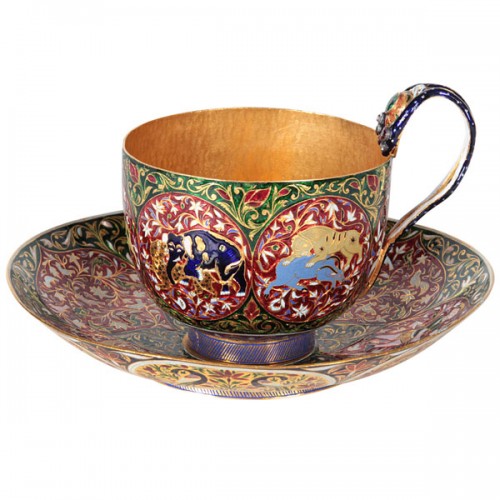
Jaipur Enameled and Gem Set Rare Solid Gold Cup and Saucer c. mid-19th Century
JAIPUR, MUGHAL INDIA
Enameled and gem set gold Cup and Saucer c. mid-19th Century
High carat yellow gold (22-24 carat) cup and saucer set with a fine emerald, ruby and diamonds, the cup with a high foot with rounded sides and handle formed of two snakes intersecting at three points and biting the rim. The exterior is decorated with red, green, blue and white enamels with roundels containing combatant animals on a ground of floral sprays, the saucer with gently rounded sides decorated with lobed cartouches containing warriors combating tigers and birds, the underside with a series of oval panels containing peacocks and hummingbirds.
Provenance: a gift from a European diplomat in the 1930’s-40’s, and thence by descent.
Saucer: Dia: 5 1/4;
Cup: H: 2 3/4″ (with handle) x Dia: 2 5/8″
Similar animal decoration can be found in an epaulette attributed to Rajesthan, probably Jaipur, in the Khalili Collection (Pedro Moura Carvalho, Gems and Jewels of Mughal India, London, 2010, p. 225, no. 120. A related cup and saucer with similar animal depictions was sold at Christie’s (Islamic Art, Indian Miniatures, Rugs and Carpets, London, 21st October 1993, lot 350.


 @hd_jewels