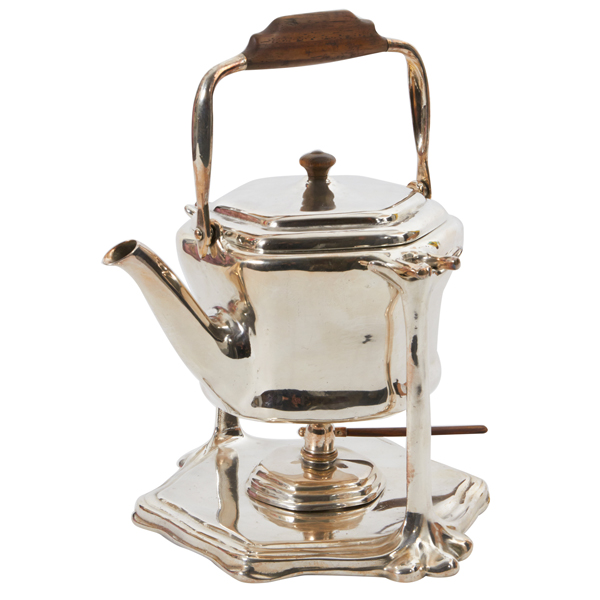
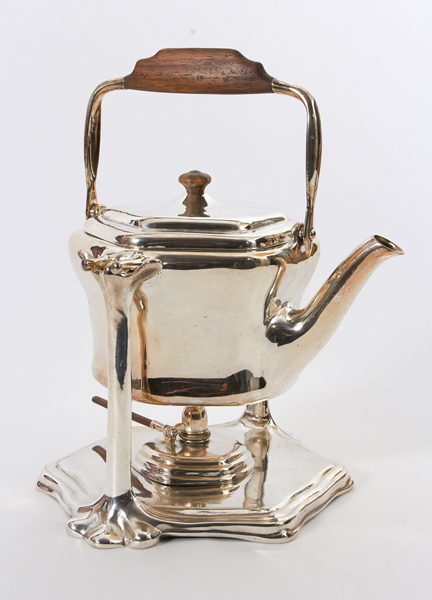
Louis C. Tiffany / Tiffany Studios Rare Kettle-on-Stand c. 1902
More Information
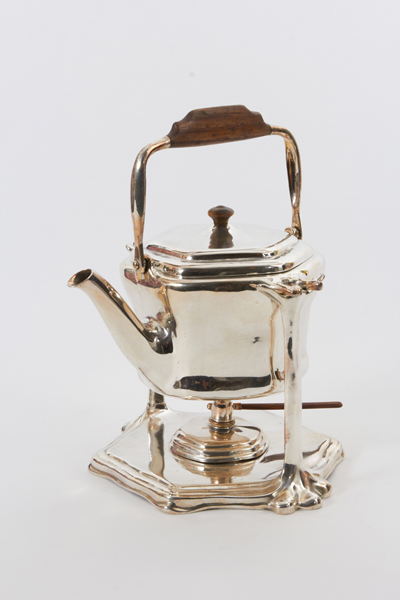
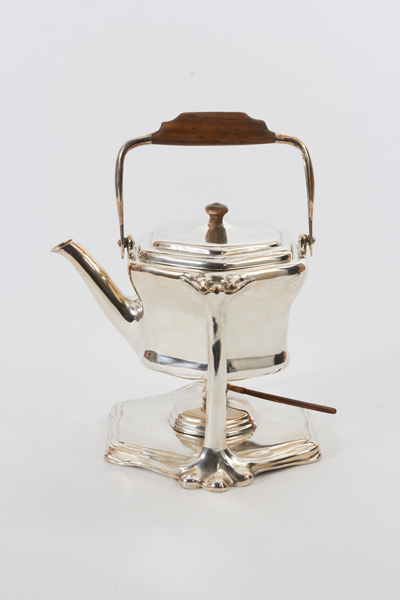
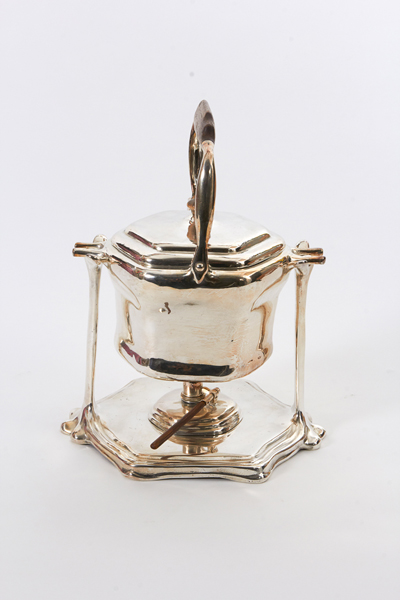
Louis C. Tiffany / Tiffany Studios Rare Kettle-on-Stand c. 1902
LOUIS C. TIFFANY (1848-1933) USA
TIFFANY STUDIOS New York
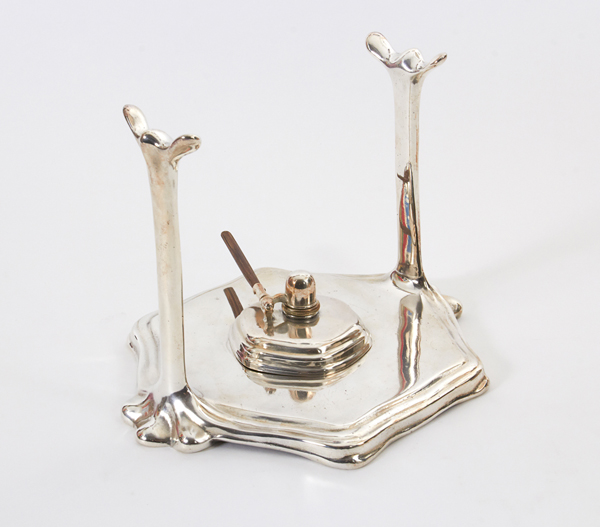
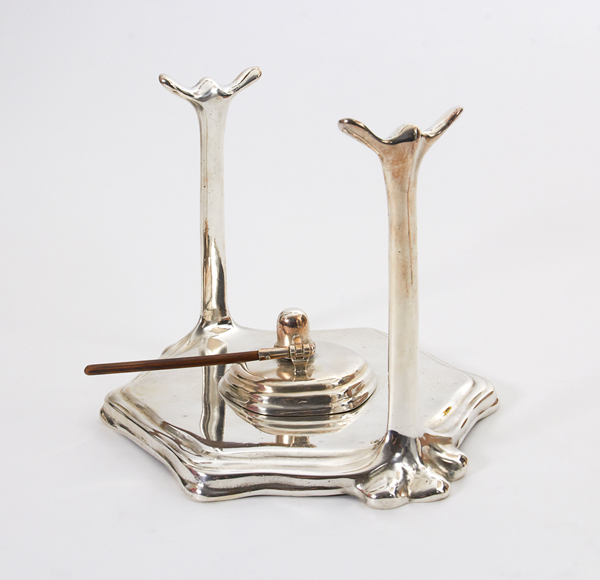
Kettle-on-Stand c.1902
Silver on copper with carved teak wood handles and finial in an organic-form and hexagonal shaped kettle-on-stand with burner
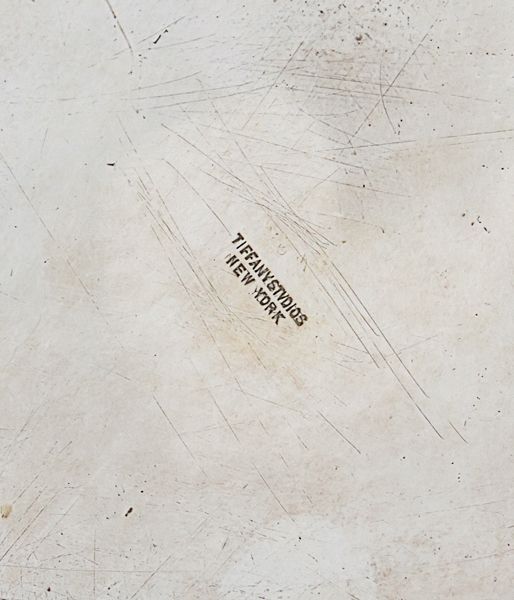
Marks: Tiffany Studios, New York (on all three pieces)
Illustrated: The Art of Louis Comfort Tiffany, Donald L. Stover (The Fine Arts Museums of San Francisco, 1981), p. 88, illus. 189 (description on p. 96); Tiffany at Auction, Alastair Duncan (New York: Rizzoli International Publications, 1981) p. 50, pl. 137.
A rare example of a subtle organic-form and hexagonal shaped kettle-on-stand emulating pooling water in a Japanese influenced design by Louis Comfort Tiffany and made by Tiffany Studios
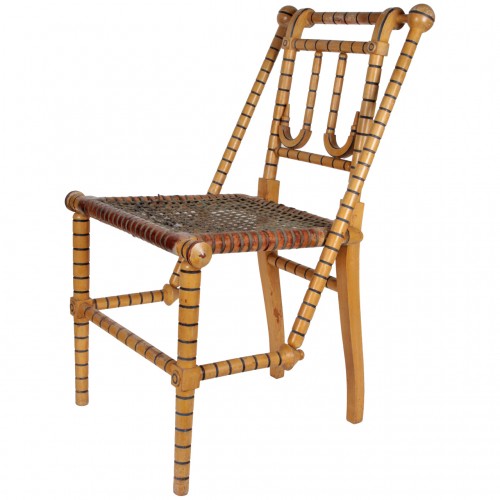
George Jakob Hunzinger New York 19th Century Rare Painted Chair 1876
GEORGE JAKOB HUNZINGER (1835-1898) Germany/ USA
Chair 1876
Yellow and blue painted elaborately turned wood, blue thread woven covered metal band mesh seat (original condition)
Marks: George Hunzinger Patent 1876
Illustrated: The Furniture of George Hunzinger, Invention and Innovation in Nineteenth-Century America, Barry R. Harwood (Brooklyn: Brooklyn Museum of Art, 1997) p.103.
H: 32″ x D: 17″ x W: 20″
GEORGE JAKOB HUNZINGER (1835-18989) USA
George Hunzinger emigrated in the 1850s from the Black Forest region of Germany where his family had worked as cabinetmakers since the 17th century. Settling in New York, he joined a community of 3,000 German furniture makers but soon distinguished himself as a maker of patent furniture and “fancy chairs”. Hunzinger’s innovative designs are often associated with the development of the Aesthetic Movement in America. By the 1870s, his chairs were sought after by many Americans as accent pieces for their parlors. The woven mesh or upholstery of these innovative chairs follows the original intention of the maker and the turned frame has an avant-garde, colorful and rather contemporary feeling painted in a combination of a rich ochre yellow and cobalt blue, a color combo that was highly prized for it’s eccentricity in Victorian America.
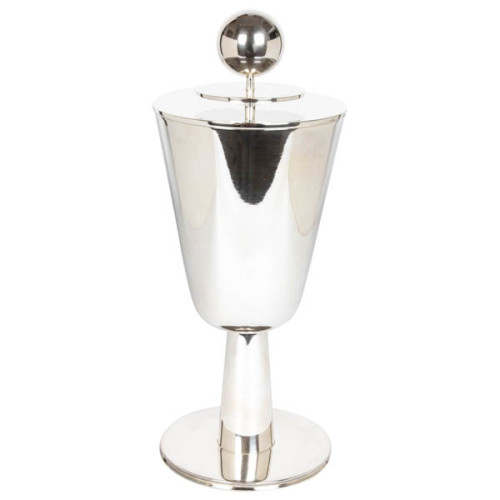
Breuhaus de Groot / WMF Ikora Germany Art Deco Rare “Pokal” Covered Footed Cup 1928
FRITZ AUGUST BREUHAUS DE GROOT (1883-1960) Germany
WMF [WÜRTTEMBERGISCHE METALLWARENFABRIK] Geislingen
“Pokal” Covered footed cup ( model no. Br 6 )1928
Silverplated brass, model no. Br 6
Marks: WMF insignia (touchmark), x/o
Illustrated: Goldschmiedekunst 49, (1928) m. Abb; Deutsche Kunst und Dekoration 63, (1928/29) Abb S 353; Metallkunst: Kunst vom Jugendstil zur Moderne (1889-1939), Karl H. Bröhan, Band IV (Berlin: Bröhan-Museum, 1990) n. 610, p. 571; WMF Ikora Metall / Metalwork, Carlo Burschel and Heinz Scheiffele (Stuttgart, Germany: ARNOLDSCHE, 2006) pp.12,19,34.
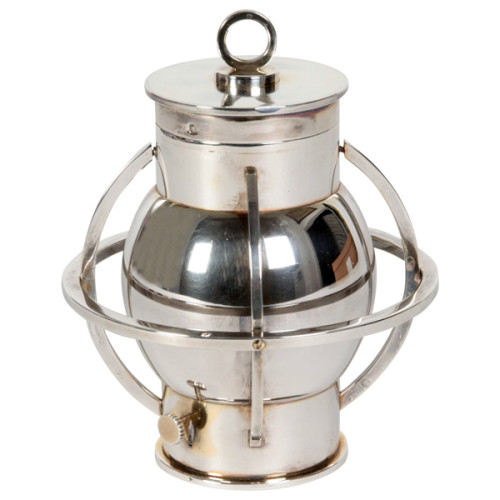
Mellerio Paris Rare French Art Deco “Gyroscope” sterling cigarette box c.1930
MELLERIO PARIS Italy/ France
Gyroscope cigarette box c.1930
French silver (950 silver standard) in a structural form of a gyroscope with a lever for an interior lifting mechanism, gilding
Marks: Mellerio Paris, 3776 D, head of Minerva French guarantee mark for 950/1000
H: 5 1/4″ x Dia: 4 1/4″
The renowned Mellerio family and their jewelry can be traced back to Lombardy, Italy as early as the 16th century. Some family members moved to Paris and became royal jewelers for Louis XIII. The revolutions of 1789 and 1848 interrupted their business and they moved to Madrid where they became the jewelers favored by Queen Isabel II. Later in the 19th century they returned to Paris where once again they prospered and participated in several international expositions including London (1862), Paris (1867, 1878 and 1900), and Vienna (1873). In the 20th century they exhibited at the renowned Paris 1925 Exposition des Arts Décoratifs in Paris and then in New York at the 1939 World’s Fair.
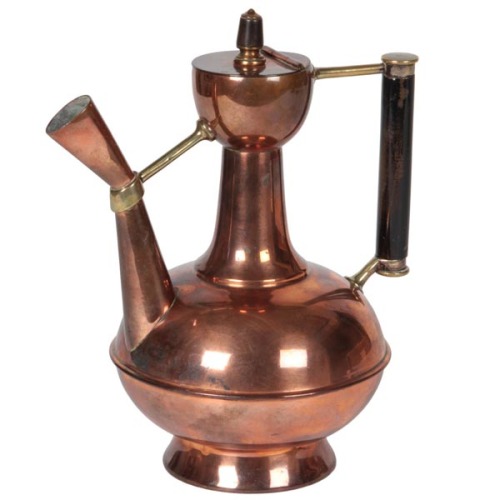
Christopher Dresser / Benham & Froud Rare Aesthetic Movement Copper coffee pot 1888
CHRISTOPHER DRESSER (1834-1904) UK
BENHAM & FROUD London, England
Coffee pot 1888
Copper, brass, wood handle and finial
***One of only two known models of this Dresser / Benham & Froud coffee pot.
Marks: maker’s cipher, Reg. no. 114566 for 1888
Only other model known illustrated: Christopher Dresser, by Widar Halén (Oxford: Phaidon, 1990), illus. 192, p. 170 (variant model); Truth, Beauty, Power: Dr. Christopher Dresser 1834-1904, exhib. cat. Historical Design, Inc. (New York, 1998) p. 66.


 @hd_jewels