Product Description
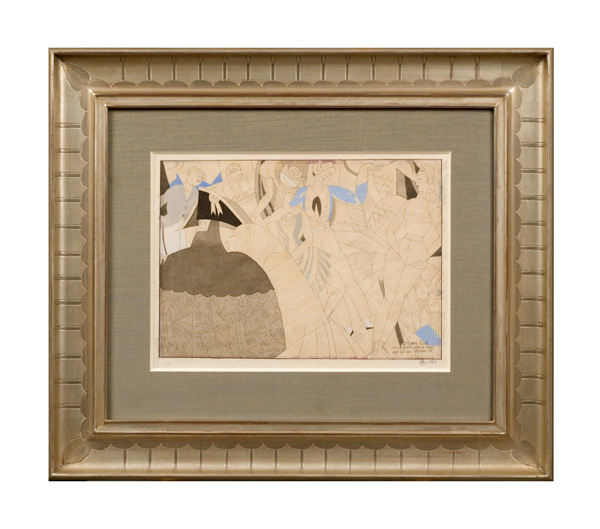
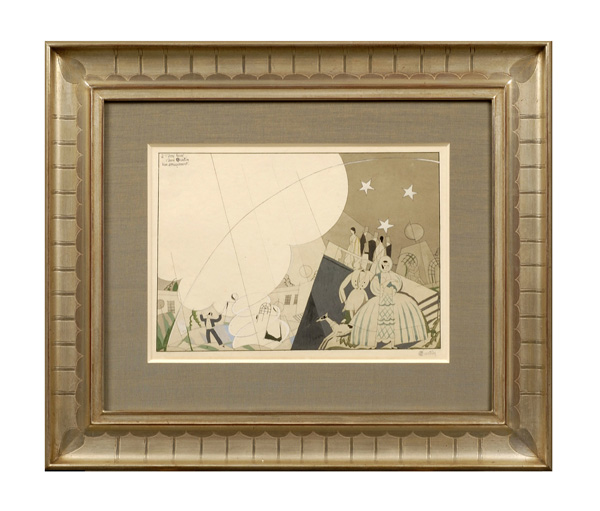
S O G A T A New York, NY “Harlem: Concert” Watercolor and pencil on paper 1931
*This SOGATA New York Watercolor and pencil on paper has been gifted to The Wolfsonian – FIU, Miami Beach, FL.

S O G A T A New York, NY
“Harlem: Concert” 1931
Watercolor and pencil on paper
Signed: SOGATA · HARLEM 1931 (in pencil, lower left corner of image); HARLEM: CONCERT. (in pencil beneath image on left)
For contextual history and similar art see: Rhapsodies in black : art of the Harlem Renaissance, (Berkeley: University of California Press, 1997); Harlem Renaissance Artists. Jordan, Denise (Chicago: Heinemann Library, 2003).
Paper H: 14 7/8″ x W: 10 7/8″
Image H: 11″ x W: 7 1/2″
Frame H: 19 1/4” x W: 16”
*This SOGATA New York Watercolor and pencil on paper has been gifted to The Wolfsonian – FIU, Miami Beach, FL.
S O G A T A New York, NY “Harlem: Concert” Watercolor and pencil on paper 1931
*This SOGATA New York Watercolor and pencil on paper has been gifted to The Wolfsonian – FIU, Miami Beach, FL.
You must be logged in to post a comment.
WES WILSON USA
Grateful Dead, Big Mama Mae Thornton at the Fillmore December 9-11, 1966
Marked: © 1966 Wes Wilson 41, printing by West Coast Lithograph Co. SF
H: 21 7/8” x W: 14”
JOYCE FRANCIS New York, NY
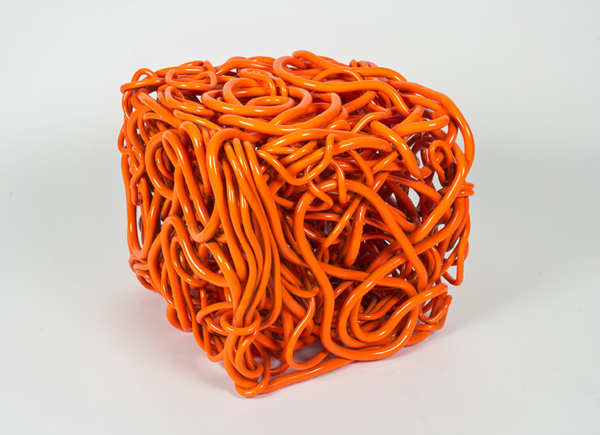
“Banana Land Flowers” box 2008
Cast and carved bright orange Lucite acrylic deeply incised and carved with three dimensional images of a monkey, a butterfly, a dragonfly and exotic flowers and foliage.
The top cover dimension is 1 3/4″ thick and the four sides of the box are 1 1/4″ thick.
Marks: Joyce Francis 08
H: 6″ x W: 4 3/4″ x D: 4 3/4″
Price: $3,750
Joyce Francis is a native Manhattanite artist who specializes in sculptured acrylic jewelry, purses, sculpture, tables and coveted collection of exciting, passionately carved decorative boxes. All pieces have been painstakingly hand carved, hand dyed, illuminated and sometimes hand painted as well. There are no embedded objects. Her purses are part of the permanent collections of the New York Metropolitan Costume Institute (New York), The Victoria and Albert Museum (London), The Fashion Institute of Technology (New York) and the Rock and Roll Hall of Fame (Cleveland).
Her work is in the collections of a number of stars and celebrities, including Hillary Swank, Phoebe Cates Kline, Emma Thompson, Cicely Tyson and Meryl Streep. Examples of her boxes and lamps are also owned by Paul Simon, Paul McCartney, Steve Martin and Tom Hanks.
GALERIE CARREFOUR 141Boulevard Raspail, Paris
Vérité Collection Wood block print poster “ARTS PRIMITIFS, CARREFOUR, 141 BD RASPAIL, DAN 5803″ c. 1948
Float mounted in a finely contoured oak frame.
Inscribed to: A Monsieur E Mme Breton, Vérité Image dimension:
H: 19 1/2″ x W: 12 3/4″
Framed dimension: H: 26 3/4″ x W: 19 3/4”
Price: $9,000
The Vérité Collection of primitive arts started after World War 1 in 1920. Pierre Vérité, a young artist started buying primitive art before anyone else. Vérité opened a small store selling exclusively tribal art in 1931 in conjunction with the Paris Colonial Exposition. Pierre Vérité regarded “primitive arts” as art, and it is the raw power of these primitive pieces that changed the history of 20th-century European culture. In 1936, he opened the Galerie Carrefour on the Boulevard Raspail, which was a hangout for artists and collectors such as Pablo Picasso, Helena Rubenstein, Nancy Cunard and Andre Breton. Tribal art was one of the key influences on Pablo Picasso and he often dropped into Pierre Vérité’s Galerie Carrefour in Paris to buy masks and carvings from Africa and Oceania. Henri Matisse was also a regular visitor, as were other artists such as Fernand Léger and Maurice de Vlaminck, while Vérité used to browse Parisian flea markets with André Breton, Surrealism’s chief theorist. In the decades that followed the opening of the gallery, the Vérité family’s client list grew to include Hollywood stars and leading museum curators, as well as some of the greatest names in 20th-century art. Vérité very quickly became the most important art dealer for primitive arts. In the 1948, Pierre’s son Claude became increasingly involved in the gallery. He went on African expeditions, collecting objects and information, and took photographs to document his travels, while his wife Jeannine was running the gallery operations. With Claude and Jeannine joining the gallery, Galerie Carrefour showed at all “Art Primitifs” exhibitions in Europe and the United States. The gallery established itself as the most important player in tribal arts in the world and exhibited until the 1990’s.
JACK RICHARD SMITH (1950-) Taos, NM
“Spiros Antonopoulos” 2004
Blackoil, wax, lead salts on copper, burl wood and ebonized wood Dutch old master style frame
Exhibited: “Taos Portraits” by Jack Smith, Harwood Museum of Art, University of New Mexico, Taos, New Mexico, May 14th – August 15th, 2004
Illustrated: “Taos Portraits” by Jack Smith, May 14th – August 15th, 2004, exhibition catalogue (Taos, NM: Harwood Museum of Art, University of New Mexico) illustr. 16
Painting: 6” x 6”
Framed: 13 3/4” x 13 11/16”
Price: $14,500
Incorporating blackoil, wax, lead salts, and copper Smith’s small format portraits and paintings are detailed and intimate depictions of creative individuals and charged tableaux. Smith’s singular style of portraits glow with a warm inner light and present honest, straightforward images that speak of personal narratives. Smith’s interest in miniatures developed first as a matter of convenience. In 1982, while preparing for a winter of travel in Mexico, he experienced logistical problems traveling with the larger size painting materials he was using at the time. The solution seemed to be a block of watercolor paper and casein, a milk base paint of versatile possibilities and vehement drying power. Suddenly, his paintings went from three by five feet to three by five inches. The history of oil painting, principally centered around the Dutch schools and their development of a method called black oil painting, often executed in miniature, also captured his interest. Black oil, an oleoresin comprised of white beeswax, raw linseed oil and litharge of lead, suspends the pigment above the painting ground, which was traditionally wood panel, linen or copper plate. This medium seems to suspend the pigment, allowing light to penetrate and reflect from the surface and illuminate the imaged from behind, a sort of light from within. The small format is an act of compression that requires the viewer to draw in close to a more intimate proximity and will, if the painting works, hopefully approach Joseph Campbell’s description of art as an “object of fascination” to engage the viewer and stop for a moment one’s busy mind. Jack Smith was born in 1950. At age 16, he began his training at the Interlochen Arts Academy in Michigan before moving to Ohio to attend Columbus College of Art and Design. He also studied for a brief time at the Instituto de Allende, at San Miguel de Allende, GTO, Mexico. He now resides in New Mexico. Reflecting a profound knowledge of art history and and an alchemist’s sense of the painting craft, contemporary painter Jack Smith has forged his own place amongst the most powerful of contemporary portraitists working in America. Jack Smith recently received a prestigious Past Achievement Award from the Peter and Madeleine Martin Foundation for the Creative Arts, following an important solo exhibition titled, Jack Smith: The Taos Portraits at the Harwood Museum of Art at the University of New Mexico in 2004. The exhibition featured fifty portraits of Taos, New Mexico residents, executed between 2000 and 2003. The series was intended as a visual biography of this unique artistic community at the turn of the century. Smith’s subjects range from the famous to the infamous — including artists, writers, art patrons, Native peoples, and street peoples. Spiros Antonopoulos’s (he always dropped the s in Spiros when saying his name) past is a little sketchy. I understand that he was trained as a musician and through that came to the world of computers, which he mastered immediately given his hot tub size brain pan. He also told me once that he had “done lots of drugs and some porn movies” while in college. Before we met he used to drive by my house in Arroyo Hondo, NM when he lived above us on the ridge road called Atalaya, about fifteen miles north of Taos and would make funny faces at me through the smudged window of his ghostly, lowrider station wagon. He was wildly eccentric dresser and had a selection of sunglasses that Elton would envy, mostly a thrift store wardrobe kind of guy. As I mentioned before, he tended to remind me of a mad computer geek samurai, which I tried to capture in this portrait. I’ve heard he now lives in the East Village and has forsaken his aforementioned life for obsessive Bikram yoga…… and that’s where the trail gets cold. The Taos portrait series was executed from 1999 to 2003 and was intended as a visual biography of this peculiar valley and town of Taos, NM. The subjects range from famous artists, writers and political activists to street people and what we affectionately call “sage bunnies”, or, folks that live out in the hinterlands in a grow hole with a goat or two and come to town once a month for provisions and bathe in patchuli oil, I presume, to save water. I would have liked to have had more of these folks but lining them up proved problematic as they tend to live in a parallel universe called locally, “the land of poco tiempo”, or “little time” , a condition caused, in their case, by smoking too much cheeba. This same time thing is true of my attempts at several more Native American friends from the pueblo…… it is something I greatly admire about them, unless of course you are scheduling a portrait sitting for the fourth time and they just had to go to Walmart without warning. But then “this is Taos” as John Nichols mentions in the forward to theexhibition catalogue and it is often referred to as an “open air asylum” for a myriad of good reasons. I thought it would be interesting to look back at some future time and see the weft and warp of the tapestry of Taos at the turn of themillennium. I could easily have done three hundred, but one must stop somewhere. The show was hanging in conjunction with Wayne Theibauld’s “City/ Country” exhibition at the Harwood Museum in Taos, New Mexico, June to September, 2004. – as told by Jack Smith, May 2006
Reviews
There are no reviews yet, would you like to submit yours?