Product Description
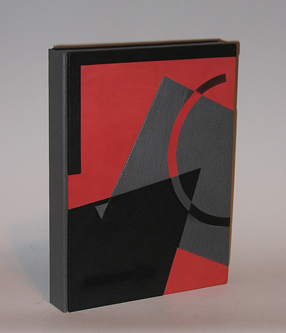
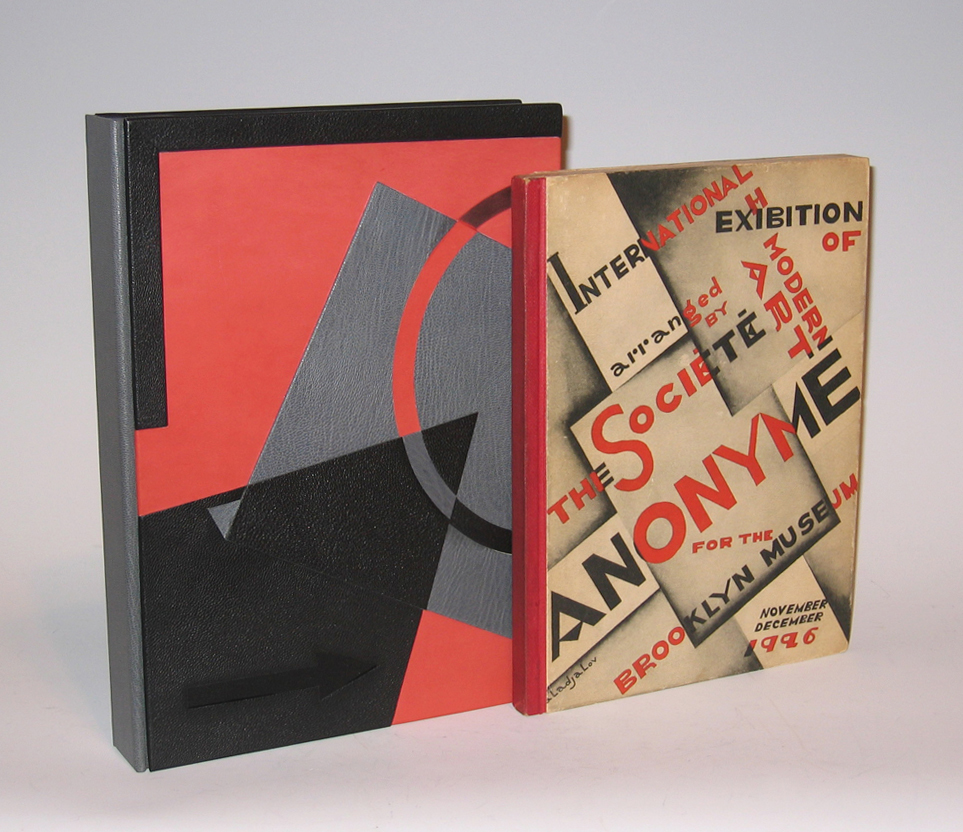
Katherine S. Dreier, “International Exhibition of Modern Art 1926”, Arranged by The Societe Anonyme for the Brooklyn Museum 1926

KATHERINE S. DREIER (1877-1952)
“International Exhibition of Modern Art 1926” 1926
Arranged by The Societe Anonyme for the Brooklyn Museum
Published by Societe Anonyme, New York
Dimensions:
Book: H: 10 1/16” x W: 7 ½”
Custom leather box: H: 11 ¼” x W: 8 ¼” x D: 1 9/16”
Custom silk slipcase: H: 12” x W: 8 5/8” x D: 2 1/8”
Katherine Sophie Dreier was born on 10 September 1877 in Brooklyn, New York to Dorothea Adelheid and John Caspar Theodor Dreier, both immigrants from Bremen, Germany; she was the youngest of five children. Early on, Dreier manifested her dual interests in social issues and art. She was treasurer of the German Home for Recreation of Women and Children and helped to found the Little Italy Neighborhood Association in Brooklyn, New York. She studied art privately, then at the Brooklyn Art School and at Pratt Institute, and then with Walter Shirlaw (with whom Dreier’s sister, Dorothea, also studied). There was a strong identification in the Dreier home with German culture, and the family often traveled to Europe to visit relatives. Between 1907 and 1914, Dreier spent much of her time abroad, traveling, studying art, and exhibiting her work in one-artist shows. In New York, in 1916, through her work with the Society of Independent Artists, Dreier met Marcel Duchamp. He was to become a close friend and colleague, and an important figure in the history of the Societe Anonyme. In January 1920, Dreier, Duchamp, and Man Ray met in Dreier’s apartment in New York City to found the Societe Anonyme, a society to promote modern art among the American public. Dreier had wanted to call the society “The Modern Ark,” but Man Ray later claimed that he was the one to suggest the French phrase for “incorporated” instead. Dreier added the subtitle “Museum of Modern Art: 1920.” The Societe Anonyme sponsored many lectures, concerts, publications, and exhibitions concerning modern art, including the International Exhibition of Modern Art at the Brooklyn Museum in 1926. In spite of a major membership campaign in 1925, the Societe’s headquarters in New York City closed in 1928, and from this point on, the Societe Anonyme existed only through Dreier’s efforts. She continued to organize events that were sponsored by the Societe, and she accumulated artwork to add to the Societe Anonyme’s collection. In 1939, Dreier began developing a plan to open the Country Museum at her house in West Redding, Connecticut (the Haven), which would house the Societe Anonyme’s collection of artwork, as well as her private collection. After little success with other potential investors, Dreier approached Yale University about funding and maintaining the museum. Yale was hesitant, because of the high costs of renovating the Haven and maintaining it as a fire-proof museum, and instead offered as a compromise to take over the Societe Anonyme’s collection if it were moved to the Yale Art Gallery. Dreier agreed, and she began sending the collection to Yale in October 1941. In 1942, Dreier was still adamant about her desire to open the Country Museum and to use her private collection as its basis. She continued her attempts to convince Yale to fund her project, but when Yale gave a final negative answer in April, Dreier decided to sell the Haven. In April 1946, she moved to a new home, Laurel Manor, in Milford, Connecticut. She continued to add artwork to the Societe Anonyme collection at Yale, through purchases and through gifts from artists and friends. In 1947, she attempted to reopen membership to the Societe Anonyme and printed a brochure, but Yale blocked distribution of the brochure because of the ambiguous connection between Yale and the membership campaign. In 1948, Dreier and Duchamp decided to limit the activities of the Societe to working on a catalog of the collection and to acquiring artwork. On the thirtieth anniversary of the Societe Anonyme’s first exhibition, 30 April 1950, Dreier and Duchamp hosted a dinner at the New Haven Lawn Club, where they formally dissolved the Societe Anonyme. In June, a catalog of the Societe’s collection at Yale, Collection of the Societe Anonyme: Museum of Modern Art 1920, was published. Dreier died on 29 March 1952.
Katherine S. Dreier, “International Exhibition of Modern Art 1926”, Arranged by The Societe Anonyme for the Brooklyn Museum 1926

Marcel Bouraine (active 1925-1930) France.
Pair of Art Deco “Dove” sculptural bookends, circa 1930.
Silvered bronze (sand cast technique) in the form of doves with openly displayed and fan shaped tail feathers perched on roof pan tiles.
Marks: Bouraine (2x), #’s 52 and 53.
For more information and other works by Bouraine see: Les Echoes D’Art (May 1927), p. 21; Art Deco Sculpture, Bryan Catley; The Art Deco Style, Selected by Theodore Menten (New York: Dover Publications, 1972), p. 172; Dictionnaire critique et documentaire des Peintres, Sculpteurs, Dessinateurs et Graveurs, E. Bénézit, vol. 2 (Paris: Librarie Grund, 1976), p. 231, An Encylopedia of Art Deco, Edited by Alastair Duncan (New York: E.P. Dutton, 1988) pp. 26,28-29,31,104; Art Deco, Victor Arwas (New York, Harry Abrams,1980) pp. 163, 269.
H: 5 ¾” x W: 4 ½” x D: 3 ½”
FLAVIO POLI (1900-1984) Italy
SEGUSO VETRI D’ARTE Italy
Vase c. 1950’s
Blue and clear Murano glass
H: 10″ x D: 3″ x W: 4 1/2″
Price: $1,850
Designer, businessman, ceramic artist. Born in Chioggia, he attended the Istituto d’Arte di Venezia and began work as a designer in ceramics. in 1929 he switched to glass and for Libero Vitali’s I.V.A.M. he designed animals, splendid Novecento-style nude figures in massiccio glass, as well as bowls and urns with figures resting on the inside, on lids or as handles. He subsequently collaborated with the Compagnia di Venezia e Murano, with the furnace of Mario and Lino Nason and with the engraver Gino Francesconi. in 1934 he accepted the artistic direction of Barovier, Seguso & Ferro, later to become Seguso Vetri d’Arte, and became partner three years later. Together with the master of the principal team Archimede Seguso, Poli was the author of grandiose lighting installations, of corroded vessels, of sculptures in bulicante glass, of animals in massiccio glass shaped while hot, productions which represented a milestone in the development of Murano glass. At the height of his artistic maturity, in the years between 1950 and 1960 he designed a series of sommerso glass pieces in a Nordic style, essential forms and sharp cold colors, which were awarded prestigious prizes (Compasso d’Oro). After leaving Seguso in 1963, between 1964 and 1966 he organized the artistic glass division at the Societˆ Veneziana di Conterie e Cristallerie.
ARCHIBALD KNOX (1864-1933) UK
LIBERTY & CO. London
Pair of tri-footed vases c. 1902-05
Pewter with abstract Celtic floral design in bas-relief on tri-footed base
Marks: 6, MADE BY LIBERTY & CO.., ENGLISH PEWTER 0227
Illustrated: Archibald Knox, ed. by Stephen A. Martin (London: Academy Editions, 1995) ; Liberty Design 1874-1914, Barbara Morris (London: Pyramid Books, 1989) p. ; The Designs of Archibald Knox for Liberty & Co., A.J. Tilbrook (London: Ornament Press Ltd., 1976)
L: 9 3/8”