Product Description
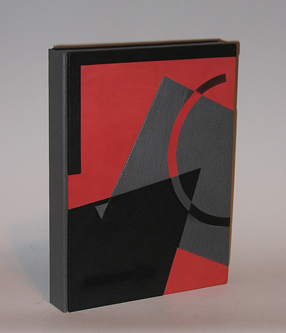
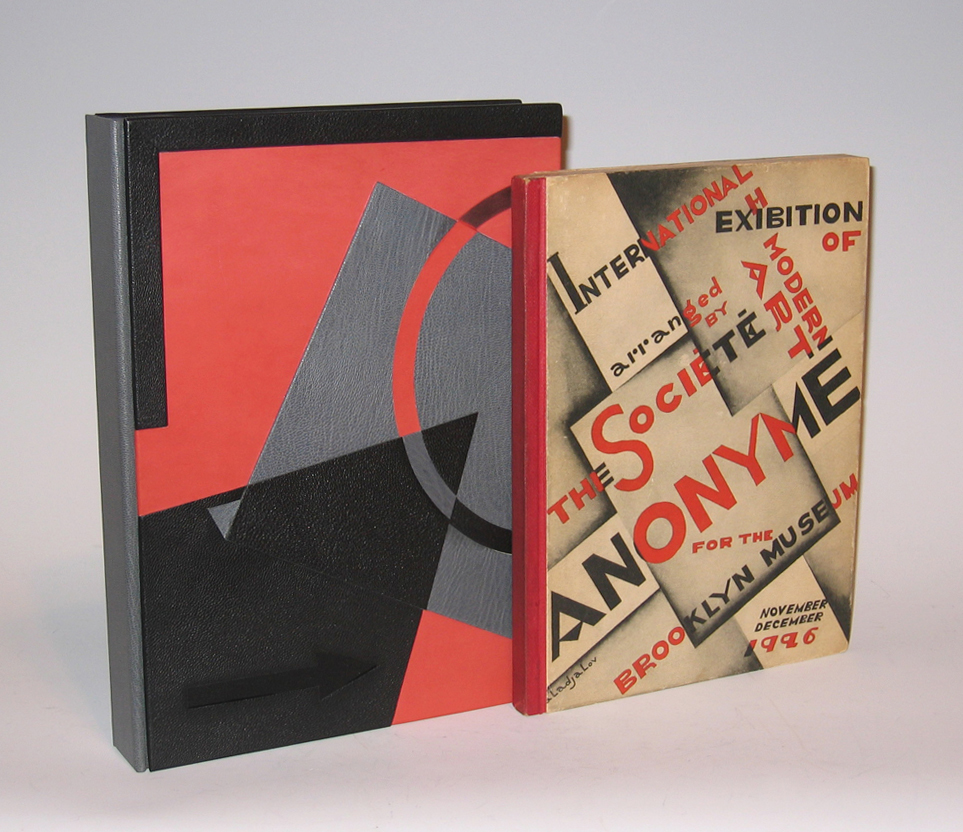
Katherine S. Dreier, “International Exhibition of Modern Art 1926”, Arranged by The Societe Anonyme for the Brooklyn Museum 1926

KATHERINE S. DREIER (1877-1952)
“International Exhibition of Modern Art 1926” 1926
Arranged by The Societe Anonyme for the Brooklyn Museum
Published by Societe Anonyme, New York
Dimensions:
Book: H: 10 1/16” x W: 7 ½”
Custom leather box: H: 11 ¼” x W: 8 ¼” x D: 1 9/16”
Custom silk slipcase: H: 12” x W: 8 5/8” x D: 2 1/8”
Katherine Sophie Dreier was born on 10 September 1877 in Brooklyn, New York to Dorothea Adelheid and John Caspar Theodor Dreier, both immigrants from Bremen, Germany; she was the youngest of five children. Early on, Dreier manifested her dual interests in social issues and art. She was treasurer of the German Home for Recreation of Women and Children and helped to found the Little Italy Neighborhood Association in Brooklyn, New York. She studied art privately, then at the Brooklyn Art School and at Pratt Institute, and then with Walter Shirlaw (with whom Dreier’s sister, Dorothea, also studied). There was a strong identification in the Dreier home with German culture, and the family often traveled to Europe to visit relatives. Between 1907 and 1914, Dreier spent much of her time abroad, traveling, studying art, and exhibiting her work in one-artist shows. In New York, in 1916, through her work with the Society of Independent Artists, Dreier met Marcel Duchamp. He was to become a close friend and colleague, and an important figure in the history of the Societe Anonyme. In January 1920, Dreier, Duchamp, and Man Ray met in Dreier’s apartment in New York City to found the Societe Anonyme, a society to promote modern art among the American public. Dreier had wanted to call the society “The Modern Ark,” but Man Ray later claimed that he was the one to suggest the French phrase for “incorporated” instead. Dreier added the subtitle “Museum of Modern Art: 1920.” The Societe Anonyme sponsored many lectures, concerts, publications, and exhibitions concerning modern art, including the International Exhibition of Modern Art at the Brooklyn Museum in 1926. In spite of a major membership campaign in 1925, the Societe’s headquarters in New York City closed in 1928, and from this point on, the Societe Anonyme existed only through Dreier’s efforts. She continued to organize events that were sponsored by the Societe, and she accumulated artwork to add to the Societe Anonyme’s collection. In 1939, Dreier began developing a plan to open the Country Museum at her house in West Redding, Connecticut (the Haven), which would house the Societe Anonyme’s collection of artwork, as well as her private collection. After little success with other potential investors, Dreier approached Yale University about funding and maintaining the museum. Yale was hesitant, because of the high costs of renovating the Haven and maintaining it as a fire-proof museum, and instead offered as a compromise to take over the Societe Anonyme’s collection if it were moved to the Yale Art Gallery. Dreier agreed, and she began sending the collection to Yale in October 1941. In 1942, Dreier was still adamant about her desire to open the Country Museum and to use her private collection as its basis. She continued her attempts to convince Yale to fund her project, but when Yale gave a final negative answer in April, Dreier decided to sell the Haven. In April 1946, she moved to a new home, Laurel Manor, in Milford, Connecticut. She continued to add artwork to the Societe Anonyme collection at Yale, through purchases and through gifts from artists and friends. In 1947, she attempted to reopen membership to the Societe Anonyme and printed a brochure, but Yale blocked distribution of the brochure because of the ambiguous connection between Yale and the membership campaign. In 1948, Dreier and Duchamp decided to limit the activities of the Societe to working on a catalog of the collection and to acquiring artwork. On the thirtieth anniversary of the Societe Anonyme’s first exhibition, 30 April 1950, Dreier and Duchamp hosted a dinner at the New Haven Lawn Club, where they formally dissolved the Societe Anonyme. In June, a catalog of the Societe’s collection at Yale, Collection of the Societe Anonyme: Museum of Modern Art 1920, was published. Dreier died on 29 March 1952.
Katherine S. Dreier, “International Exhibition of Modern Art 1926”, Arranged by The Societe Anonyme for the Brooklyn Museum 1926

NORMAN BEL GEDDES (1893 – 1958) USA
Medal 1933 (Commemorating the twenty-fifth anniversary of General Motors)
Silvered bronze
Signed: Norman Bel Geddes [copyright mark ] 1933
Exhibited: The Metropolitan Museum of Art, New York, May 16-Jan. 7, 2001, Mint Museum of Craft & Design, North Carolina, May 3-July 28, 2002
Illustrated: Johnson, J. Stewart, American Modern 1925-1940: Design for a New Age, Harry N. Abrams & The American Federation of the Arts, 2000, p. 127
Diameter: 3″
This medallion, commemorating the twenty-fifth anniversary of General Motors, is an example of the Streamlined style that dominated architecture and design in America from the late 1920s to the end of the 1930s. With its abstracted, teardrop-shaped vehicle form depicted in motion, with the tall winglike element rising from its center, the overall effect is one of speed and movement—characteristic of the Streamlined style and appropriate to the automobile and airplane age. Norman Bel Geddes was trained as a theatrical set designer but best known for another project for General Motors, the Futurama exhibition at the 1939 New York World’s Fair. This exhibit, through which visitors were propelled on a giant conveyor belt, depicted a utopian vision of America in the near future, a world dependent on the speed and efficiency of the automobile for work and recreation.
NIGERIA
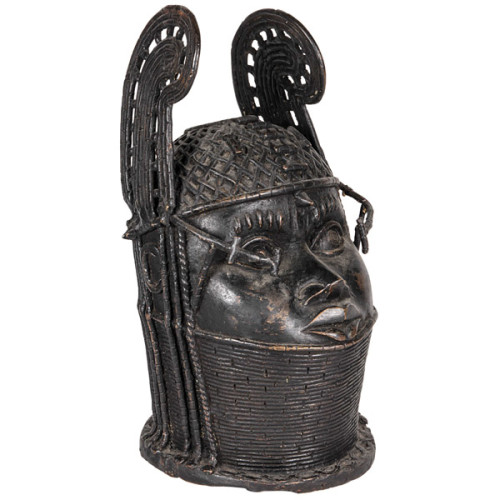
Benin Head of King Oba, c. early to mid-20th Century
Lost wax cast bronze with a rich brown and black patina with light desert sand patina in some of the recessed areas.
The art of Benin is the product of an urban royal court, and is meant to symbolize and to extol the power, mystique, grandeur, continuity, and endurance of the ruling dynasty and its governing institutions. From the 14th century until its fall in 1897, Benin was ruled by the Oba, a divine ruler at the head of the political system of titled chiefs. Under royal support, a number of craftsman’s guilds produced bronze, brass, and wood sculptures and embroidered cloth, all of which have become prized by museums and collectors.
These heads were typically placed on altars dedicated to each of the past Oba’s of Benin. The altars are semicircular mud platforms that have been packed hard and rubbed smooth and are located in open courtyards of the palace. The royal altars are the settings for one of the two most important rites of divine kingship in Benin, Ugie Erha Oba, when the Oba honors the spirit of his late father and performs sacrifices to the royal ancestors and to the earth in which they are buried. Acknowledging his role as his fathers’ successor, the chiefs pay homage to the king and greet him in order of seniority. The rite expresses the continuity of divine kingship, and the altar before which it takes place provides the means by which the connection between the living king and his predecessors was established and made.
H: 14 1/2″ x D: 7 1/2″ x W: 8 1/2″
PER SAX MØLLER (b. 1950) Denmark
Round sculptural centerpiece with geometrical shapes 2000
Sterling silver
Marks: PER SAX MØLLER, Copenhagen, 925s, Sterling
Exhibited: Danske Sølsmede-nye arbejder (Danish silversmiths-new work), Museet på Koldingshus, 2002.
Diameter: 8 ¼”
Price: $12,500
The silversmith Per Sax Møller was trained in the Danish silver tradition with Jeweler to the Royal Danish Court, A. Michelsen, from 1968-1972. The workshop specialized in style copies and modern silver, which during the 1900’s was designed by architects such as Thorvald Bindesbøll, Kay Fisker, Erik Herløw, Tove and Edvard Kint-Larsen, among many others.
After completing his apprenticeship, he worked at Preben Salomonsen’s workshop in Copenhagen, mainly creating style copies for stores such as Tiffany, Bloomingdale’s and Aspery. Here, the ancient silversmith’s craft he had learned at A. Michelsen, was further honed. During the years 1973-1975, he attended classes at Guldsmedehøjskolen, but he was disappointed in the low standard of teaching and therefore did not graduate.
He found the opportunity for a far richer artistic education as a conscientious objector, stationed at the art museum Louisiana in Humlebæk, outside Copenhagen. He spent more than a year here, surrounded by the works of Henry Moore, Arp, Calder, Laurent and Danish artists such as Astrid Noack, Ejler Bille, Sonja Ferlov Mancoba, Villy Ørskov and many more, which left a deep and profound mark.
In 1976, Per Sax Møller established himself in a workshop alongside goldsmith Jørgen Bindesbøll, in St. Kongensgade in Copenhagen. Over the next couple af years, he also joined the association “Danske Sølvsmede” in exhibitions throughout Scandivavia. He retired from the workshop with Jørgen Bindesbøll in 1980, but continued to create works in rented space. To help earn a living, he drove a city bus and worked for Folketeateret in Copenhagen, creating theatre sets.
Jørgen Bindesbøll moved to Møn in 1984, and Per Sax Møller took over his workshop in St. Kongensgade. Soon thereafter, he established himself in a workshop in Pilestræde, Copenhagen, and then in 1992, he took over silversmith Kay Bojesen’s workshop in Bredgade 47, where he resides today.
In the mid 1990’s Per Sax Møller rejoins “Danske Sølvsmede”, and in 1999 he succeeds silversmith Ib Andersen as president of the association. As president, he revitalizes Danish silver by initiating the exhibition Danish Silver 2000, which takes up most of the space in the museum Koldinghus and becomes one of the largest manifestations of Danish silver. During one summer month, the exhibition was visited by 30,000 guests.
In 2002, Per Sax Møller resigns the presidency of “Danske Sølvsmede” to once again concentrate on his own works. Per Sax Møller has received Danish State Arts Foundation grant in 1979, 1997, 2000 and 2002. His works are represented at Oslo Museum of Art and Design, Danish Museum of Art and Design, at the museum Koldinghus and in private collections in Europe, USA and Canada.