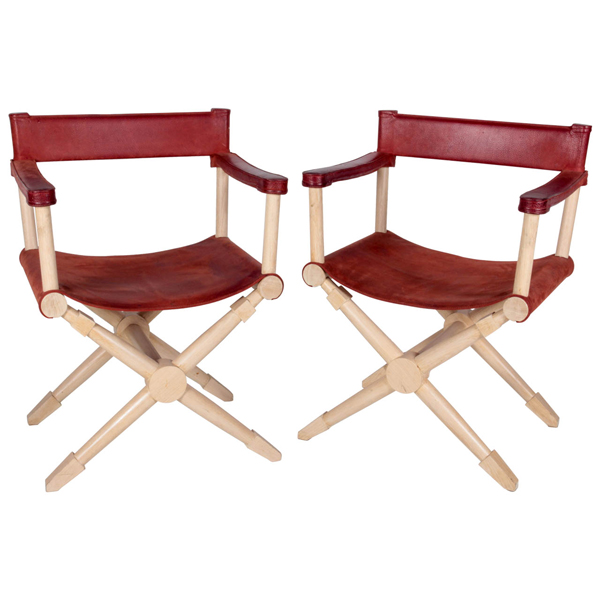
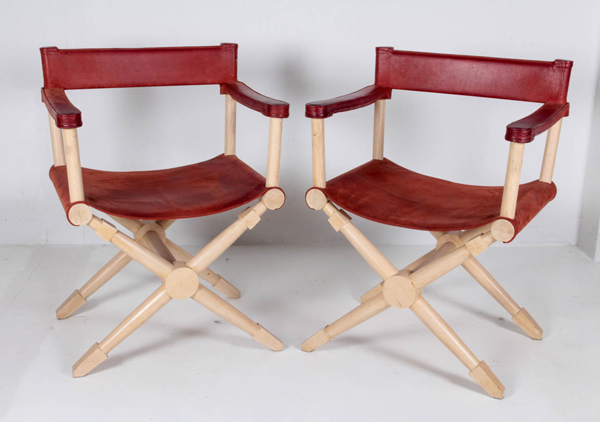
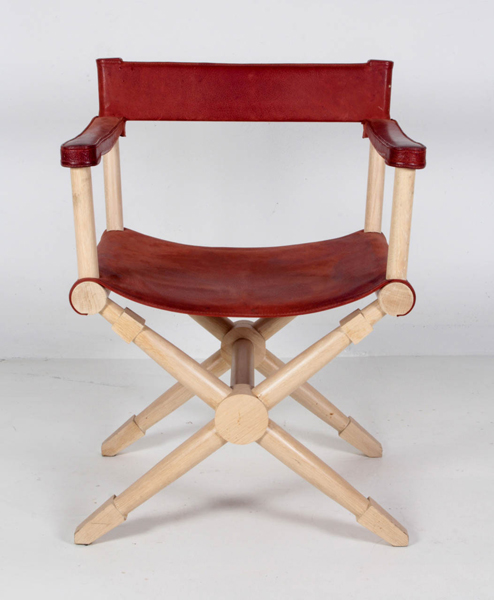
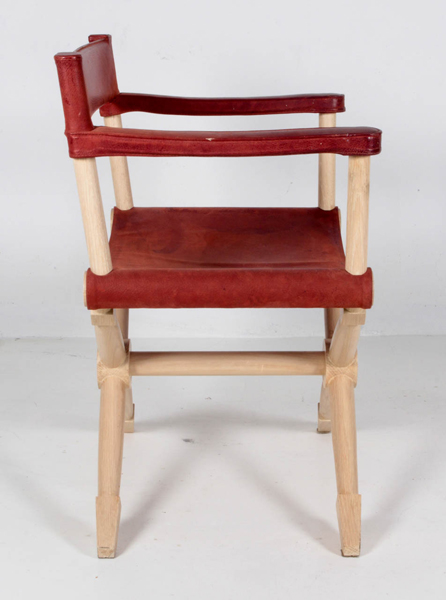
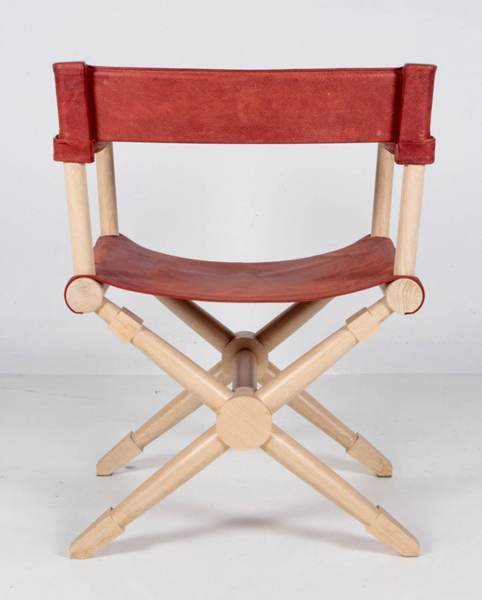
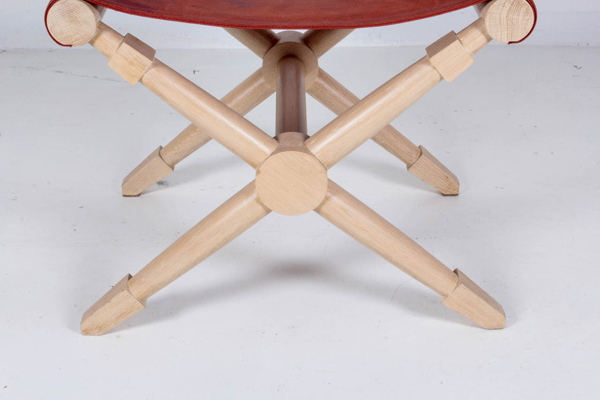
In the style of Jean-Michel Frank / Hermès Pair of French Art Deco "Rodo" chairs 20th Century
More Information
In the style of Jean-Michel Frank / Hermès Pair of French Art Deco “Rodo” chairs 20th Century
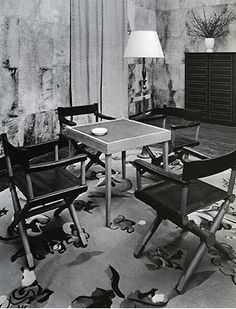
In the Style of JEAN-MICHEL FRANK (1895 – 1941) France
Pair of “Rodo” chairs 20th Century
Light ceruse oak with red Hermès sueded leather
For more information see: Jean-Michel Frank: The Strange and Subtle Luxury of the Parisian Haute-Monde in the Art Deco period, P.E. Martin-Vivier (Paris, 2006)
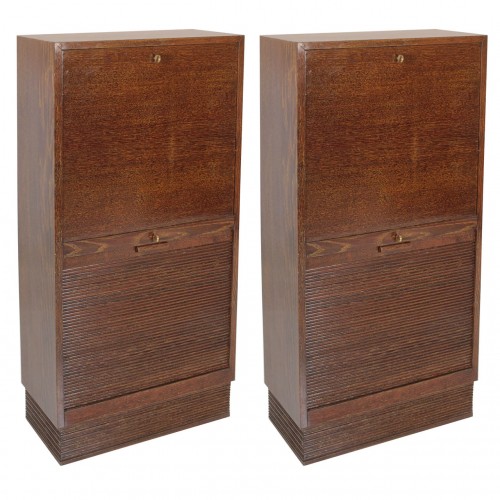
Pierre-Emile Legrain (attr.) Pair of French Art Deco drop and roll front cabinets c. 1927
PIERRE-EMILE LEGRAIN attr. (1889-1929) France
Matching Cabinets (pair) c. 1927
Golden cerused oak, roll-front and drop front doors,
original brass keys, reeded base
Provenance: Felix Marcilhac, Paris
For more information on Legrain see: Pierre-Emile Legrain 1889-1929 (Paris: exh. cat. Galerie Jacques de Vos,1996); Union des Artistes Modernes, Arlette Barré-Despond (Paris: Editions du Regard, 1986) 119-120.
H: 50 1/2 ” x W: 23 1/2” x D: 11 1/2”
The Art Deco movement centered in early 20th-century Paris sought to bridge the transition from academic art and craftsmanship to modern art and industrial production. Regarded by some as one of its founders, Pierre-Emile Legrain (1889-1929) worked at a time of great ferment in art, as well as in society. Legrain’s curiosity and receptiveness to these changes led him to adapt forms, materials and techniques from other cultures.
Legrain created two distinct bodies of work: an assemblage of approximately 1,200 bookbinding designs and a much smaller production of furniture made for couturiers in the French fashion trade. Both artistic endeavors shared fine craftsmanship, masterful use of rare and expensive materials, unusual combinations of textures and surfaces, and spare, geometrical forms. Nearly all of his creations were one-of-a-kind.
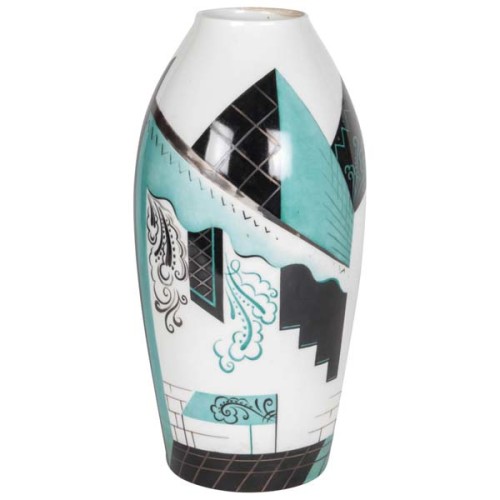
Lucien Lelong / French Art Deco Handpainted Porcelain Vase circa 1935
LUCIEN LELONG (1889 – 1958) Paris, France
“Metaphysical” vase c. 1935
Hand painted and glazed porcelain with aqua, black and silver tones.
Marks: LL monogram, AB
H: 13 3/4″
Lucien Lelong was born in Paris, France on October 11, 1889. Lucien learned his trade from his father, Arthur Lelong, who owned a textile factory in 1896, and his mother Eleanore, a dressmaker. He discovered his vocation in the family business and as soon as World War I was over, he expanded the family business by creating his own fashion house in the late 1918.
He became immediately famous due to the neat tailoring of his designs and his skill in choosing and manufacturing fabrics. He did not actually create his own designs but hired the most prominent designers of the moment to design his collections such as Christian Dior, Pierre Balmain and Hubert Givenchy. Lelong was one of the first designers to diversify into lingerie and stockings. He introduced a line of ready-to-wear in 1934 which he labeled “editions.” In 1939, Lelong’s collections showed tightly waisted, full skirts; a style which became the “new Look” in Dior’s collection in 1947. After the war, in 1947, Lelong showed pencil-slim dresses; pleated, tiered, harem hemlines; and suits with wasp waists, cutaway fronts and square shoulders.
After a trip to the United States where he learned everything pertaining to the working methods in the mass production of clothes, he returns to France and creates a line of pret-a-porter (ready-to-wear) collection, branded “LL” Edition. Lelong used his double” LL” logo to influence his designs as well as refining the packaging design of his perfumes and cosmetics. He was a master of the use of knits and bias to shape the body in the most complementary way. His house’s trademark was their unique ability in designing with fur.
He was married to Natalie Paley who was the daughter of the Grand Duke Paul of Russia that assisted him with his business. Lelong was an active member of high society; socialized with the women he dressed, and did not miss the opportunity to capitalize on his name. From 1937 until the end of the war in 1948, Lelong was President of the Chambre Syndicale de la Couture Parisienne, in which role he was able to fight and hinder the transfer of the Parisian fashion houses to Berlin during the German occupation. It was largely due to his efforts that ninety-two houses stayed opened during the war.
Poor health caused the end of his career; Lelong retired in 1952, and died in 1958 of a heart attack.


 @hd_jewels