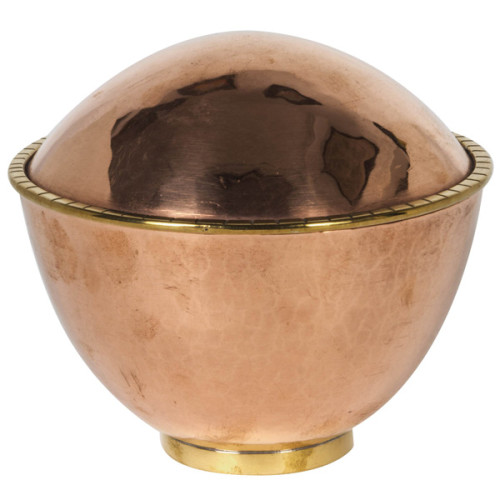
Hayno Focken / Modernist round covered copper box c. 1935
HAYNO FOCKEN (1905-1968) Germany
Round covered box c. 1935
Hand-wrought and hand-hammered copper with brass details
Marks under the foot: HF (conjoined monogram)
For other works by Hayno Focken see: Metallkunst: Vom Jugendstil zur Moderne (1889-1939), ed. Karl H. Bröhan (Berlin: Bröhan Museum, 1990), illus. 177, p. 183; Avantgarde Design 1880=1930,Torsten Bröhan & Thomas Berg (Köln, Benedict Taschen, 1994) p. 116; , (Berlin 1937) S. 43f, Abb. 37, Abb. S 128, S 146, Sl 243; Die Schaulade 15 Ausg. A (1939) Abb. S. 197, S. 204, S. 213; Die Schaulade 16 Ausg. A (1940) Abb. S. 44, S. 51., S. 54, S. 71, S. 83. S. 89; Die Kunst 84 (1941) S. 136, S. 139-39; Die Schaulade 17 (1941) Abb. S. 13, S. 41, S. 82, S. 229;
H: 4 ¼” x Dia: 4 7/8”
Hayno Focken (1905-1968) was an eminent German metal artist. He completed his training under Professor Karl Müller (1888-1972) at the design and arts school on Giebichenstein Castle in Halle (Saale), which was strongly tied to the ideals of the Deutsche Werkbund and the Bauhaus. In 1932 he established his own workshop in Lahr/Schwarzwald and continued his work until shortly before his death. His artistic work always stood out with a strong preference for large, organic forms, a similar manner of surface design and the same adherence to the principle of handicraft. Even his artist signet was modelled on the simple, square castle mark. In the 1950s he became one of those significant artists who had a major impact on contemporary metal design. The foundation of his creative work was a masterful understanding of proportions.
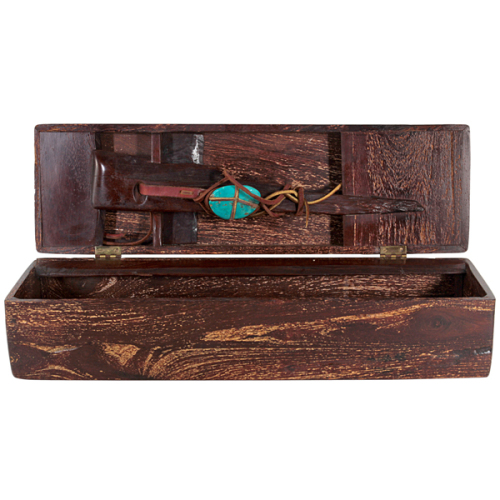
Jan de Swart hand carved Zebra wood Mystery box c. 1970
JAN DE SWART (1908-1987) Netherlands / USA
Mystery box c. 1970
Hand carved and assembled box form with a curiosity element of a large turquoise cabochon with raw hide wraps underneath the lid.
For more information see: Jan de Swart: A Day That Becomes a Lifetime, exhibition catalogue (California: Fine Arts Gallery at the San Fernando Valley State College, February 1972); Jan de Swart, Mike McGee and William G. Otton (Laguna Beach, California: Laguna Art Museum, 1986).
W: 16 1/2″ x H: 4 1/2″ x D: 5″
Price: $4,700
Constantly seeking and inventing new materials Jan de Swart was a true modernist. He was influenced by artists such as Isamu Noguchi, Harry Bertoia, Charles Eames, and later Sam Maloof and Wendell Castle. Although he had been creating small sculptures since his arrival in California from Holland in 1929, he had not been widely recognized until being introduced to John Entenza, publisher of Arts & Architecture magazine in 1947. Soon thereafter, he was able to create larger works and began collaborating with architects such as Whitney Smith and Victor Gruen on special commissions. His work is in the permanent collection of Los Angeles County Museum of Art, The Smithsonian, and the Ford Foundation. He was honored with the American Institute of Architects Gold Medal for Sculpture in 1965.
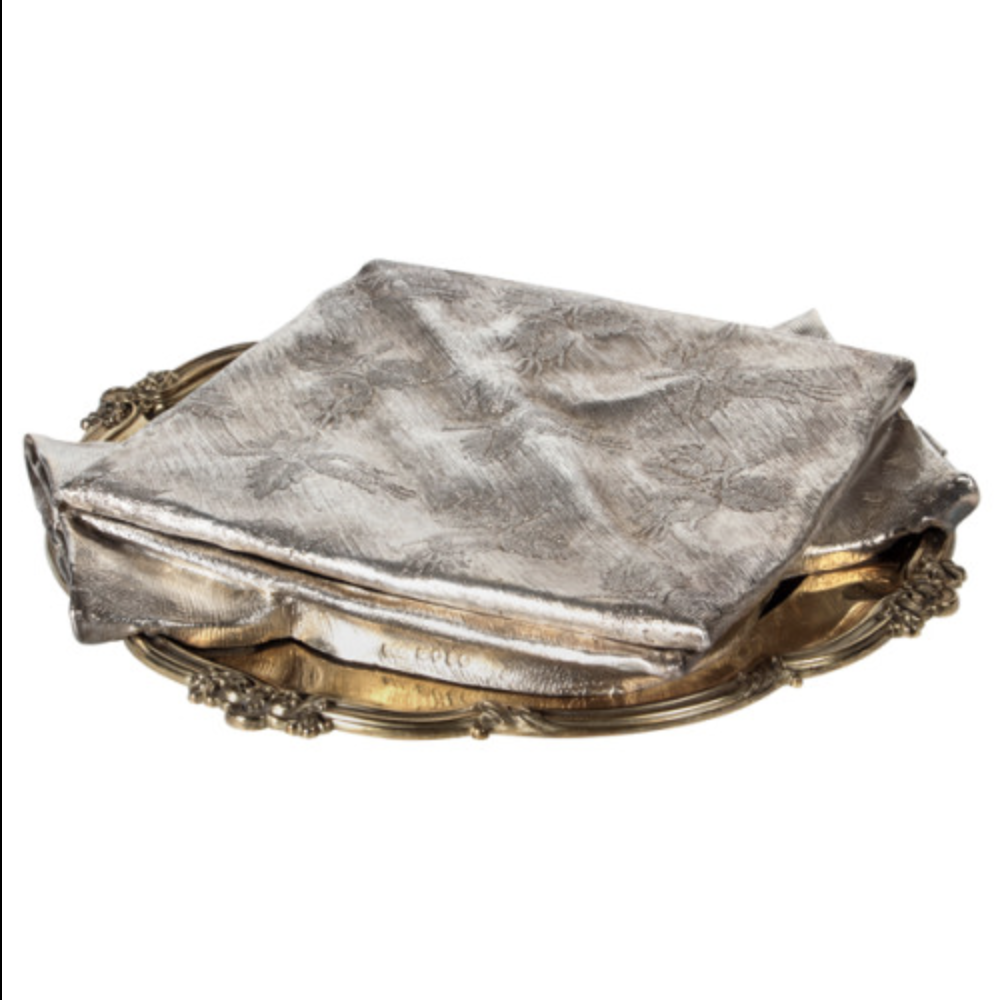
George Richards Elkington British Sterling Trompe L’Oeil Covered Box 1854
George Richards Elkington (1801-1865)
Trompe L’Oeil Box 1854
Sterling silver shallow box with a hinged lid of a life-size trompe l’oeil damask napkin neatly folded on a gilt-sterling Georgian dinner plate
Weight: 45 troy ounces
Marks: GRE makers mark, London hallmarks for 1854
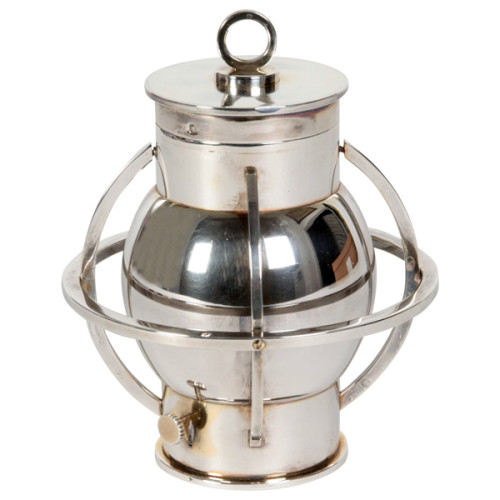
Mellerio Paris Rare French Art Deco “Gyroscope” sterling cigarette box c.1930
MELLERIO PARIS Italy/ France
Gyroscope cigarette box c.1930
French silver (950 silver standard) in a structural form of a gyroscope with a lever for an interior lifting mechanism, gilding
Marks: Mellerio Paris, 3776 D, head of Minerva French guarantee mark for 950/1000
H: 5 1/4″ x Dia: 4 1/4″
The renowned Mellerio family and their jewelry can be traced back to Lombardy, Italy as early as the 16th century. Some family members moved to Paris and became royal jewelers for Louis XIII. The revolutions of 1789 and 1848 interrupted their business and they moved to Madrid where they became the jewelers favored by Queen Isabel II. Later in the 19th century they returned to Paris where once again they prospered and participated in several international expositions including London (1862), Paris (1867, 1878 and 1900), and Vienna (1873). In the 20th century they exhibited at the renowned Paris 1925 Exposition des Arts Décoratifs in Paris and then in New York at the 1939 World’s Fair.


 @hd_jewels