Tiffany & Co. / Art Nouveau "Frog on a lily pad" covered snuff box 1880
More Information
Tiffany & Co. / Art Nouveau “Frog on a lily pad” covered snuff box 1880
TIFFANY & CO. New York, NY
“Frog on a lily pad” cigarette case 1880
Hand wrought sterling silver with repoussé and chased gold design of a frog sitting on a lily pad with a dragonfly in it’s mouth, “lap over edge” and hand hammered details, gilt interior and spring action to the hinge when the sides are pressed
Tiffany Archive Illustration: Design for Cigarette Case No. 5804, No. 1019, 249, stamped Tiffany & Co. New York, February 26, 1880
Model and Archive illustration: Bejewelled by Tiffany 1837-1987 Clare Phillips (New Haven and London: Yale University Press, 2006)
For more information see: Tiffany Silver, Charles H. Carpenter, Jr. (New York: Dodd, Mead & Company, 1978); The Silver of Tiffany & Co., 1850-1987, Charles H. Carpenter, Jr. and Janet Zapata (Boston: Museum of Fine Arts, 1987).
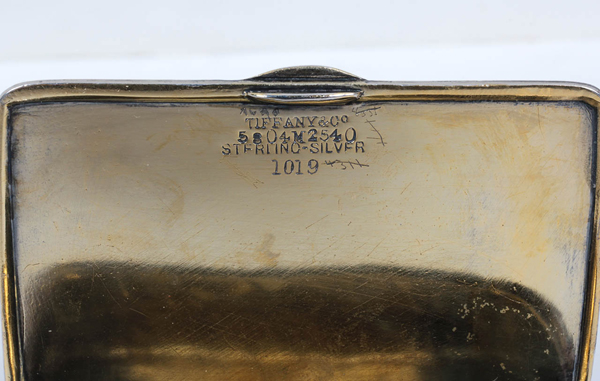
Marks: Tiffany & Co., 5804, M, 2540, Sterling-Silver, 1019
H: 3/4” x W: 2 7/8” x D: 2 1/8”
The Frog and the Dragonfly
from The Lost Lagoon
by Reg Down, 2010
Once upon a time a dragonfly lived beside a lake high in the mountains. He flitted from bulrush to bulrush – and zipped after mosquitoes. He snapped them out of the air so quickly that no one could ever quite see what he was doing.
One day, as he was flying across the water, his beautiful wings glistening like rainbows, he came across a frog.
“Ribbit!” said the frog. “Come here, Mr. Dragonfly. I would like to have a better look at you.”
But the dragonfly was clever. In fact, he was so clever that his eyes were made up of hundreds of eyes all put together on the top of his head. And each one of those eyes said to him: “That frog wants to eat me!”
So he landed on top of a bulrush where the frog could not get him, and said, “Yes, Mr. Frog, I am close enough for you. What do you want?”
“Ribbit! Ribbit!” croaked the frog, “I think you should come closer because my eyes are not very good.”
So the dragonfly came a little closer. He flitted to a flower floating on the water—but still not close enough for the frog to grab him with his mouth.
“Yes, Mr. Frog, what do you want?” he asked.
“Oh, Mr. Dragonfly,” said the frog, “I have an itch on the end of my nose and my legs aren”t long enough to reach it. But your legs are scratchy—they will be able to scratch my itchiness much better that I ever could.”
The dragonfly found this quite funny. He thought, “That frog wants to eat me! I am sure that frog wants to eat me!” So he flew behind the frog and landed on his back.
The frog could feel the dragonfly crawling on his back, but he could not turn around to grab him. “Oh, Mr. Dragonfly,” he said, “you have to come closer to my nose. In fact, my lips are getting very itchy—please come closer.”
So the dragonfly went and sat between the frog”s eyes. Now the frog”s eyes were looking into the dragonfly”s eyes, and the frog saw that the dragonfly had far, far more eyes than he had. So he said, “Oh, Mr. Dragonfly, you are surely much, much more wise than I am. You have so many eyes that you can see the whole world!”
And the dragonfly replied, “Of course I can see the whole world! I have so many eyes that I am the wisest of all flies!”
“Well,” said the frog, “I have a little tickle in the bottom of my throat—what is happening there?”
And the dragonfly looked, and looked, and looked…….and Snap! the frog ate him up.
Bernhard Amster Austrian Silver “Winged Heart” Covered Box c.1910
BERNHARD AMSTER (active Vienna early 20th century) Austria JEWELER, GOLDSMITH AND SILVERSMITH
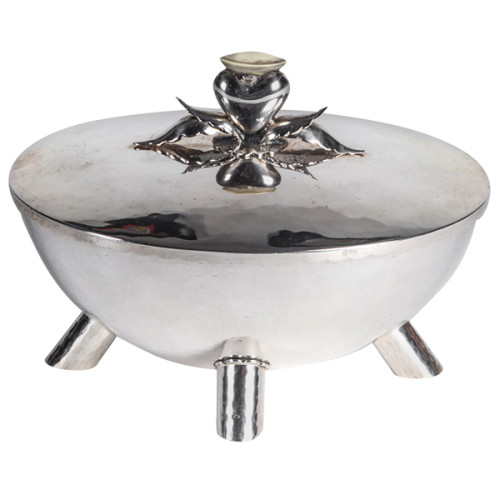
“Winged Heart” Covered Box c. 1910
Handwrought and hand-hammered silver in a half oval form on four cylindrical feet with heart-shaped finial inset with bone and stylized silver feathers
Marked: BA (in a rectangle 2x), Austrian touchmark for 800 silver (in a pentagon 2x)
For more information see: Blühender Jugendstil – Österreich (Art Nouveau in Blossom – Austria), Firmen und Marken (Companies and Marks), Waltraud Neuwirth, II (Vienna: Selbstverlag Neuwirth, 1991)
George Richards Elkington British Sterling Trompe L’Oeil Covered Box 1854
George Richards Elkington (1801-1865)
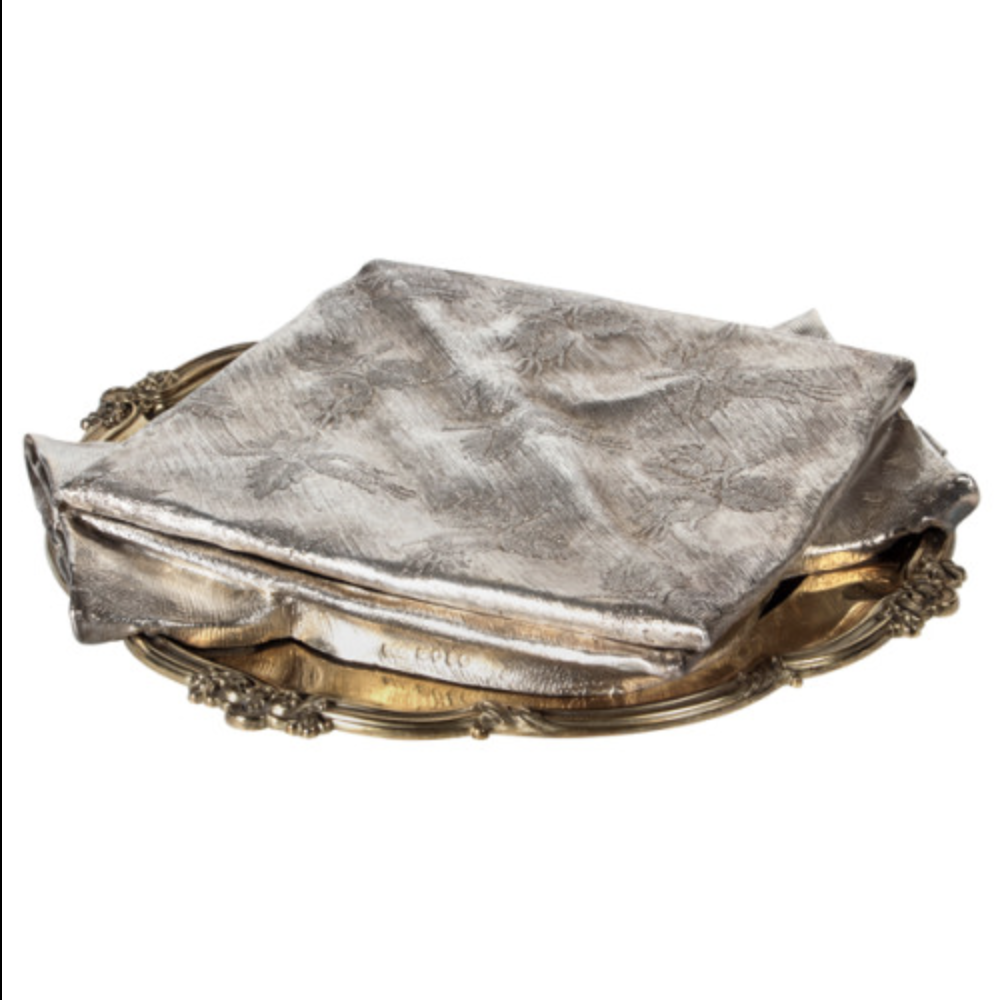
Trompe L’Oeil Box 1854
Sterling silver shallow box with a hinged lid of a life-size trompe l’oeil damask napkin neatly folded on a gilt-sterling Georgian dinner plate
Weight: 45 troy ounces
Marks: GRE makers mark, London hallmarks for 1854






 @hd_jewels