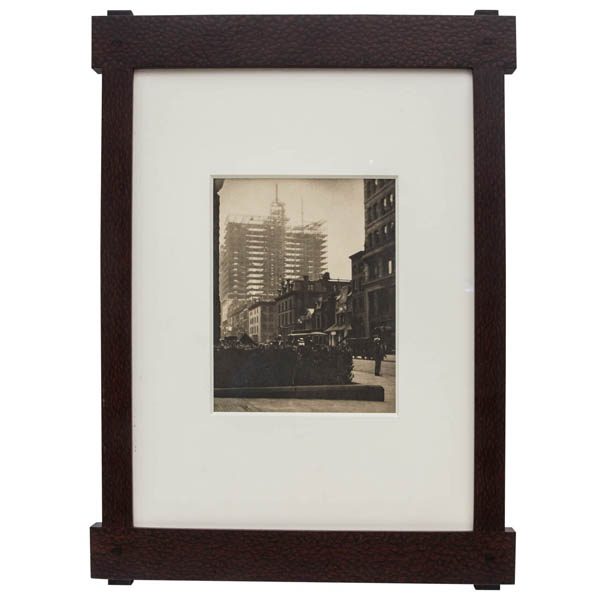
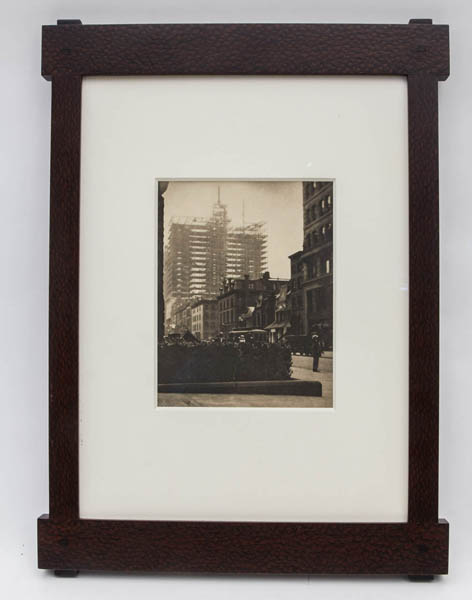
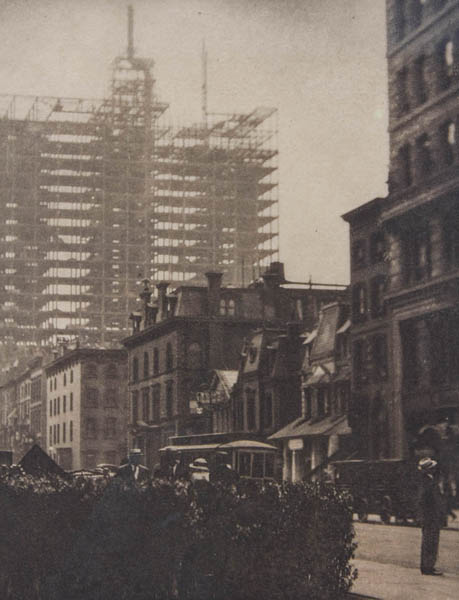
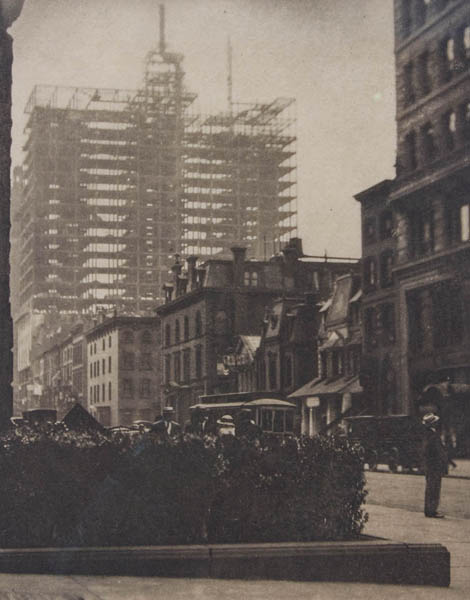
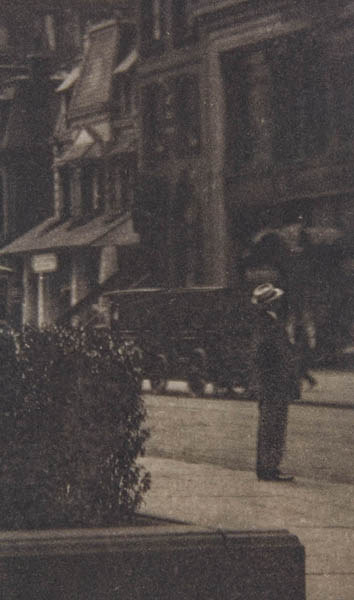
Alfred Stieglitz, Old & New, New York, Photogravure from Camera Work 1910
More Information
Alfred Stieglitz, Old & New, New York, Photogravure from Camera Work 1910
ALFRED STIEGLITZ (1864-1946) USA
Old & New, New York 1910
Photogravure from Camera Work, Oak frame in the Arts & Crafts style
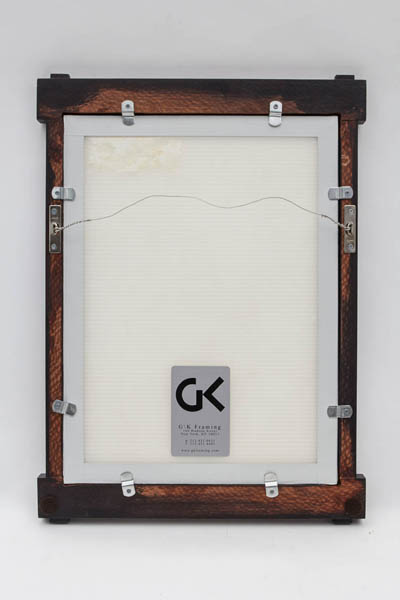
Signed: Alfred Stieglitz Old & New, New York, RMG #1081.30 (all in pencil on back)
Image: H: 8” x W: 6 1/4”
Page size: H: 11” x W: 7 7/8”
Framed: H: 15 ¼” x 11 ¼”
Price: $18,500
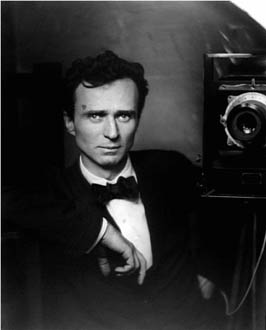
Alfred Stieglitz was an American photographer who was instrumental over his fifty-year career in making photography an acceptable art form alongside painting and sculpture. Many of his photographs are known for appearing like those other art forms, and he is also known for his marriage to painter Georgia O’Keeffe, most famous for her large-scale paintings of flowers.
Stieglitz was born the eldest of six children in Hoboken, New Jersey and raised in a brownstone on Manhattan’s Upper East Side. His father moved with his family to Germany in 1881. The next year, Stieglitz began studying mechanical engineering at the Technische Hochschule in Berlin and soon switched to photography. Traveling through the European countryside with his camera, he took many photographs of peasants working on the Dutch seacoast and undisturbed nature within Germany’s Black Forest and won prizes and attention throughout Europe in the 1880s.
From 1893 to 1896, Stieglitz was editor of American Amateur Photographer magazine; however, his editorial style proved to be brusque, autocratic and alienating to many subscribers. After being forced to resign, Stieglitz turned to the New York Camera Club (which was later renamed The Camera Club of New York and is in existence to this day) and retooled its newsletter into a serious art periodical known as Camera Notes. He announced that every published image would be a picture, not a photograph – a statement that allowed Stieglitz to determine which was which.
Big camera clubs that were the vogue in America at the time did not satisfy him; in 1902 he organized an invitation-only group, which he dubbed the Photo-Secession, to force the art world to recognize photography “as a distinctive medium of individual expression.” Among its members were Edward Steichen, Gertrude Käsebier, Clarence H. White and Alvin Langdon Coburn. Also in 1902 he ceased being editor of Camera Notes and in 1903 started a new independent journal of his own, Camera Work. Photo-Secession held its own exhibitions and its work was published Camera Work, which became the pre-eminent quarterly photographic journal of its day, although in later years its popularity declined markedly and it ceased publication in 1917.
From 1905 to 1917, Stieglitz managed the Little Galleries of the Photo-Secession at 291 Fifth Avenue (which came to be known as 291). In 1910, Stieglitz was invited to organize a show at Buffalo’s Albright Art Gallery, which set attendance records. He was insistent that “photographs look like photographs,” so that the medium of photography would be considered with its own aesthetic credo and so separate photography from other fine arts such as painting, thus defining photography as a fine art for the first time. This approach by Stieglitz to photography gained the term “straight photography” in contrast to other forms of photography such as “pictorial photography” which practiced manipulation of the image pre and/or post exposure.
In the 1930s, Stieglitz presided over two non-commercial New York City galleries, The Intimate Gallery and An American Place. It was at An American Place that he formed his friendship with the great 20th century photographer Ansel Adams. Adams displayed many prints in Stieglitz’s gallery, corresponded with him and also photographed Stieglitz on occasion. Stieglitz was a great philanthropist and sympathizer with his fellow human beings. He once received a phone call on one of Adams’s visits. A man wanted to show Stieglitz some work. He invited him over, looked at the prints, looked at the man in a rather disheveled state of affairs and looked at the work again. He then offered to buy one of the paintings, wrote him a check for $150, gave him five dollars and told him to get something good to eat.
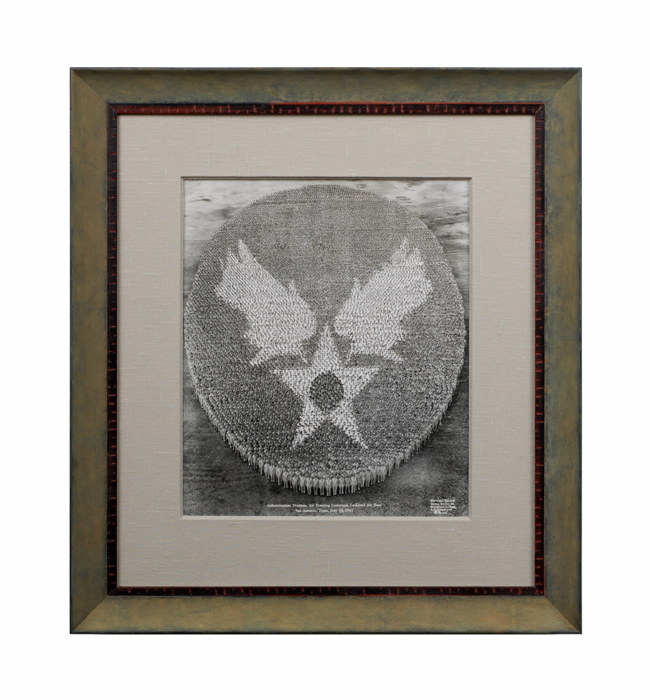
Size: H: 19” x W: 16 ½”; Size (with mat): H: 24” x W: 20”
Framed: H: 26 5/8” x W: 23 7/8”
Price: $6,500
Known as the “unofficial photographer of America’s military,” Goldbeck conducted three-year tours to all of the major military bases in and outside of the United States until demand diminished for military group photos after World War II. He pushed the limits of his craft by working with larger and larger groups in striking designs. For his record setting group shot, in which 21,765 men were arranged to represent the Air Force insignia, he spent more than six weeks building a 200-foot tower and making blueprints of the formation and attire of his subjects. The photograph was subsequently featured in Life magazine and became the most frequently reproduced of his prints.
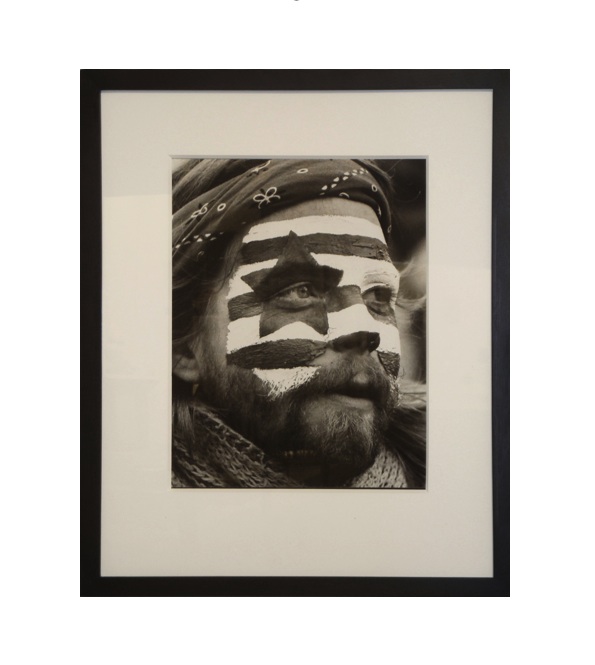
Barry L. Thumma, Face of America, Gelatin silver print 1980
BARRY L. THUMMA (1947-2003) USA
Face of America 1980
Gelatin silver print
Size: H: 13 3/8” x W: 11”
Size (with board): H: 14” x W: 11”
Size (framed): H: 21 ¼” x W: 17”
Price: $2,750
Barry L. Thumma, a former New Era photographer, covered four presidents as White House photographer for The Associated Press. In his 20-year career with the AP, he traveled on more than 100 Air Force One flights to photograph presidents Jimmy Carter, Ronald Reagan, George H.W. Bush and Bill Clinton. He also photographed Pope John Paul II, Jerry Falwell, Mikhail Gorbachev, Michael Deaver, Alan Greenspan and Donald Rumsfeld, among other personalities and politicians of his time. He was a member of the White House News Photographers Association. Thumma began his career in 1967 as a part-time photographer for the Lancaster New Era. He joined the Associated Press in 1973 in Cincinnati, where he covered the Reds and the Bengals. After two years as the Ohio photo editor, Thumma moved to Washington, D.C. to cover the White House. He also captured heartbreaking images of the famine in Ethiopia, NASA space flight operations and troop actions in the field.
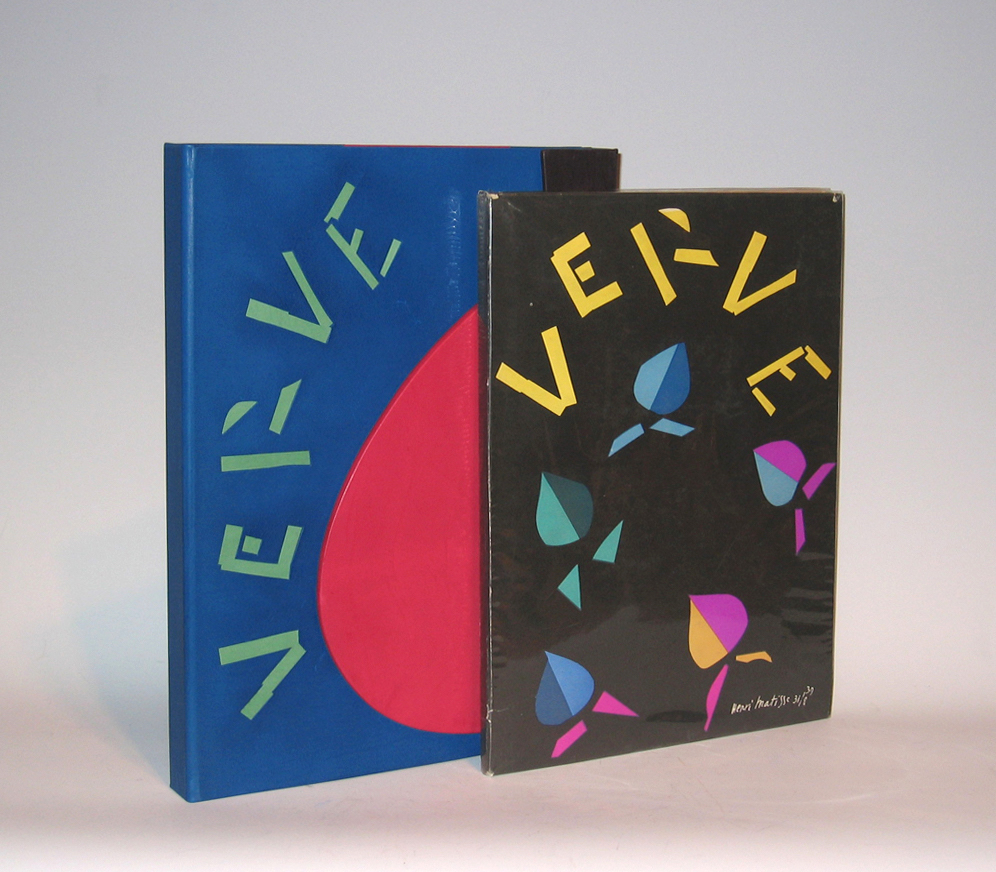
HENRI MATISSE (1869-1954) France
“Verve” Vol. II No. 8 1939
Revue artistique et littéraire paraissant quatre fois par an
Published by E. Tériade, 4, Rue Férou (VI) Paris
Dimensions:
Book: H: 14 1/4” x W: 10 3/16”
Custom leather box: H: 15 5/16” x W: 11 1/2” x D: 1 5/8”
Custom linen case: H: 16 1/2” x W: 12 1/4” x D: 2 3/8”
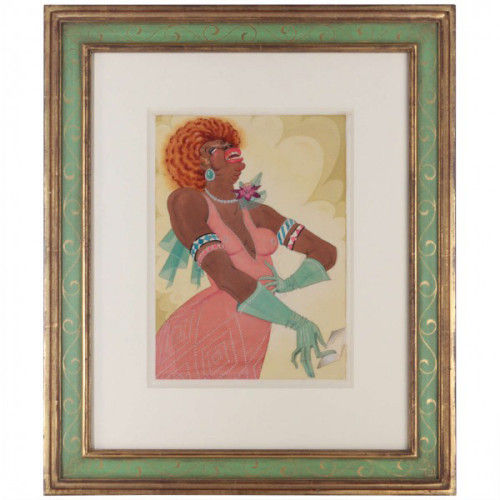
S O G A T A New York, NY “Harlem: Cabaret” Watercolor and pencil on paper 1931
S O G A T A New York, NY
“Harlem: Cabaret” 1931
Watercolor and pencil on paper
Signed: SOGATA, HARLEM · 31(painted, lower right corner of image); HARLEM: CABARET. (in pencil beneath image on left)
For contextual history and similar art see: Rhapsodies in black : art of the Harlem Renaissance,(Berkeley: University of California Press, 1997); Harlem Renaissance Artists. Jordan, Denise (Chicago: Heinemann Library, 2003).
Image H: 11″ x W: 7 3/4″
Frame H: 19 1/4” x W: 16”
*This SOGATA New York Watercolor and pencil on paper has been gifted to The Wolfsonian – FIU, Miami Beach, FL.


 @hd_jewels
Reviews
There are no reviews yet, would you like to submit yours?