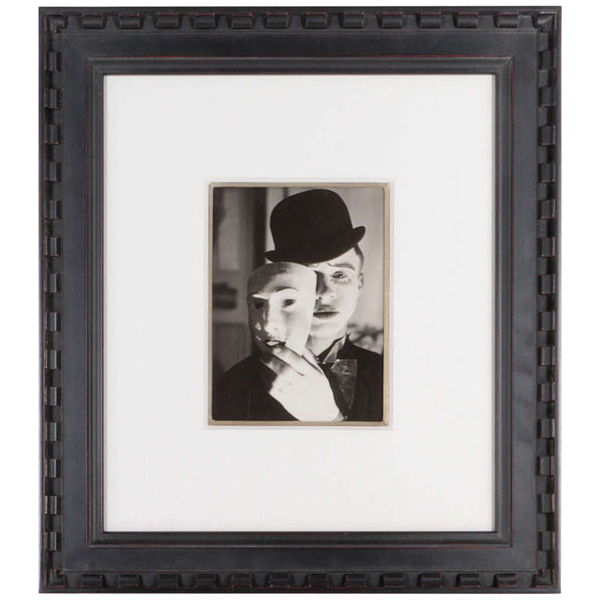
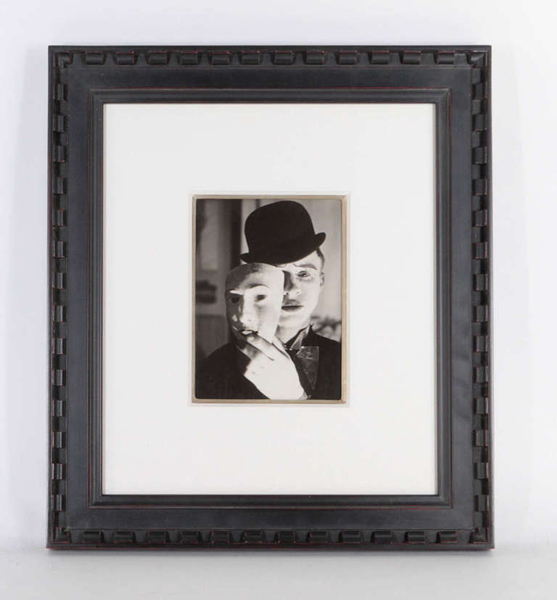
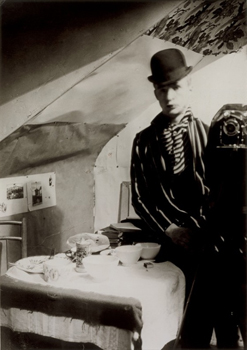
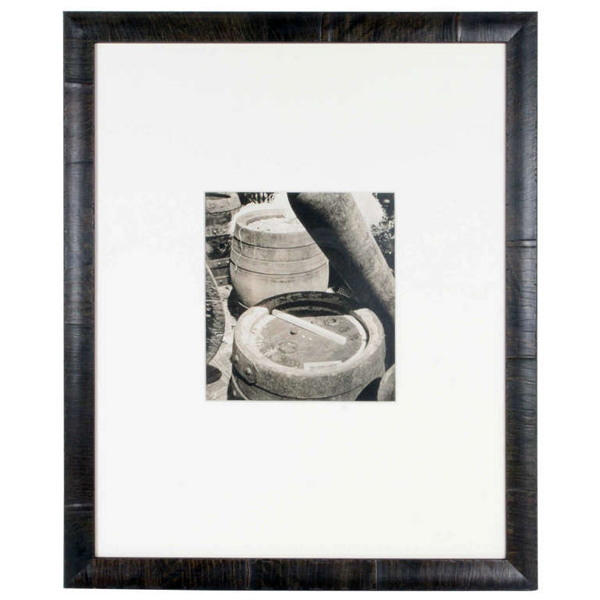
Werner Rohde, Self-portrait, Silver gelatin print 1926
WERNER ROHDE (1906-1990) Germany
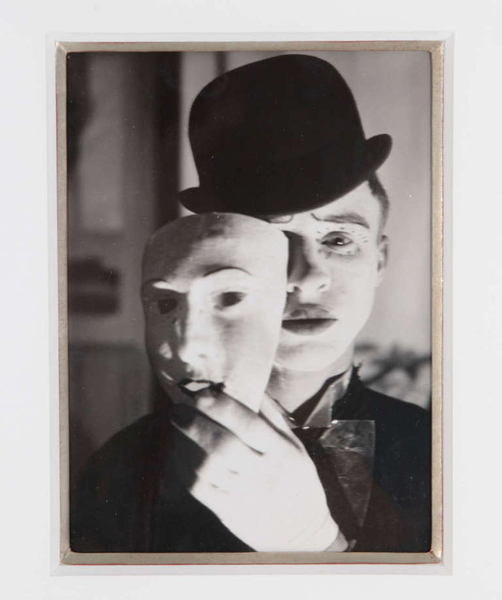
Self-portrait 1926
Silver gelatin print, ebonized wood frame
Signed: Werner Rohde 1926 (pencil signature and date on back on photo); inv. 3RMG 1081.27
Photo: H: 6 13/16” x W: 4 15/16”
Framed: H: 16 5/16” x W: 14 3/8”
Price: $38,000
Werner Rohde’s visual play with the animate and inanimate draws him close to the aesthetics of the surrealists while maintaining a strong alignment with Germany’s new-vision avant-garde. Rohde experimented widely with double exposures, photomontage, perspective and dramatic lighting that reflected his interest in filmic effects. The son of a glass painter (a medium he would turn to later in life), Rohde took up photography during his studies at the Arts and Craft School in Halle. Like Kesting, Willy Zielke and Kretschmer, he participated in the 1929 ‘Film und foto’ exhibition in Stuttgart that remains one of the historical focal points for Germany’s new photographic vision. Despite this early recognition of his work, Rohde fell into obscurity after the war until the rediscovery of his photographs in the mid 1970s.
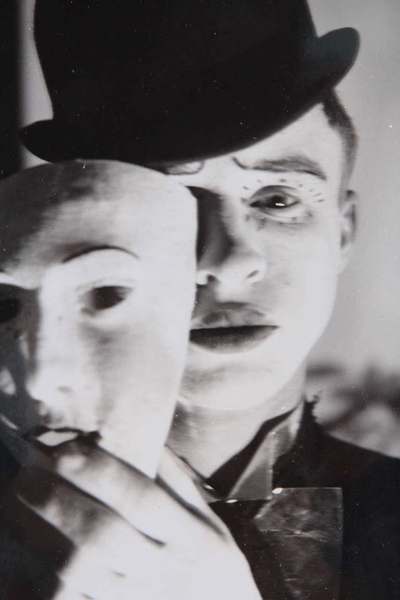
Rohde’s fascination with the play between life and lifeless, animate and inanimate, has strong reverberations with surrealism. Masks, mannequins and paper models were used in his photographs to illuminate the uncanny. They were also employed in his self-portraiture in which he mimicked his idol Charlie Chaplin. These techniques of visual illusion provided a mnemonic tool for the images of his wife in which she is posed and photographed to resemble a doll or mannequin. In the act of art imitating life, ‘Wachspuppenkopf’ is uncanny in its mimicry of the human form with realistic teeth, eyes, skin and even the unusual detail of small wrinkles under the eyes. The downward angle, lighting and odd doubling of the neckline utilizes standard surrealist methods to infer life and movement.
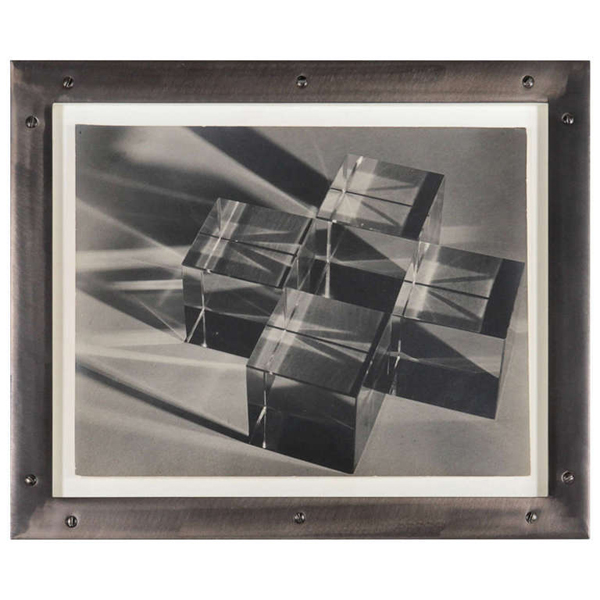
Carlotta Corpron, Light Cubes, Gelatin silver print c. 1947
CARLOTTA CORPRON (1901-1988) USA
Light Cubes c. 1947
Silver gelatin print, patinated steel frame
Signed: Carlotta M. Corpron, Denton, Texas, RM6 #1081.47 (stamped on back)
Framed size: H: 13 ¾” x W: 16 ¾”
Price: $40,000
Corpron became a teacher at Texas Woman’s University in 1935 and in 1942 she led a light workshop at Texas Woman’s University for photographer Laszlo Moholy-Nagy. Although he praised her rapport with her students, Moholy-Nagy did not encourage Corpron’s independent photography. More influential on her work was the arrival of Gyorgy Kepes, who came to Denton to write a book in 1944. His interest in Corpron’s work prompted her to produce several series of photographs that were the most original of her career. At his suggestion Corpron experimented by placing white paper cut in simple shapes within a perforated box that was open at one end. When flashlights were shined through the holes onto the paper shapes, interesting patterns of light and shadow were reflected. The resulting abstract photographs comprised Corpron’s “Light Patterns” series.
In her “Light Follows Form” series she extended her exploration of the modeling properties of light to three-dimensional form. In this series, she used light filtered through Venetian blinds or glass to dramatize a plaster cast of a Greek head. She also experimented with solarization, a process in which already exposed negatives are exposed. Works such as Solarized Calla Lilies (1948) convey a surreal elegance, but Corpron favored more original methods of expression. She regarded her “Space Compositions” and “Fluid Light Designs” series as her best work. In the former she used still-lifes composed of eggs, nautilus shells, or glass paperweights, usually combined with a curving reflective surface, to produce an illusion of receding three-dimensional space. She emphasized distortions of form that occurred in her egg photographs by experimentation during the development process. Her work is included in the collections of the Museum of Modern Art in New York City, the Art Institute of Chicago, the New Orleans Museum of Art, the Dallas Museum of Art, and the Amon Carter Museum in Fort Worth.
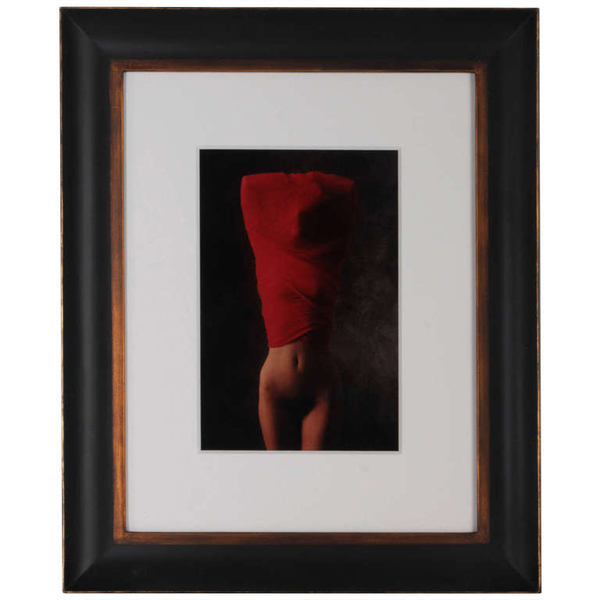
Christian Vogt has exhibited internationally at venues including The Photographer’s Gallery, (London), the ICP (New York), the Kunsthaus (Zürich), the Yajima Gallery (Montreal), the Tel Aviv Museum (Isreal), the Rencontres Internationales (Arles), the Centre Pompidou (Paris), the Galerie Watari (Tokyo), the Preuss Museum (Norway), the Edwynn Houk Gallery (Chicago), the CCD Galerie (Düsseldorf) and the Kunstmuseum (Hannover) among many others.
His photography is included in numerous important collections such as the Bibliotheque Nationale (Paris), the Swiss Foundation for Photography (Winterthur), the Musée de l’Elysee (Lausanne), the Modern Museet (Stockholm), the Tel Aviv Museum (Tel Aviv) and the Polaroid Collection (Cambridge, USA). He currently resides in Basel, Switzerland.
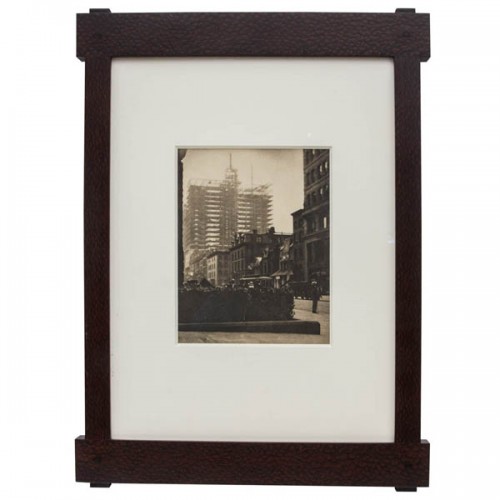
Alfred Stieglitz, Old & New, New York, Photogravure from Camera Work 1910
ALFRED STIEGLITZ (1864-1946) USA
Old & New, New York 1910
Photogravure from Camera Work, Oak frame in the Arts & Crafts style
Signed: Alfred Stieglitz Old & New, New York, RMG #1081.30 (all in pencil on back)
Image: H: 8” x W: 6 1/4”
Page size: H: 11” x W: 7 7/8”
Framed: H: 15 ¼” x 11 ¼”
Price: $18,500
Alfred Stieglitz was an American photographer who was instrumental over his fifty-year career in making photography an acceptable art form alongside painting and sculpture. Many of his photographs are known for appearing like those other art forms, and he is also known for his marriage to painter Georgia O’Keeffe, most famous for her large-scale paintings of flowers.
Stieglitz was born the eldest of six children in Hoboken, New Jersey and raised in a brownstone on Manhattan’s Upper East Side. His father moved with his family to Germany in 1881. The next year, Stieglitz began studying mechanical engineering at the Technische Hochschule in Berlin and soon switched to photography. Traveling through the European countryside with his camera, he took many photographs of peasants working on the Dutch seacoast and undisturbed nature within Germany’s Black Forest and won prizes and attention throughout Europe in the 1880s.
From 1893 to 1896, Stieglitz was editor of American Amateur Photographer magazine; however, his editorial style proved to be brusque, autocratic and alienating to many subscribers. After being forced to resign, Stieglitz turned to the New York Camera Club (which was later renamed The Camera Club of New York and is in existence to this day) and retooled its newsletter into a serious art periodical known as Camera Notes. He announced that every published image would be a picture, not a photograph – a statement that allowed Stieglitz to determine which was which.
Big camera clubs that were the vogue in America at the time did not satisfy him; in 1902 he organized an invitation-only group, which he dubbed the Photo-Secession, to force the art world to recognize photography “as a distinctive medium of individual expression.” Among its members were Edward Steichen, Gertrude Käsebier, Clarence H. White and Alvin Langdon Coburn. Also in 1902 he ceased being editor of Camera Notes and in 1903 started a new independent journal of his own, Camera Work. Photo-Secession held its own exhibitions and its work was published Camera Work, which became the pre-eminent quarterly photographic journal of its day, although in later years its popularity declined markedly and it ceased publication in 1917.
From 1905 to 1917, Stieglitz managed the Little Galleries of the Photo-Secession at 291 Fifth Avenue (which came to be known as 291). In 1910, Stieglitz was invited to organize a show at Buffalo’s Albright Art Gallery, which set attendance records. He was insistent that “photographs look like photographs,” so that the medium of photography would be considered with its own aesthetic credo and so separate photography from other fine arts such as painting, thus defining photography as a fine art for the first time. This approach by Stieglitz to photography gained the term “straight photography” in contrast to other forms of photography such as “pictorial photography” which practiced manipulation of the image pre and/or post exposure.
In the 1930s, Stieglitz presided over two non-commercial New York City galleries, The Intimate Gallery and An American Place. It was at An American Place that he formed his friendship with the great 20th century photographer Ansel Adams. Adams displayed many prints in Stieglitz’s gallery, corresponded with him and also photographed Stieglitz on occasion. Stieglitz was a great philanthropist and sympathizer with his fellow human beings. He once received a phone call on one of Adams’s visits. A man wanted to show Stieglitz some work. He invited him over, looked at the prints, looked at the man in a rather disheveled state of affairs and looked at the work again. He then offered to buy one of the paintings, wrote him a check for $150, gave him five dollars and told him to get something good to eat.
Donald Deskey was a native of Blue Earth, Minnesota. He studied architecture at the University of California, but did not follow that profession, becoming instead an artist and a pioneer in the field of Industrial design. In Paris he attended the 1925 Exposition Internationale des Arts Décoratifs et Industriels Modernes, which influenced his approach to design. He established a design consulting firm in New York City, and later the firm of Deskey-Vollmer (in partnership with Phillip Vollmer) which specialized in furniture and textile design. His designs in this era progressed from Art Deco to Streamline Moderne.
He first gained note as a designer when he created window displays for the Franklin Simon Department Store in Manhattan in 1926. In the 1930's, he won the competition to design the interiors for Radio City Music Hall. In the 1940's he started the graphic design firm Donald Deskey Associates and made some of the most recognizable icons of the day. He designed the Crest toothpaste packaging, as well as the Tide bullseye. His company is still in operation in Cincinnati. A collection of his work is held by the Cooper-Hewitt, National Design Museum. He is regarded the American pioneer of industrial design, and contemporary American graphic design.


 @hd_jewels
Reviews
There are no reviews yet, would you like to submit yours?