Product Description
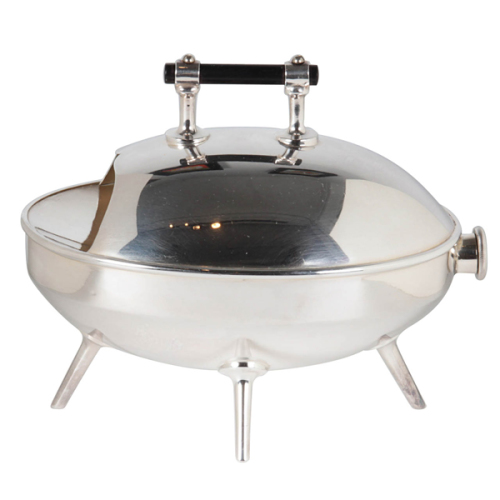
Christopher Dresser / Hukin & Heath Aesthetic Movement “Adjustable” Toast or Letter Rack 1881

CHRISTOPHER DRESSER (1834-1904) UK
HUKIN & HEATH Birmingham, England
Adjustable toast or letter rack 1881
Silver-plate (articulated model)
Marks: H&H, 2555, stylized fleur-de-lis touch mark
Illustrated: Truth, Beauty, Power: Dr. Christopher Dresser 1834-1904, exhibition catalogue Historical Design, Inc. (New York, 1998) p. 21.
H: 5″ x W: 6 1/2″ x D: 4″
There is another model of this toast /letter rack in the collection of the British Museum, London, as well as the Metropolitan Museum of Art, New York.
Christopher Dresser / Hukin & Heath Aesthetic Movement “Adjustable” Toast or Letter Rack 1881
You must be logged in to post a comment.
THOMAS JEKYLL (attr.) (1827–1881)
BRITISH AESTHETIC MOVEMENT
Umbrella stand c. 1885
Black nickelled and patinated cast and wrought iron,
sunburst detail and decorative fretwork
H: 25 1/4” x W: 13” x D: 9 1/2”
Base W: 9 1/2”
Although he was a successful architect, Jeckyll is best known today for his “epoch-making” designs in metalwork. His architectural practice routinely included the design of gates, railings, and metal fittings for domestic commissions and of coronas, candelabra, and altar rails for ecclesiastical ones. But it was his exhibition pieces for the ironworks firm of Barnard, Bishop & Barnards of Norwich that brought him his greatest renown. His “Norwich Gates” for the 1862 London International Exhibition set in motion the 19th-century wrought iron revival in Great Britain. Subsequent creations, including his “Four Seasons Gates,” exhibited in Paris in 1867 and Vienna in 1873, and his cast iron pavilion for the 1876 Philadelphia Centennial Exhibition, received substantial praise, in particular for their creative use of Asian principles and motifs. His innovative Anglo-Japanese designs for stoves, stove fronts, fenders, fire irons, and other domestic metalwork were also produced and sold in large numbers. As these designs were both artistic and affordable, they allowed the incorporation of objects of beauty into middle-class homes. He was one of the few figures in the design reform movement in Britain who managed to unite beauty and utility.
A very intricately worked late Victorian or Aesthetic Movement wrought and cast iron tall stand for umbrellas or canes with delicately riveted cross hatch fretwork and curling details and handle motif along with an attached iron base with a sunburst design all in the original black nickel finish.
CHRISTOPHER DRESSER (1834-1904) UK
LINTHORPE ART POTTERY, Middlesbrough, England
HENRY TOOTH Artistic Manager Linthorpe (1842-1918) UK
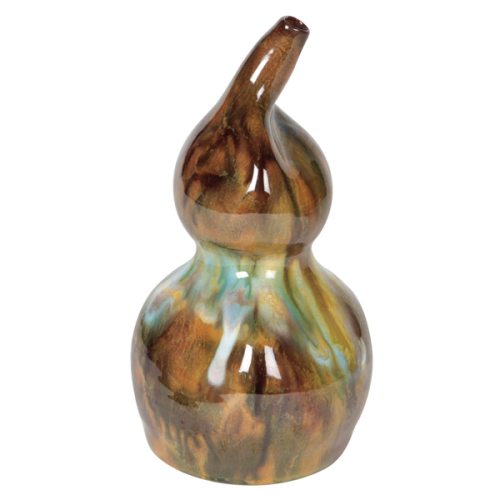
“Flaring Lip” Pitcher 1879-1882
Glazed earthenware
Marks: LINTHORPE, Chr. Dresser (facsimile signature),
HT, no. 346
Illustrated: Christopher Dresser, by Widar Halén (Oxford: Phaidon, 1990), illus. 185, p.163; Truth, Beauty, Power: Dr. Christopher Dresser 1834-1904, exhibition catalogue Historical Design, Inc. (New York, 1998) p. 76.
H: 9 3/4″
The contrasts in Dresser’s designs for different materials showed how his approach to design was also shaped by the properties and nature of a material. In 1879 Dresser was appointed art director at the newly established Linthorpe pottery, near Middlesbrough. Founded by John Harrison, a local businessman, the pottery’s aim was to use local clay to provide jobs for local men. Dresser’s design for the moulds for the pottery were inspired by a wide range of cultures from Japan, Peru, Mexico, Morocco and Ancient British forms. These very striking pieces, with the metal oxides in the complex and innovative glazes providing the only decoration. All of his designs were impressed with a facsimile signature. When Linthorpe closed in 1889, its moulds were acquired by a rival, Ault Pottery in Derbyshire. In 1893, Dresser signed a contract with Ault for new designs specifying that each pot should be marked with his facsimile signature.
CHRISTOPHER DRESSER (1834-1904) UK
JAMES DIXON & SONS Sheffield, England
“Gothic Arch” toast rack c.1881
Silver-plate
Marks: JD&S (stamped), EP, #72, “D”
Drawing illustrated: Christopher Dresser’s 1881 design and account book
For more information see: Truth, Beauty, Power: Dr. Christopher Dresser 1834-1904, exhib. cat. Historical Design, Inc. (New York, 1998); Charles Handley-Read, “High Victorian Design: An Illustrated Commentary” in ‘Design 1860-1960’ sixth conference report of the Victorian Society (London, 1968); Victorian and Edwardian Decorative Art: The Handley-Read Collection, ed. Simon Jervis (London: Diploma Galleries,1972); Christopher Dresser: pottery, glass, metalwork, (London: The Fine Arts Society Ltd., 1972); Isabelle Anscombe & Charlotte Gere, Arts & Crafts in Britain and America (New York: Rizzoli International Publications, Inc., 1978); Truth, Beauty and Design, Victorian, Edwardian and later Decorative Art (London: Fischer Fine Art Limited),; A Thing of Beauty: Art Nouveau, Art Deco, Arts & Crafts Movement and Aesthetic Movement Objects in Atlanta Collections (Atlanta, GA: The High Museum of Art, 1980), cat. no. M2; Widar Halén, Christopher Dresser (Oxford: Phaidon, 1990),; Judy Rudoe, Decorative Arts 1850-1950: A Catalogue of the British Museum Collection (London: Trustees of the British Museum, 1991),; Gerda Breuer, Von Morris bis Mackintosh – Reformbewegung zwischen Kunstgewerbe und Sozialutopie, Arts and Crafts (Darmstadt: Institut Mathildenhöhe, 1994/95); “The Silver Designs of Dr. Christopher Dresser,” Shirley Bury, Apollo (December, 1962)
H: 6″ x D: 4 1/8″ x W: 4 5/8″
CHRISTOPHER DRESSER (1834-1904) UK
JAMES COUPER & SONS Glasgow, Scotland
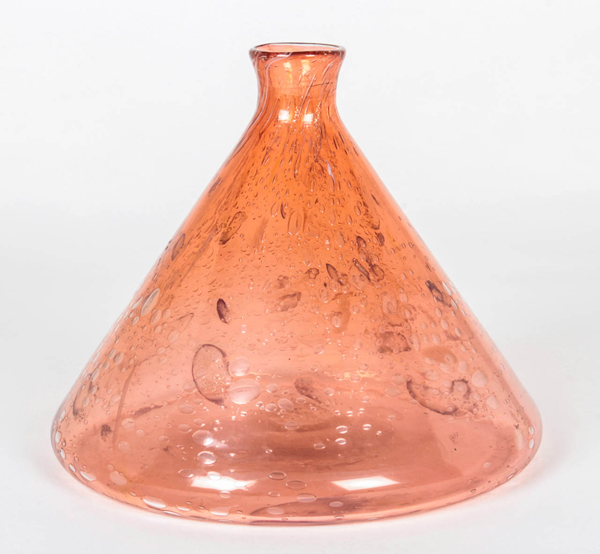
“Clutha” pitcher c. 1895
Aventurine blown glass with iridescent gold streaks and internal bubbles
Illustrated: “Liberty & Co.” Yuletide Gifts catalogue, 1895, “Clutha” Glass; Truth, Beauty, Power: Dr. Christopher Dresser 1834-1904, exhib. cat. Historical Design, Inc. (New York, 1998) p. 72
H: 8 1/2” x 6 1/2”
Reviews
There are no reviews yet, would you like to submit yours?