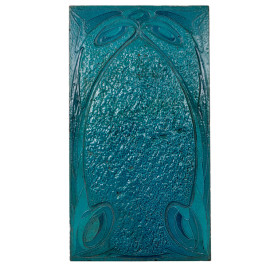
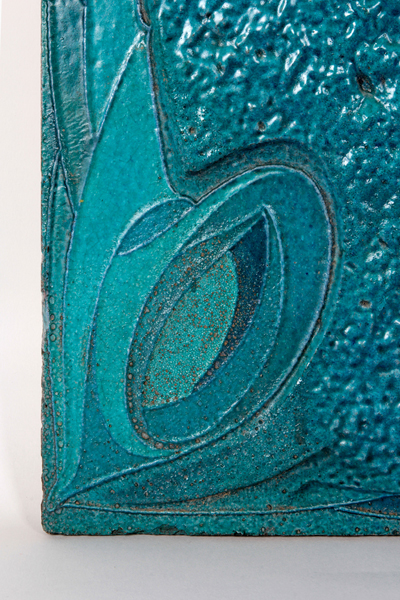
Hector Guimard for Maison Coilliot / Art Nouveau glazed lava tile 1898
More Information
Hector Guimard for Maison Coilliot / Art Nouveau glazed lava tile 1898
HECTOR GUIMARD (1867-1942) France
MAISON COILLIOT Lille, France
Tile c. 1898
Fired and glazed lava with abstract whiplash motifs in various tones of aqua blue on the obverse and a partial graphic on the reverse with polychrome floral and linear details.
Marks: 16 (on top of tile)
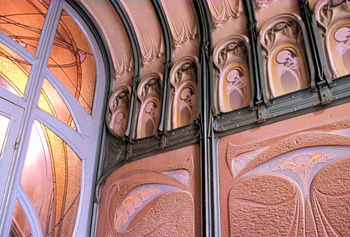
French architect Hector Guimard (1867-1942) realized the decorative possibilities of glazed lava, a substance made from mixing pulverized lava with clay when he built a villa for Louis Coillot, (1898-1900) a ceramics manufacturer in Lille who monopolized the distribution of the material. Guimard sided the entire facade of Maison Coilliot in lava stone.
***A related glazed lava tile from the Castel Henriette is in the Collection of the Musee d’Orsay.
The Maison Coilliot is an Art Nouveau house located on 14, rue de Fleurus in Lille, France. Louis Coilliot, a French ceramic entrepreneur, was fond of enameled lava and wanted to popularize the technique. To do so, Coilliot commissioned Hector Guimard, an architect he’d met at the 1897 fair La Céramique et tous les arts du feu, (“Ceramic Arts & Glass Making”), to apply the technique to his house’s façade. Coilliot’s factory and warehouse were located to the rear of his house, and therefore the façade held a double
purpose, both decorating the front of his home and advertising his business.
For more information see: Hector Guimard, 1867-1942: Architektur in Paris um 1900 (Munich: Museum Villa Stuck, 1975)
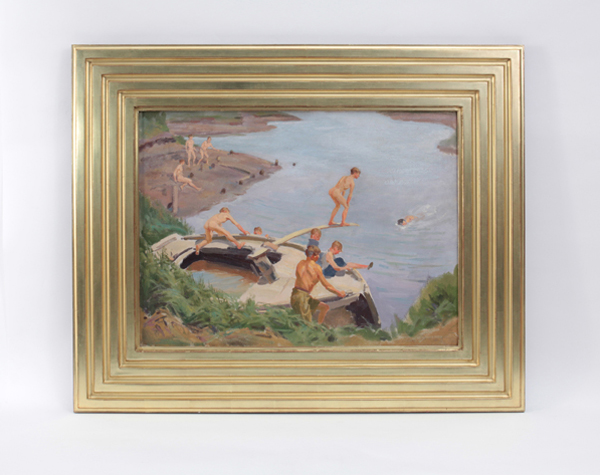
Edmund F. Ward “The Swimming Hole” Oil on canvas c. 1930
EDMUND F. WARD (b. 1892 – 1991) USA
“The Swimming Hole” c. 1930
Oil on canvas
Marks: signed Edm. F. Ward (lower right); partial labels verso:Westchester Arts and Crafts Guild; 4 Edmund F. Ward
For more information on the artist see: Who Was Who in American Art,Peter Hastings Falk, ed. (Madison, Conn.: Sound View Press, 1985), p. 658.
Canvas H: 18” x W: 24”
Framed H: 27 9/16” x W: 33 9/16”
Price: $14,000
Ward studied at the Arts Student’s League with Edward Dufner, George Bridgeman, and Thomas Fogarty. He was an illustrator for several national magazines and books. In 1925, Ward exhibited an award winning work at the Art Institute of Chicago. He is perhaps best known for his WPA mural in the Federal Building, White Plains, New York.
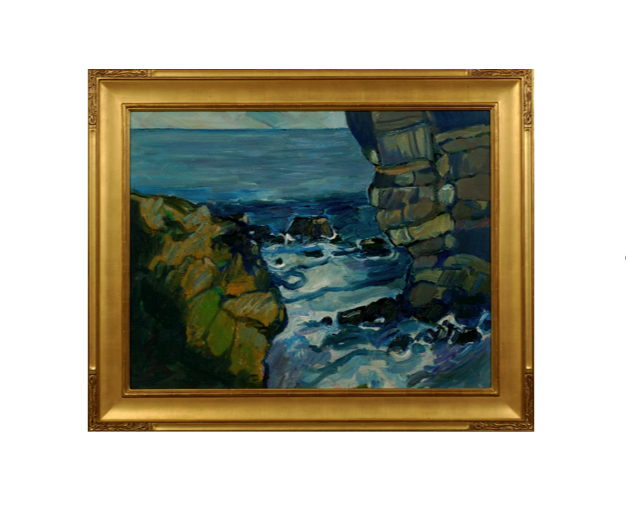
Peter Canty received his BA in art from the Chouniard Art Institute, Los Angeles (now California Institute of the Arts) and an MA from the University of California, Santa Cruz in 1969. Heavily influenced by the Post-Impressionist masters Van Gogh, Gauguin and Cezanne, in his own he words he describes his interest in landscapes, believing they are, “the best vehicle for motion, force, and color dynamics.” Although his work reference realistic subjects, Canty’s imagery is drawn strictly from his own imagination.
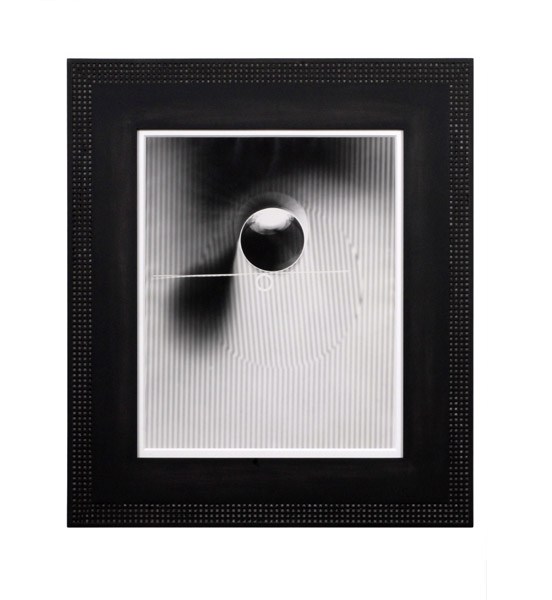
György Kepes, Abstraction, Gelatin silver print, 1942
GYÖRGY KEPES (1906-2001) Hungary/USA
Abstraction 1942
Silver gelatin print
Signed: 9 (in a circle, on back); Gyorgy Kepes 1942 (in ink on back)
György Kepes was a Hungarian-born painter, designer, educator and art theorist. After emigrating to the U.S. in 1937, he taught design at the New Bauhaus (later the School of Design, then Institute of Design, then Illinois Institute of Design or IIT) in Chicago. In 1947 He founded the Center for Advanced Visual Studies at the Massachusetts Institute of Technology (MIT) where he taught until his retirement in 1974.






 @hd_jewels