Michael Powolny / Wiener Werkstaette Vienna Secession "Schneckenreiter" c. 1910
More Information
Michael Powolny / Wiener Werkstaette Vienna Secession “Schneckenreiter” c. 1910
MICHAEL POWOLNY (1871-1954) Austria
BERTOLD LÖFFLER (1874-1960) Austria
VEREINIGTE WIENER UND GMUNDNER KERAMIK Vienna
Schneckenreiter c. 1910
Glazed white earthenware hand-painted with black enamel
Marks: conjoined WK (in a square), KG with flower (in a square), 81 (impressed)
***Extremely rare Powolny model in black and white.
Model illustrated: Michael Powolny: Keramik und Glas aus Wien 1900 bis 1950, Elisabeth Frottier (Vienna: Böhlau Verlag, 1990), p. 50, illus. 20, cat. no. WV43; Vienna 1900, Vienna, Scotland and the European Avant-Garde, Peter Vergo (Edinburgh, Scotland, 1983), p. 63, plate 19; “Austrian Architecture and Decoration,” The Studio Year Book of Decorative Art 1911 (London: The Studio, 1911), p. 233.
This model may also be found in the permanent collection of the Victoria & Albert Museum, London (Inventory number 604, 1966).
For more information see: The Fine Art of California Indian Basketry, Brian Bibby (Sacramento/Berkeley: Crocker Art Museum, Heyday Books, 1996), p. 90.
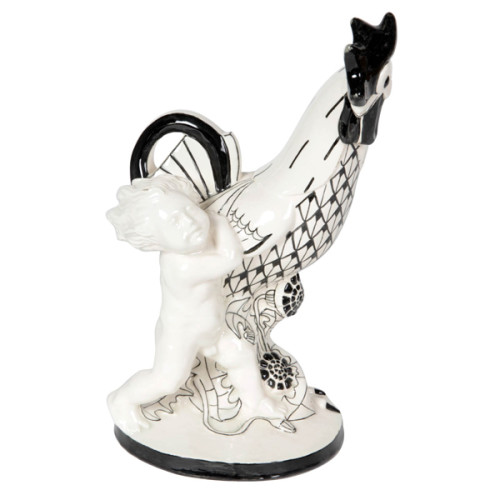
Michael Powolny / Wiener Keramik / Wiener Werkstaette / Vienna Secession “Putto mit Hahn” c. 1910
MICHAEL POWOLNY (1871-1954) Austria
BERTOLD LÖFFLER (1874-1960) Austria
WIENER KERAMIK Vienna
Putto mit Hahn c. 1910
Glazed white earthenware handpainted with black enamel
Marks: MP (impressed artist’s monogram), WK (impressed company logo in a square), original Wiener Keramik paper label
Exhibited: Frühjahrsausstellung Österreichischer Kunstgewerbe in Österreichisches Museum für Kunst und Industrie (MAK museum), Vienna, 1912.
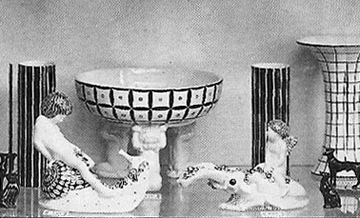
Model illustrated: Deutsche Kunst und Dekoration, Vol. XXXI, October 1912 – March 1913, n.p.; Michael Powolny: Keramik und Glas aus Wien 1900 bis 1950, Elisabeth Frottier (Vienna: Böhlau Verlag, 1990) 1912 photograph with the cock sculpture displayed in vitrine from Frühjahrsausstellung Österreichischer Kunstgewerbe, illus. 4, p. 15 and illus. 27, p. 54, cat. no. WV92.
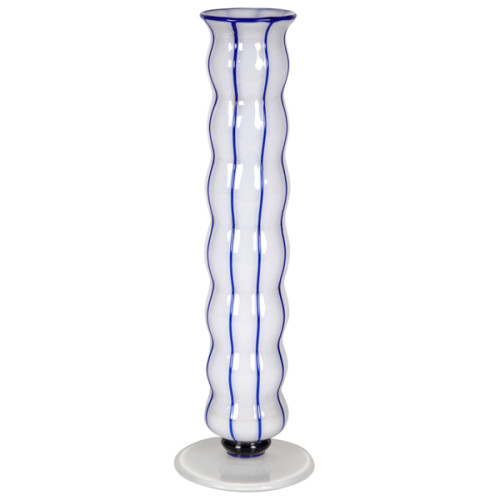
“Opal mit streifen” opaline blown glass with applied blue glass canes and blue knob above opaline base
Exhibited: 1914 Werkbundausstellung, Cologne (Lötz period photograph, vase for the 1914 Cologne Werkbund Exhibition) Lötz: Böhmisches Glas 1880-1940: Werkmonographie, Band 1, Helmut Ricke and Ernst Ploil (Munich: Prestal-Verlag, 1989), p. 267; Wiener Werkstätte Design in Vienna 1903-1932, Christian Brandstätter (New York:Verlag Harry Abrams, 2003) p. 247.
Form illustrated: Lötz: Böhmisches Glas 1880-1940: Werkmonographie, Band 1, Helmut Ricke and Ernst Ploil (Munich: Prestal-Verlag, 1989), p. 267
Same ”opal mit streifen” technique illustrated: Glaskunst der Moderne: von Josef Hoffmann bis Wilhelm Wagenfeld, Torsten Bröhan (Munich: Klinkhardt & Biermann, 1992), cat. no. 19, pp. 74-77.
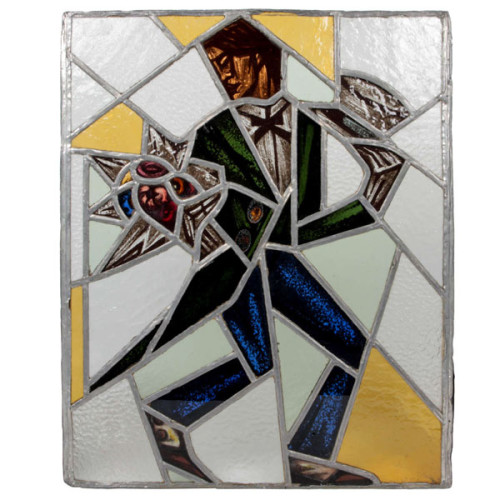
Reinhold Klaus / Carl Geyling Atelier Vienna “Cubist Man with top hat and flowers” stained glass window c. 1930
REINHOLD KLAUS (1881-1963) Vienna, Austria
CARL GEYLING ATELIER (founded 1841) Vienna, Austria
Man with tophat and flowers c. 1930
Window of stained and hand-painted leaded glass
Provenance: Estate of Carl Geyling (1814-1880), Vienna
H: 17 3/4″ x W: 14 1/2″
Reinhold Klaus studied from 1898-1902 with Alfred Roller at the Kaiserlich-Königliche Kunstgewerbeschule in Vienna. In 1914 Klaus married into the Carl Geyling family and became extensively involved with with stained glass painting. As early as 1918 Klaus worked on a stained glass window for the Siegestempel am Bisamberg in Vienna. In 1934 he became a professor of stained glass painting at the Kunstgewerbeschule, as well as creative director of the C. Geylings Erben glass painting company. Reinhold Klaus, a member of the Künstlerhaus since 1924 received many prizes and honors. He worked on commissions for the St. Veits cathedral in Prague, the St. Stephan cathedral in Vienna and many others.




 @hd_jewels