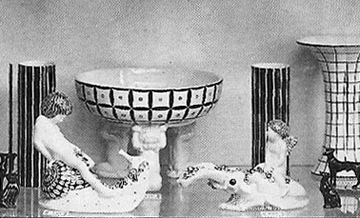
Michael Powolny / Wiener Werkstaette Vienna Secession "Schneckenreiter" c. 1910
More Information
Michael Powolny / Wiener Werkstaette Vienna Secession “Schneckenreiter” c. 1910
MICHAEL POWOLNY (1871-1954) Austria
BERTOLD LÖFFLER (1874-1960) Austria
VEREINIGTE WIENER UND GMUNDNER KERAMIK Vienna
Schneckenreiter c. 1910
Glazed white earthenware hand-painted with black enamel
Marks: conjoined WK (in a square), KG with flower (in a square), 81 (impressed)
***Extremely rare Powolny model in black and white.
Model illustrated: Michael Powolny: Keramik und Glas aus Wien 1900 bis 1950, Elisabeth Frottier (Vienna: Böhlau Verlag, 1990), p. 50, illus. 20, cat. no. WV43; Vienna 1900, Vienna, Scotland and the European Avant-Garde, Peter Vergo (Edinburgh, Scotland, 1983), p. 63, plate 19; “Austrian Architecture and Decoration,” The Studio Year Book of Decorative Art 1911 (London: The Studio, 1911), p. 233.
This model may also be found in the permanent collection of the Victoria & Albert Museum, London (Inventory number 604, 1966).
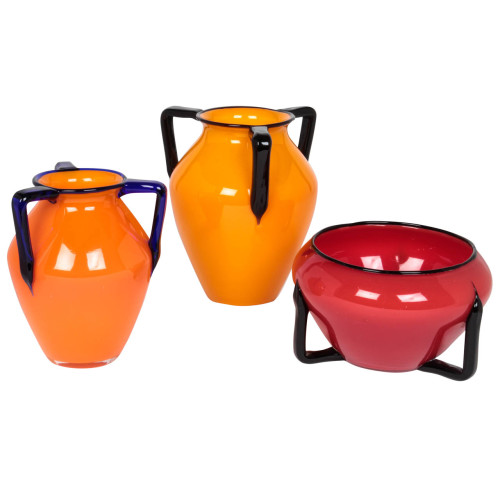
Michael Powolny / Lötz Witwe Glaswerks Jugendstil Set of Three “Tango” Glass Vases c. 1920
PROF. MICHAEL POWOLNY (1871-1954) Austria
LÖTZ WITWE GLASWERKS Klostermuhle
Set of three “Tango” glass vases c. 1920
Blown tall yellow glass with applied black handles, blown orange glass with applied cobalt blue handles, blown red glass with applied black handle-form feet
Marks: Cecho. Slovakia (acid etched in an oval) (red vase)
Yellow and black vase H: 6 1/2” x Dia: 6″
Orange and cobalt blue vase H: 5 1/2” x Dia: 6″
Red and black vase H: 3 1/2” x Dia: 6″
For more information see: Lötz: Böhmisches Glas 1880-1940, Band 1, Helmut Ricke and Ernst Ploil, (Munich: Prestel-Verlag, 1989) ; Glass of the Avant-Garde, From Vienna Secession to Bauhaus, The Torsten Bröhan Collection from the Museo Nacional de Artes Decorativas, Madrid, Torsten Bröhan, Martin Eidelberg (Munich, London, New York: Prestel Verlag, 2001).
Other Powolny works: Jugendstil Art Nouveau: floral und functional forms, Siegfried Wichmann (New York / Boston: Graphic Society, Little, Brown and Co., 1984), p. 226; Vienna 1900-1930: Art in the Home, Historical Design exhibition catalogue (New York: Historical Design, Inc., 1996), p. 45; Modernism:Modernist Design 1880-1940, The Norwest Collection, Norwest Corporation, Minneapolis, Alastair Duncan (Woodbridge, Suffolk, England: The Antique Collector’s Club, 1998).
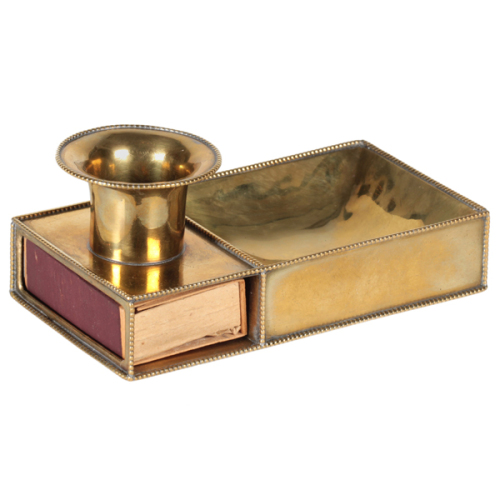
Josef Hoffmann / Wiener Werkstätte Brass Candleholder and Match Safe 1906
JOSEF HOFFMANN (1870-1956) Austria
WIENER WERKSTÄTTE (1903-1932) Vienna
Candlestick holder and match safe 1906
Hand wrought brass with beading around the perimeter of the edges
Marks: JH monogram, WIENER/WERK/STÄTTE, rosemark
Model illustrated: Österreichische Werkkultur, Max Eisler (Vienna: Österreichischer Werkbund, 1916). (slipcovered); Wiener Werkstätte G. M. B. H. catalog (December 1923), p. 114
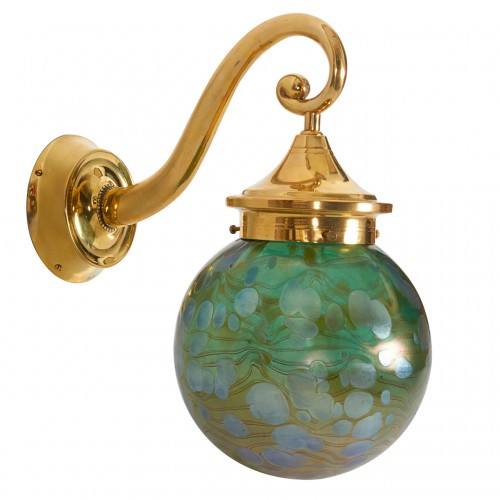
Josef Hoffmann / Wiener Werkstätte / Loetz globe Vienna Secession sonce c.1915
JOSEF HOFFMANN (1870 – 1956) Austria
JOH. LÖTZ WITWE Klostermühle, Bohemia
WIENER WERKSTÄTTE (1903-1931) Vienna
Wall sconce with Loetz globe c. 1915
Polished brass, wall arm in the form of volute with pearl ribbon, handblown Lötz glass, cobalt Phänomen Gre
Marks: JH, WIENER WERKSTÄTTE
For more information see: Wiener Werkstätte: 1903-1932 Gabriele Fahr-Becker (Cologne: Taschen, 1994); Wiener Werkstätte Design in Vienna 1903-1932, Werner J. Schweiger (New York,1984); Josef Hoffmann Designs, ed. Peter Noever, MAK and Prestel-Verlag: Munich, 1992); Wiener Werkstätte by Gabriele Fahr-Becker.
Extension from the wall forward: 11 ½”
H top of arch to bottom of globe: 11 ¼”
Diameter of globe: 6 1/2”
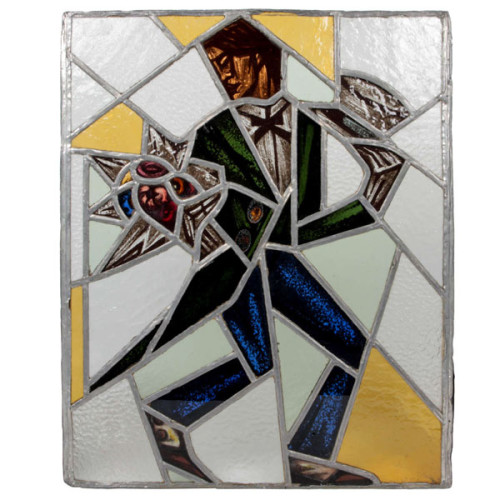
Reinhold Klaus / Carl Geyling Atelier Vienna “Cubist Man with top hat and flowers” stained glass window c. 1930
REINHOLD KLAUS (1881-1963) Vienna, Austria
CARL GEYLING ATELIER (founded 1841) Vienna, Austria
Man with tophat and flowers c. 1930
Window of stained and hand-painted leaded glass
Provenance: Estate of Carl Geyling (1814-1880), Vienna
H: 17 3/4″ x W: 14 1/2″
Reinhold Klaus studied from 1898-1902 with Alfred Roller at the Kaiserlich-Königliche Kunstgewerbeschule in Vienna. In 1914 Klaus married into the Carl Geyling family and became extensively involved with with stained glass painting. As early as 1918 Klaus worked on a stained glass window for the Siegestempel am Bisamberg in Vienna. In 1934 he became a professor of stained glass painting at the Kunstgewerbeschule, as well as creative director of the C. Geylings Erben glass painting company. Reinhold Klaus, a member of the Künstlerhaus since 1924 received many prizes and honors. He worked on commissions for the St. Veits cathedral in Prague, the St. Stephan cathedral in Vienna and many others.




 @hd_jewels