Marks: stamped in black: E. Gallé, nancy depose, E G with cross of Lorraine
Designs for other Egyptian decoration illustrated: Les dessins de Gallé, Philippe Thiébaut (Paris: Réunion des musées nationaux, 1993) p. 98-99
Related forms and designs illustrated: La Ceramique de Gallé (Nancy: Musée de l’Ecole de Nancy, 1984) p. 119; Egyptomania: Egypt in Western Art, 1730-1930 (Paris: Éditions de la Réunion des Musées Nationaux and Ottawa: National Gallery of Canada, 1994), pp. 472=74.
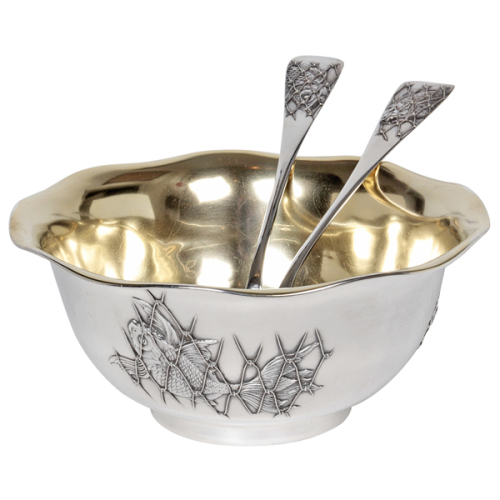
Whiting American Sterling Koi Theme “Japonisme” Serving Bowl and Servers c.1880
WHITING MANUFACTURING CO. North Attleboro, MA
“Koi” serving bowl with matching servers c. 1880
Sterling silver serving bowl and matching servers with applications of Koi fish behind nets, gilt interior
Marks: on base: lion with W in oval (manufacturer’s insignia), STERLING, 2124A, J.E. CALDWELL & CO. (retailer)
H: 4 3/8″ x Dia: 9 3/4″
In 1840 Albert Tifft and William Whiting started their business in North Attleboro, MA as a jewelry manufacturing company and then in 1866 created the Whiting Mfg. Co. and expanded production into small holloware as well. The Gorham Company bought Whiting in 1926 and all operations were then moved to Providence, R.I.
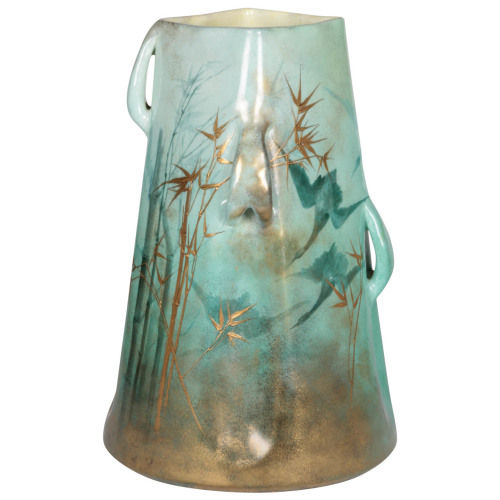
Clement Massier / French Art Nouveau “Bamboo and Flying Crane” Vase circa 1900
CLÉMENT MASSIER (1845-1917) France
MASSIER ART POTTERY Golfe Juan, France
“Bamboo and flying crane” vase c. 1900
Earthenware tapering form with applied handles, hand painted with bamboo and flying cranes with gilt motives and details
Marks: Clement Massier Golfe Juan (block impressed letters)
For more information and other works by the Massier family see: Lost Paradise: Symbolist Europe (Montreal, Quebec: The Montreal Museum of Fine Arts, 1995) p. 176, cat. 269; Jugendstil Art Nouveau, Floral and Functional Forms, Siegfried Wichmann (New York/Boston: Graphic Society/Little, Brown & Co., 1984) p. 45; Art Nouveau Belgium France. Exh. cat. Yvonne Brunhammer et al. (Houston, TX: Institute for the the Arts, Rice University, 1976); La Céramique Art Nouveau, Edgar Pélichet, Michèle Duperrex (Paris: La Bibliothèque des Arts, 1976) p. 89
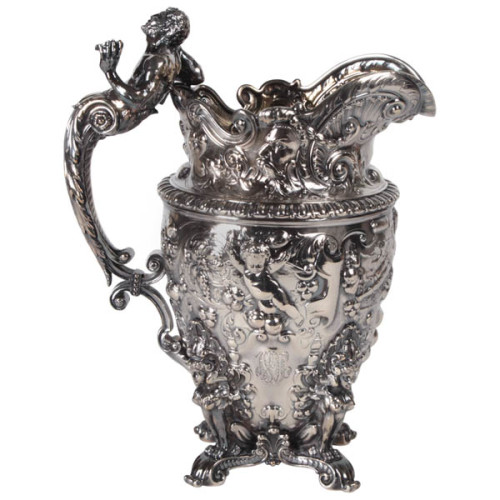
Gorham T.B. Starr Important Sterling “Macy” Renaissance Revival Pitcher 1893
GORHAM MFG. CO SILVERSMITHS Providence, RI
THEODORE B. STARR Retailer
Renaissance Revival pitcher 1893
A highly important Gorham sterling pitcher chased with mythological faces, putti and various scrolling foliate patterns, the handle in the form of Pan with four sphinx figures supporting the base, all with elaborate and exquisite hand chasing and repousse throughout. Extremely fine original condition with original gilded interior.
Marks: Lion, Anchor, G (Gorham silver touch marks), EX. (Exhibition), Theodore B. Starr, 6 pint, Sterling, 1805, double circle touch mark (date mark for 1893)
Provenance: Private Collection, New York; Private Collection Florida from 1984 to 2009; directly descended in the family of Thomas H. Macy (founder of Nantucket) prior to 1984




 @hd_jewels