Marks: stamped in black: E. Gallé, nancy depose, E G with cross of Lorraine
Designs for other Egyptian decoration illustrated: Les dessins de Gallé, Philippe Thiébaut (Paris: Réunion des musées nationaux, 1993) p. 98-99
Related forms and designs illustrated: La Ceramique de Gallé (Nancy: Musée de l’Ecole de Nancy, 1984) p. 119; Egyptomania: Egypt in Western Art, 1730-1930 (Paris: Éditions de la Réunion des Musées Nationaux and Ottawa: National Gallery of Canada, 1994), pp. 472=74.
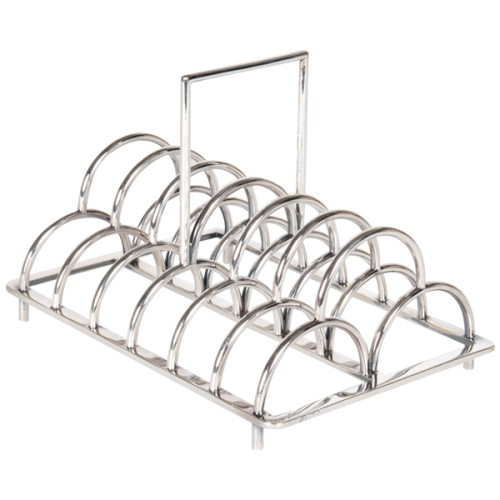
Christopher Dresser / James Dixon & Sons “Triple Arch” square handle toast rack c.1881
CHRISTOPHER DRESSER (1834-1904) UK
JAMES DIXON & SONS Sheffield, England
“Triple Arch” square handle toast rack c.1881
Silver-plate
Marks: JD&S (stamped), Chr. Dresser (facsimile signature), EP, #67, diamond or clover touchmark
Illustrated: 1885 Dixon catalogue, p. 95
For more information see: Truth, Beauty, Power: Dr. Christopher Dresser 1834-1904, exhib. cat. Historical Design, Inc. (New York, 1998); Charles Handley-Read, “High Victorian Design: An Illustrated Commentary” in ‘Design 1860-1960’ sixth conference report of the Victorian Society (London, 1968); Victorian and Edwardian Decorative Art: The Handley-Read Collection, ed. Simon Jervis (London: Diploma Galleries,1972); Christopher Dresser: pottery, glass, metalwork, (London: The Fine Arts Society Ltd., 1972); Isabelle Anscombe & Charlotte Gere, Arts & Crafts in Britain and America (New York: Rizzoli International Publications, Inc., 1978); Truth, Beauty and Design, Victorian, Edwardian and later Decorative Art (London: Fischer Fine Art Limited),; A Thing of Beauty: Art Nouveau, Art Deco, Arts & Crafts Movement and Aesthetic Movement Objects in Atlanta Collections (Atlanta, GA: The High Museum of Art, 1980), cat. no. M2; Widar Halén, Christopher Dresser (Oxford: Phaidon, 1990),; Judy Rudoe, Decorative Arts 1850-1950: A Catalogue of the British Museum Collection (London: Trustees of the British Museum, 1991),; Gerda Breuer, Von Morris bis Mackintosh – Reformbewegung zwischen Kunstgewerbe und Sozialutopie, Arts and Crafts (Darmstadt: Institut Mathildenhöhe, 1994/95); “The Silver Designs of Dr. Christopher Dresser,” Shirley Bury, Apollo (December, 1962);
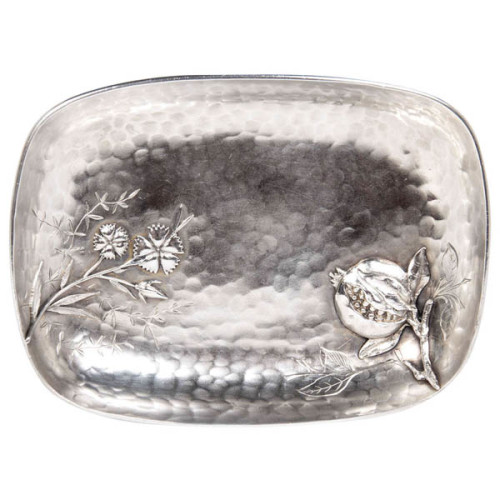
Whiting / Late 19th Century Sterling dish with pomegranate motif c. 1890
WHITING MANUFACTURING CO. No. Attleboro, MA
Footed dish with pomegranate motif c. 1890
Sterling silver with a hand hammered honey comb surface, applied pomegranate and pomegranate blossom motif
Marks: Whiting logo (lion with W in oval (manufacturer’s insignia)), STERLING, 757, C
L: 5″ x D: 4″
In 1840 Albert Tifft and William Whiting started their business in No. Attleboro MA as a jewelry manufacturing company and then in 1866 created the Whiting Mfg. Co. and expanded production into small hollowware as well. The Gorham Company bought Whiting in 1926 and all operations were then moved to Providence, R.I.





 @hd_jewels