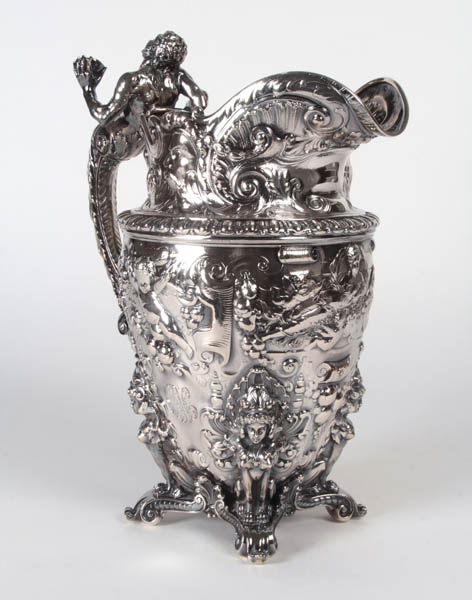
Gorham T.B. Starr Important Sterling "Macy" Renaissance Revival Pitcher 1893
More Information
Gorham T.B. Starr Important Sterling “Macy” Renaissance Revival Pitcher 1893
GORHAM MFG. CO SILVERSMITHS Providence, RI
THEODORE B. STARR Retailer
Renaissance Revival pitcher 1893
A highly important Gorham sterling pitcher chased with mythological faces, putti and various scrolling foliate patterns, the handle in the form of Pan with four sphinx figures supporting the base, all with elaborate and exquisite hand chasing and repousse throughout. Extremely fine original condition with original gilded interior.
Marks: Lion, Anchor, G (Gorham silver touch marks), EX. (Exhibition), Theodore B. Starr, 6 pint, Sterling, 1805, double circle touch mark (date mark for 1893)
Provenance: Private Collection, New York; Private Collection Florida from 1984 to 2009; directly descended in the family of Thomas H. Macy (founder of Nantucket) prior to 1984
Important Lucien Gaillard “Staghorn beetle” silver and gold inlay magnifying glass, signed c. 1900
Silver hand finished and repoussed in the form of a staghorn beetle with horns encircling the round magnifying glass, gold details
Signed: L. GAILLARD (engraved) on lower right leg, head of Minerva (950/1000 pure silver)
The staghorn beetle was a favorite form for Gaillard and the inspiration for many examples of his work including jewelry, vases and this magnifying glass. A variant model in cast bronze can be seen in the collection of the Musee d’Orsay in Paris.
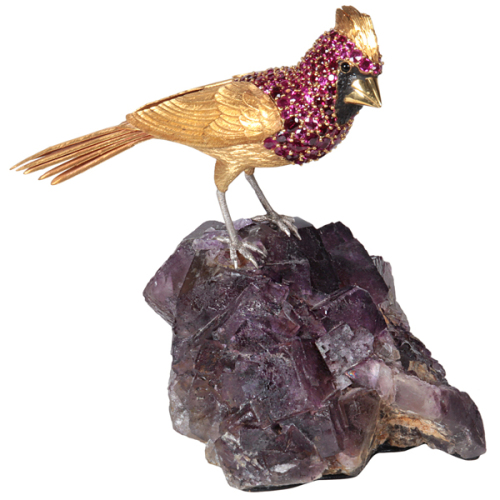
Asprey & Co., Important Cardinal Sculpture gem set with natural rubies, 18K gold and amethyst quartz, signed,1980
ASPREY & CO. LTD. (founded 1781) London, UK
Important Natural Ruby Gem Set 18K Gold Cardinal Bird Sculpture 1980
Finely chased and chiseled 18K yellow and white gold realistically rendered sculpture of a Cardinal bird set with
85+ carats (approx.) of natural gem quality oval and round cut Burmese rubies (GIA certificate) further heightened with enamel eyes and blackened gold face plumage details, the 18K gold and natural ruby cardinal sets atop a natural Amethyst crystal “mountain rock” with a tooled and gilt (script mark) on the leather under-pad.
Marks: A & Co. (in a quatrefoil), Crown mark, 750 (gold standard mark) Lion’s head (London assay mark) “F” date mark for 1980, tooled and gilt Asprey (script mark) on the leather under-pad
Provenance: Privately commissioned by the Sultan of Brunei’s younger brother, Prince Jefri Bolkiah who also later became the owner of Asprey & Co in the 1995. This rare sculptural 18K gold and natural ruby Cardinal was handmade by the finest jewelers and work masters in the workshop of the London Asprey & Co. located above the flagship store at 167 New Bond Street.
H: 3 ¾” x L: 5 3/4” x W: 1 ½”(Cardinal only)
H: 6” x W: 6 ¾” x D: 5 ¾” (with Cardinal atop natural Amethyst crystal rock)
As one might guess, a large part of the animal symbolism of the cardinal comes from the brilliant red color of the males. In fact, its name is derived from the royal red vestments worn by Catholic cardinals. This shock of red, especially against the stark backdrop of winter snow, is a magnificent sight. The male cardinal reminds us passion, warmth and vibrancy is available to us – even under the cloak of Winter’s grey clouds. Interestingly, the more bold and bright his color is, the more successful the cardinal will be at prolonging his lineage. Dull colored male cardinals are less likely to mate successfully than bright colored ones. True to the fire of his color, the crimson cardinal has got some major spunk. He will aggressively defend his territory, and fight attackers with ferocity. Indeed, they have been known to fight ghost males (their reflections) in mirrors for hours on end. Both male and female give us glorious songs. Along with peeps and pips and warbles, the tuned ear can also hear “cheer, cheer, cheer!” Very appropriate to the animal symbolism of cardinals, because they are a delight to both eyes and ears. The cardinal makes a fantastic animal totem. It reminds us to hold ourselves with pride, not ego pride but rather the cardinal asks us to stand a little taller, be a bit more regal and step into our natural confidence as if we were born to lead with grace and nobility. Those who attract the cardinal as their totem are naturally energetic, love life, and happily help others where and when they can!









 @hd_jewels