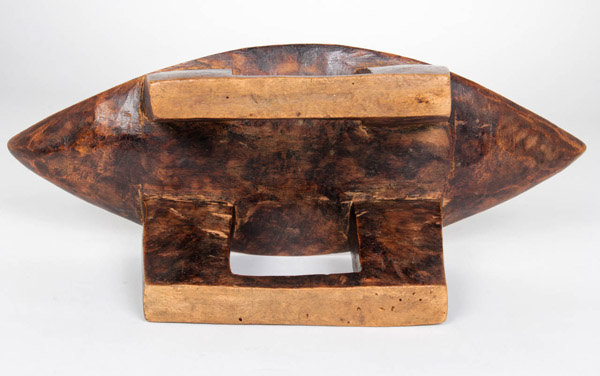
Somalia African Tribal Wood Headrest, Early to mid 20th Century
More Information
Somalia African Tribal Wood Headrest, Early to mid 20th Century
SOMALIA
Head rest early to mid 20th Century
Carved wood with rich natural patina
H: 4 3/4″ x W: 13″
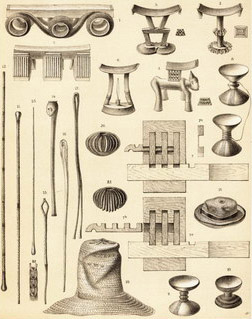
Headrests are used by both Somali men and women while resting or sleeping. It is popularly believed that the headrest serves a protective function by elevating the head off the ground during sleep, thereby preventing any possible attack by snakes or scorpions. Men’s headrests, such as this one, generally feature a smaller base that makes them somewhat unstable to sleep on, while the rectangular bases of women’s headrests are usually more stable. Scholars suggest that this instability is purposeful as it prevents the user from falling into a deep sleep while guarding the herds at night. It is in this sense that the headrest itself has become a symbol of vigilance among Somali nomads. Headrests also play an important role in the nuptial ceremonies of Somali nomads. On his wedding night, the groom places the tubash (a sum of money) under the bride’s headrest. The morning after the marriage is consummated, the bride will use this money to purchase an amber necklace, the symbol of her new status.
Jack Richard Smith “10003” Blackoil, wax, lead salts on copper 2006
JACK SMITH (1950-) Taos, NM
“10003” 2006
Blackoil, wax, lead salts on copper, ebonized wood frame
For more information on Jack Smith see: “Taos Portraits” by Jack Smith, May 14th – August 15th, 2004, exhibition catalogue (Taos, NM: Harwood Museum of Art, University of New Mexico)
Canvas: H: 18” x W: 13 3/16”
Framed: H: 25 1/4” x W: 20 7/16”
Jack Smith was born in 1950. At age 16, he began his training at the Interlochen Arts Academy in Michigan before moving to Ohio to attend Columbus College of Art and Design. He also studied for a brief time at the Instituto de Allende, at San Miguel de Allende, GTO, Mexico. He now resides in New Mexico. Reflecting a profound knowledge of art history and and an alchemist’s sense of the painting craft, contemporary painter Jack Smith has forged his own place amongst the most powerful of contemporary portraitists working in America. Incorporating blackoil, wax, lead salts, and copper Smith’s small format portraits and paintings are detailed and intimate depictions of creative individuals and charged tableaux. Smith’s singular style of portraits glow with a warm inner light and present honest, straightforward images that speak of personal narratives.Jack Smith recently received a prestigious Past Achievement Award from the Peter and Madeleine Martin Foundation for the Creative Arts, following an important solo exhibition titled, Jack Smith: The Taos Portraits at the Harwood Museum of Art at the University of New Mexico in 2004. The exhibition featured fifty portraits of Taos, New Mexico residents, executed between 2000 and 2003. The series was intended as a visual biography of this unique artistic community at the turn of the century. Smith’s subjects range from the famous to the infamous – including artists, writers, art patrons, Native peoples, and street peoples.
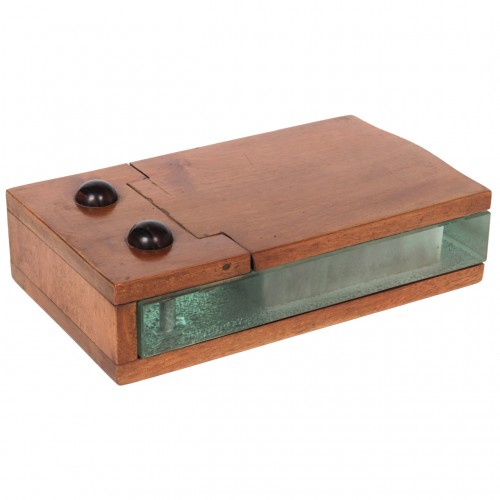
Alexandre Noll rare and early Art Deco mahogany and glass box c. 1930
ALEXANDRE NOLL (1890-1970) France
Covered box c. 1930
Mahogany with ebony peg details and 1 ¼ inch thick Saint-Gobain glass.
Marks: ANoll
Provenance: Private Collection New York, Galerie de Beyrie Paris, Odile Noll (A. Noll’s daughter), Alexandre Noll Estate
For more information see: Alexandre Noll, Olivier Jean-Elie, Pierre Passebon (Paris:Edition du Regard, 1999); Alexandre Noll: Les Matres de L’ Art Decoratif Contemporain, Collection dirigée par R. Moutard-Uldry edited by (Geneve: Pierre Cailler, 1954); Le Mobilier du Xxe Siécle: Dictionnaire des
Créateurs, Pierre Kjellberg (Paris: Les Éditons de l’Amateur, 1994) p. 455-456.





 @hd_jewels