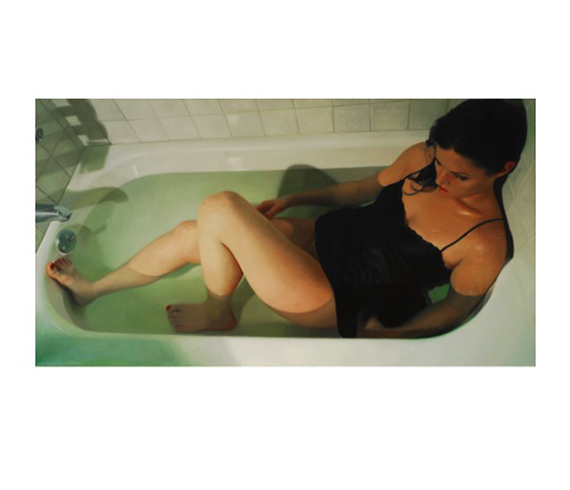
Signed: Alyssa Monks 2006 (on lower back of canvas)
Exhibited: DFN Gallery, New York 2006
Illustrated: American Art Collector, May 2006, p. 155
H: 30” x W: 56”
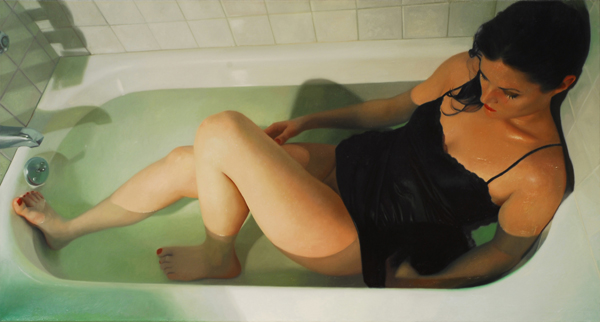
“Push” is somewhat of a response to the long tradition of bathtub paintings where a nude woman is displayed. However, the figure is me, the painter, so that the subject is also the artist, juxtaposing the objectification of women in that tradition. Also, the figure wears a black negligee and red lipstick, white makeup gently drips down the cheek, closing the door on naturalism.
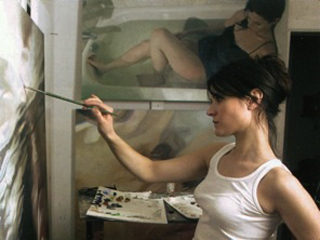
At the New York Academy of Art, Alyssa Monks studied with Vincent Desiderio, Wade Schuman, Brenda Zlamany, John Jacobsmeyer, Harvey Citron, Deane Keller, Edward Schmidt, Steven Assael, Lisa Bartolozzi, Patrick Connors, Peter Cox, Jon DeMartin, Leonid Lerman, and Hong Nian Zhang. Alyssa’s sensibility of paint and color allows one to be seduced into the illusion of each image. Striving for anatomical and realistic accuracy, it is her intention to elicit a serious confrontation. The work requires attention to detail and a slow and rich execution. It is this artist’s concern to visually relate the contemporary human experience with sensitivity, empathy, and integrity.
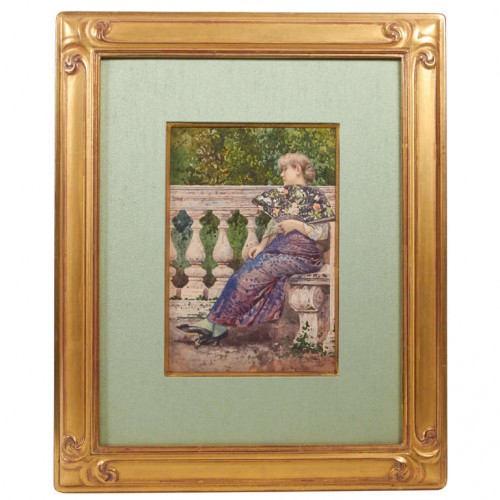
Giovanni Battista Filosa, In the Garden, Watercolor, 1884
GIOVANNI BATTISTA FILOSA (1850-1935) Naples, Italy
“In the Garden” 1884
Watercolor, gilt frame and filet with silk mount.
Signed: G Filosa '84
***Filosa exhibited at the Esposizione Internazionale d'Arte della Città di Venezia 1895 – La Biennale di Venezia, Venice
An extremely fine and exquisitely painted watercolor “In the Garden” by the Italian artist Giovanni Battista Filosa (1850-1935). It is a radiant painting with a wonderful subtle coloration and very charming late 19th century “en plein-air” imagery. Filosa's technique is similar in quality to the work of the 19th Century Pre-Raphaelite watercolorist, Albert Moore. Gilt frame and filet with silk mount. Signed: G Filosa '84 Filosa exhibited at the Esposizione Internazionale d'Arte della Città di Venezia 1895 – La Biennale di Venezia, Venice
Watercolor: H: 7 1/2″ x W: 5 1/4″
Framed: H: 14 1/2″ x W: 12″
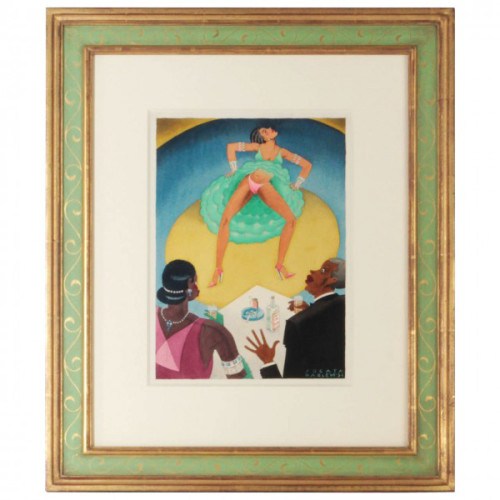
S O G A T A New York, NY “Harlem: Concert” Watercolor and pencil on paper 1931
S O G A T A New York, NY
“Harlem: Concert” 1931
Watercolor and pencil on paper
Signed: SOGATA · HARLEM 1931 (in pencil, lower left corner of image); HARLEM: CONCERT. (in pencil beneath image on left)
For contextual history and similar art see: Rhapsodies in black : art of the Harlem Renaissance, (Berkeley: University of California Press, 1997); Harlem Renaissance Artists. Jordan, Denise (Chicago: Heinemann Library, 2003).
Paper H: 14 7/8″ x W: 10 7/8″
Image H: 11″ x W: 7 1/2″
Frame H: 19 1/4” x W: 16”
*This SOGATA New York Watercolor and pencil on paper has been gifted to The Wolfsonian – FIU, Miami Beach, FL.
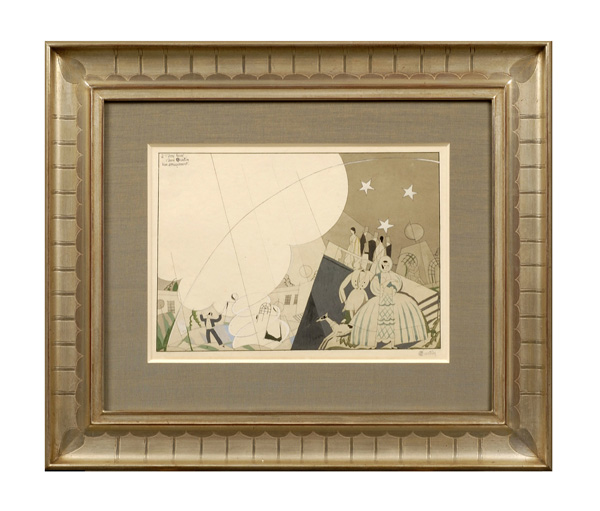
Charles Martin, “Bal Masque”, Pencil, ink, gouache and watercolor on paper 1927
CHARLES MARTIN (1884-1934) France
Bal Masque 1927
Pencil, ink, gouache and watercolor on paper.
Signed: Martin (lower right corner); A l’Ami Koval, l’Ami Martin, Bien Amicalement (upper left corner)
H: 8” x W: 11 7/16”
Price: $12,500
Charles Martin was a notable French illustrator, graphic artist, posterist, fashion and costume designer. His drawings are charming, amusing and sophisticated. The artist studied at the Montpelier Ecole des Beaux Arts, Academie Julian and Ecole Des Beaux Arts, Paris. Throughout his career, Martin was also a contributor to the French fashion journals Gazette du Bon Ton, Modes et Manieres d’Aujourd’hui, Journal Des Dames et Des Modes, and Vogue. His illustrated books include the hat catalogue “Les Modes en 1912,” the erotic “Mascarades et Amusettes” 1920, and “Sports et Divertissements” 1919, written in collaboration with composer Erik Satie.
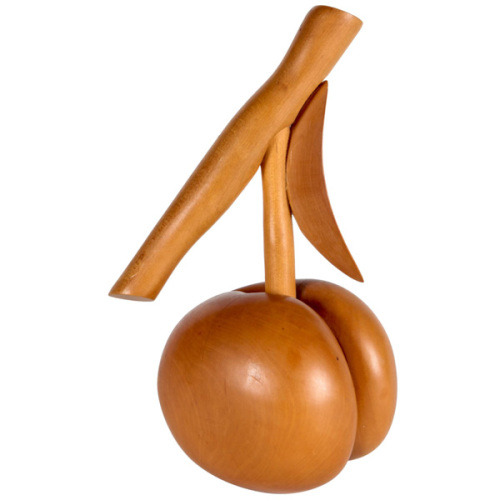
Jan de Swart, Handcarved “Peach” Sculpture, c.1970
JAN DE SWART (1908-1987) Netherlands / USA
Peach sculpture c. 1970
Hand carved and formed jelutong wood in a symbolic / erotic form of a peach
For more information see: Jan de Swart: A Day That Becomes a Lifetime, exhibition catalogue (California: Fine Arts Gallery at the San Fernando Valley State College, February 1972); Jan de Swart, Mike McGee and William G. Otton (Laguna Beach, California: Laguna Art Museum, 1986).
H: 7 ½” x D: 4”
Price: $7,500
Constantly seeking and inventing new materials Jan de Swart was a true modernist. He was influenced by artists such as Isamu Noguchi, Harry Bertoia, Charles Eames, and later Sam Maloof and Wendell Castle. Although he had been creating small sculptures since his arrival in California from Holland in 1929, he had not been widely recognized until being introduced to John Entenza, publisher of Arts & Architecture magazine in 1947. Soon thereafter, he was able to create larger works and began collaborating with architects such as Whitney Smith and Victor Gruen on special commissions. His work is in the permanent collection of Los Angeles County Museum of Art, The Smithsonian, and the Ford Foundation. He was honored with the American Institute of Architects Gold Medal for Sculpture in 1965.


 @hd_jewels