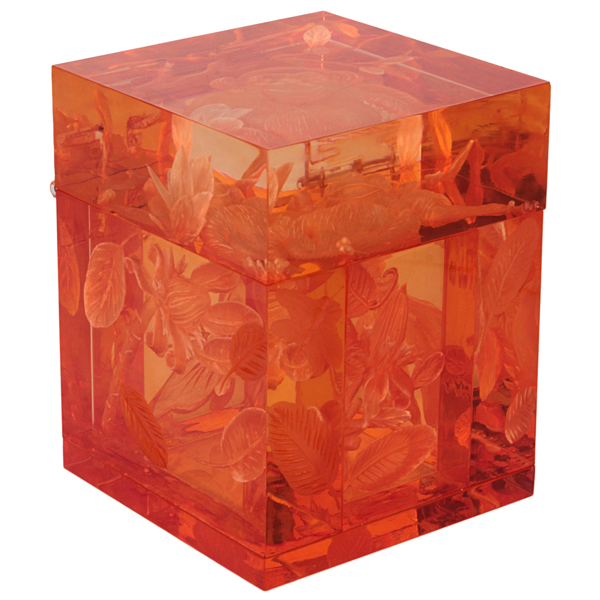
Joyce Francis "Banana Land Flowers" Bright Orange Box 2008
More Information
Joyce Francis “Banana Land Flowers” Bright Orange Box 2008
JOYCE FRANCIS New York, NY
“Banana Land Flowers” box 2008
Cast and carved bright orange Lucite acrylic deeply incised and carved with three dimensional images of a monkey, a butterfly, a dragonfly and exotic flowers and foliage.
The top cover dimension is 1 3/4″ thick and the four sides of the box are 1 1/4″ thick.
Marks: Joyce Francis 08
H: 6″ x W: 4 3/4″ x D: 4 3/4″
Price: $3,750
Joyce Francis is a native Manhattanite artist who specializes in sculptured acrylic jewelry, purses, sculpture, tables and coveted collection of exciting, passionately carved decorative boxes. All pieces have been painstakingly hand carved, hand dyed, illuminated and sometimes hand painted as well. There are no embedded objects. Her purses are part of the permanent collections of the New York Metropolitan Costume Institute (New York), The Victoria and Albert Museum (London), The Fashion Institute of Technology (New York) and the Rock and Roll Hall of Fame (Cleveland).
Her work is in the collections of a number of stars and celebrities, including Hillary Swank, Phoebe Cates Kline, Emma Thompson, Cicely Tyson and Meryl Streep. Examples of her boxes and lamps are also owned by Paul Simon, Paul McCartney, Steve Martin and Tom Hanks.
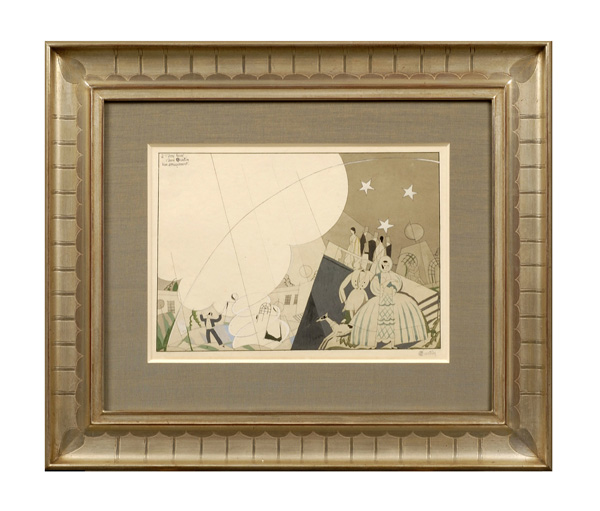
Charles Martin, “Bal Masque”, Pencil, ink, gouache and watercolor on paper 1927
CHARLES MARTIN (1884-1934) France
Bal Masque 1927
Pencil, ink, gouache and watercolor on paper.
Signed: Martin (lower right corner); A l’Ami Koval, l’Ami Martin, Bien Amicalement (upper left corner)
H: 8” x W: 11 7/16”
Price: $12,500
Charles Martin was a notable French illustrator, graphic artist, posterist, fashion and costume designer. His drawings are charming, amusing and sophisticated. The artist studied at the Montpelier Ecole des Beaux Arts, Academie Julian and Ecole Des Beaux Arts, Paris. Throughout his career, Martin was also a contributor to the French fashion journals Gazette du Bon Ton, Modes et Manieres d’Aujourd’hui, Journal Des Dames et Des Modes, and Vogue. His illustrated books include the hat catalogue “Les Modes en 1912,” the erotic “Mascarades et Amusettes” 1920, and “Sports et Divertissements” 1919, written in collaboration with composer Erik Satie.
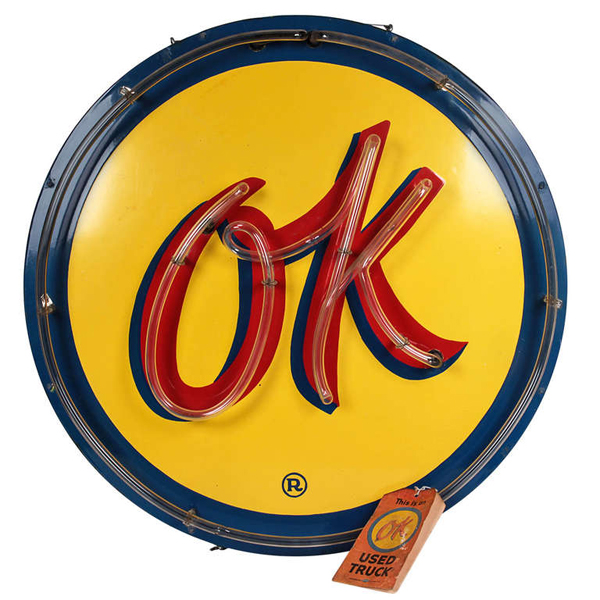
American Art Deco, Neon, OK Chevrolet Used Truck Sign c.1940’s
AMERICAN NEON DESIGN
OK Chevrolet Used Truck Sign c.1940’s
Blue, yellow and red baked enamel on metal with an orange neon tube spelling out “OK” encircled with a round blue neon border, original paper tag.
Marks: Registration Mark (in the enamel) Original paper tag, This is an OK Used Truck, Authorized Chevrolet Dealer, Chevrolet Motor Division, General Motors Corporation
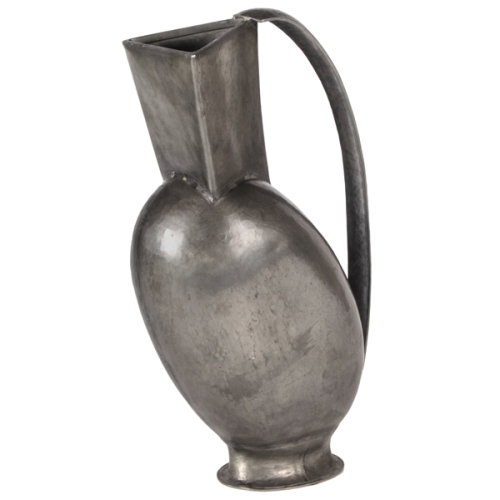
Italian Futurist 1950’s “Auntie Mame” Handwrought Pewter Pitcher c.1950
1950’s ITALIAN DESIGN
Futurist pitcher c. 1950
Handwrought and hand hammered pewter in an overall footed ovoid form with a traingle form spout body and an elongated arching contoured handle
Marked: PELTRO with lion, MADE ITALIA
H: 15″ x W: 9″ x D: 4″
Price: $6,000
The 1958 classic film, Auntie Mame, starring Rosalind Russell, features this sculptural pitcher on the coffee table in the surrealist interior of Mame Dennis’ penthouse on Beekman Place #3, New York City.
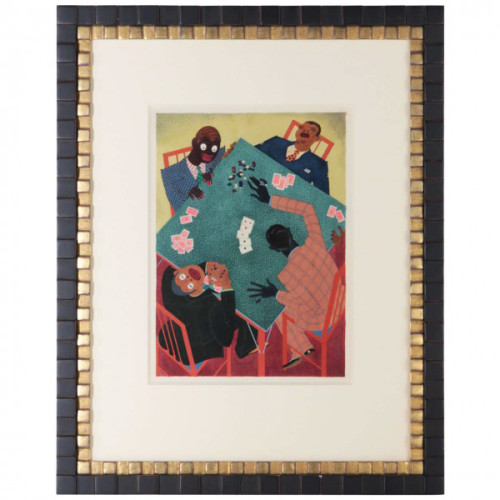
S O G A T A New York, NY “Harlem: Five Aces” Watercolor and pencil on paper 1931
S O G A T A New York, NY
“Harlem: Five Aces” 1931
Watercolor and pencil on paper
Signed: SOGATA, HARLEM 1931 (painted, lower right corner of image); HARLEM: FIVE ACES. (in pencil beneath image on left)
For contextual history and similar art see: Rhapsodies in black : art of the Harlem Renaissance, (Berkeley: University of California Press, 1997); Harlem Renaissance Artists. Jordan, Denise (Chicago: Heinemann Library, 2003).
Paper H: 14 7/8″ x W: 10 7/8 ”
Image H: 11″ x W: 7 1/2″
Frame H: 19” x W: 15 1/4”
*This SOGATA New York Watercolor and pencil on paper has been gifted to The Wolfsonian – FIU, Miami Beach, FL.



 @hd_jewels