Product Description
Andree Flamant-Ducany-Gide (1882-1970)/ Valsuani Foundry French Cubist bronze “African” mask sculpture 20th Century

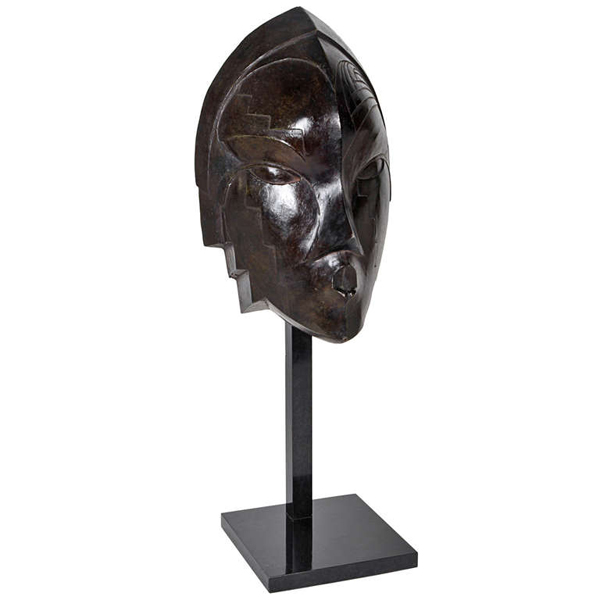
ANDREE FLAMANT-DUCANY-GIDE (1882-1970) France
VALSUANI FONDEUR (1899-1981) Paris, France
Cubist mask sculpture 20th Century
Cast bronze with rich brown-black patina (possibly cast at a later date by the Valsuani Foundry)
Marks: G. Flamant, 2/8 C. Valsuani Cire Perdue (signed on chin)
H: 11” x W: 7” x D: 5 ½”;
On stand: H: 18 ½”
Price: $35,000
ANDREE FLAMANT-DUCANY-GIDE
Flamant-Gide was born in Nimes, France on January 2nd, 1892 and died on March 28th 1970. She was both a painter and sculptor and exhibited regularly at the Salon des Artists Francais beginning in 1923. She sculpted in an angular Cubist style influenced by African Art and was a fellow artist of Joseph Csaky, Gustave Miklos, Jacques Lipchitz and Henri Laurens who were considered the leading Art Deco sculptors in Paris during the 1920’s.
CUBISM
Cubism drew its influence from: Cezanne’s structural analysis in his oil landscapes, e.g. ‘La Montagne Sainte Victorie’ c.1887; Gauguin’s figurative landscapes, e.g. ‘Haymaking’ 1889; and African tribal Art such as Gabon masks. European artists were greatly influenced by African and Oceanic Art during the late 1890s and early 1900s. African sculpture, with its bold shapes and lines, had a great impact on the development of Cubism. Maurice de Vlaminck became a keen admirer and collector of African masks after seeing them in a Paris anthropological museum. He purchased similar masks and his excitement for these works displaying bold primitive expressions and simplistic design filtered through to Matisse, Derain, Gris and Picasso, who all became collectors as well. By the 1920s African art exhibitions were common in Paris and other cities throughout Europe.
Cubist sculpture brought the simplified shapes of Cubist painting together with the three-dimensional modeling medium of sculpture. The first Cubist sculpture, which could be properly deemed as such was made by Picasso in 1909 and was titled ‘Head of a Woman’. However Picasso did experiment with sculptural forms as early as 1907 when he found himself fascinated and deeply influenced by African masks. Cubist sculpture was mostly reminiscent of Analytical Cubism in its stripping away of illusionist details to reveal the fundamental form contained in each individual subject, be it human or still-life.
VALSUANI FOUNDRY
The Valsuani foundry was started by the brothers Claude and Attilio Valsuani who learned the foundry trade while employed at the Hebrard foundry. While working for Hebrard, Claude Valsuani showed great promise as a finisher and eventually worked his way up to become the Technical Director of the Hebrard foundry. In 1899 Claude Valsuani started his own foundry in Chatillon, casting mostly small works for various artists primarily using the lost wax technique of casting (cire perdue). In 1905 he moved his foundry to 74 Rue des Plantes in Paris. Among the famous sculptors who had the Valsuani foundry cast their works were: Renoir, Picasso, Despiau, Paul Troubetzkoy, Matisse, and Gaugin. Claude Valsuani died in 1923 in his native Italy but his son, Marcele then took over the foundry and continued the tradition of producing extremely fine bronzes until the 1970’s.
Andree Flamant-Ducany-Gide (1882-1970)/ Valsuani Foundry French Cubist bronze “African” mask sculpture 20th Century
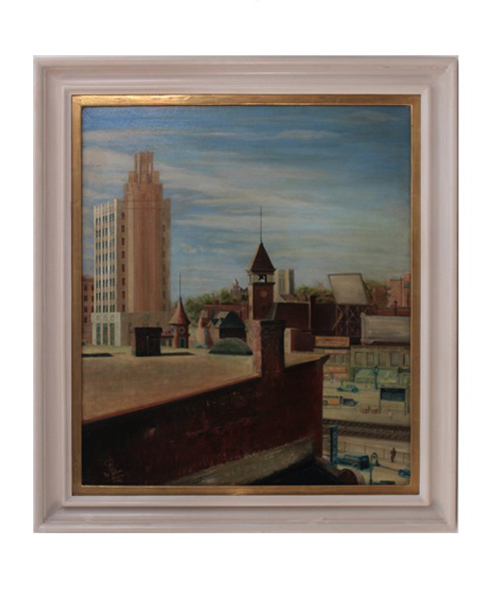
ARRIGO VARETTONI DE MOLIN (1902-1985)
Passaic Rooftops 1932
Oil on canvas
Signed: A V de Molin ’32
Listed: Who’s Who in America, Series II, no. 11 (November 1, 1941) p. 6.
Exhibited: New Jersey State Annual, Montclair Art Museum, 1934
Canvas: H: 39” x W: 35”
HERBERT BAYER (1900-1985) Austria
Self portrait 1932 (printed later)
Silver gelatin print
Edition: 28/40
Signed: bayer 32 (in ink on bottom right corner)
Provenance: Kennedy Gallery, New York
H: 13 7/16” x W: 9 ½”
Framed size: H: 21 ½” x W: 17 ½”
Price: $16,000
Herbert Bayer (1900 – 1985) was an Austrian graphic designer, painter, photographer, and architect. Bayer apprenticed under the artist Georg Schmidthammer in Linz. Leaving the workshop to study at the Darmstadt Artists’ Colony, he became interested in Walter Gropius’s Bauhaus manifesto. After Bayer had studied for four years at the Bauhaus under such teachers as Wassily Kandinsky and László Moholy-Nagy, Gropius appointed Bayer director of printing and advertising. In the spirit of reductive minimalism, Bayer developed a crisp visual style and adopted use of all-lowercase, sans serif typefaces for most Bauhaus publications. Bayer is one of several typographers of the period including Kurt Schwitters and Jan Tschichold who experimented with the creation of a simplified more phonetic-based alphabet. Bayer designed the 1925 geometric sans-serif typeface, universal, now issued in digital form as Architype Bayer that bears comparison with the stylistically related typeface Architype Schwitters.
In 1928, Bayer left the Bauhaus to become art director of Vogue magazine’s Berlin office. He remained in Germany far later than most other progressives. In 1936 he designed a brochure for the Deutschland Ausstellung, an exhibition for tourists in Berlin during the 1936 Olympic Games. In 1938 he left Germany and settled in New York City where he had a long and distinguished career in nearly every aspect of the graphic arts. In 1946 Bayer relocated again. Hired by industrialist and visionary Walter Paepcke, Bayer moved to Aspen, Colorado as Paepcke promoted skiing as a popular sport. Bayer’s architectural work in the town included co-designing the Aspen Institute and restoring the Wheeler Opera House, but his production of promotional posters identified skiing with wit, excitement, and glamour. Bayer would remain associated with Aspen until the mid-1970s. Bayer gave the Denver Art Museum a collection of around 8,000 of his works. In 1959, he designed his “fonetik alfabet”, a phonetic alphabet, for English. It was sans-serif and without capital letters. He had special symbols for the endings -ed, -ory, -ing, and -ion, as well as the digraphs “ch”, “sh”, and “ng”. An underline indicated the doubling of a consonant in traditional orthography.