Archibald Knox / Liberty & Co. Double inkwell stand c. 1902-05
More Information
Archibald Knox / Liberty & Co. Double inkwell stand c. 1902-05
ARCHIBALD KNOX (1864-1933) UK
LIBERTY & CO. London
Double inkwell stand c. 1902-05
Pewter with abstract Celtic design in bas-relief
Condition: excellent, no repairs or damage
Marks: 3, ENGLISH PEWTER 00715
Illustrated: Archibald Knox, ed. by Stephen A. Martin (London: Academy Editions, 1995) p 113; Liberty Design 1874-1914, Barbara Morris (London: Pyramid Books, 1989) p. 86; The Designs of Archibald Knox for Liberty & Co., A.J. Tilbrook (London: Ornament Press Ltd., 1976) p. 158.
H: 2 ¾” x W: 9 ¼” x D: 4”
This early British inkwell stand demonstrates the profound influence of Celtic ornament upon Knox and his highly individual and sophisticated use of these ancient graphic devices of interlocking loops and tendrils.
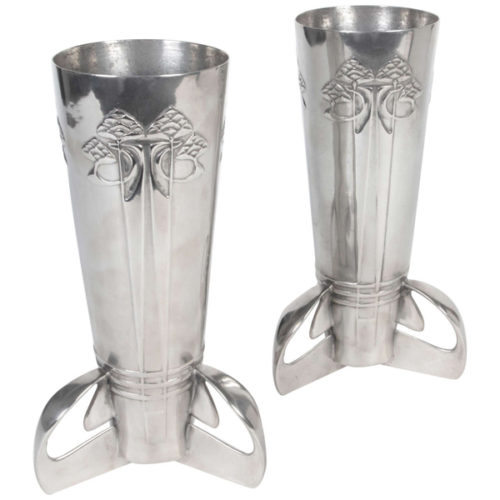
Archibald Knox / Liberty & Co. Pair of tri-footed vases c. 1902-05
ARCHIBALD KNOX (1864-1933) UK
LIBERTY & CO. London
Pair of tri-footed vases c. 1902-05
Pewter with abstract Celtic floral design in bas-relief on tri-footed base
Marks: 6, MADE BY LIBERTY & CO.., ENGLISH PEWTER 0227
Illustrated: Archibald Knox, ed. by Stephen A. Martin (London: Academy Editions, 1995) ; Liberty Design 1874-1914, Barbara Morris (London: Pyramid Books, 1989) p. ; The Designs of Archibald Knox for Liberty & Co., A.J. Tilbrook (London: Ornament Press Ltd., 1976)
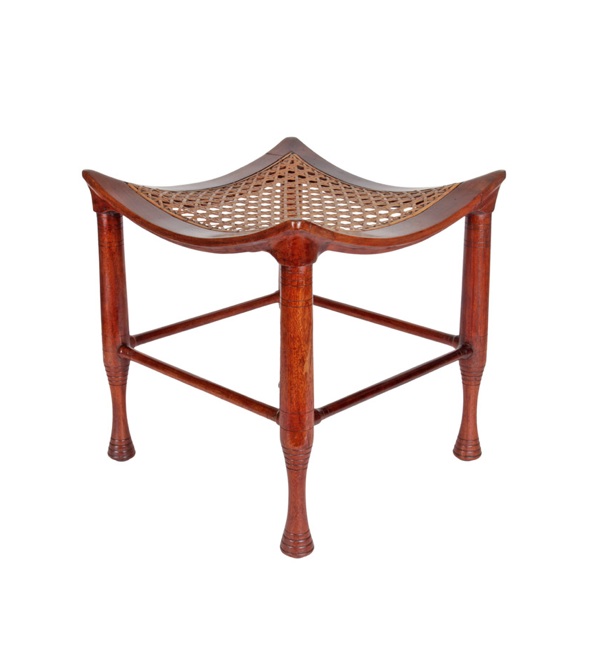
Liberty & Co. / Leonard Wyburd Egyptian Revival Four-Legged Mahogany Thebes Stool c. 1890-95
Leonard Wyburd UK
Liberty & Company London
Four-legged Thebes stool circa 1890-95.
Mahogany, woven wicker seat, turned details.
Comparable Liberty stools illustrated: Egyptomania: Egypt in Western Art, 1730-1930 (Paris: Éditions de la Réunion des Musées Nationaux and Ottawa: National Gallery of Canada, 1994), pp. 465-66.
H: 15 3/4″ x D: 15″ x W: 15″
One of the driving influences of the Aesthetic Movement of the late 19th century was an informed interest in authentic ancient designs inspired by recent archaeological discoveries. Both the three- and four-legged Thebes stool were inspired by actual furniture and wall paintings unearthed from royal tombs in the ancient Egyptian city for which they are named. Leonard Wyburd, who was one of the principal designers for Liberty, patented his designs for the Thebes stools in 1884. Liberty & Co. continued to make the popular stools into the early 1900’s.
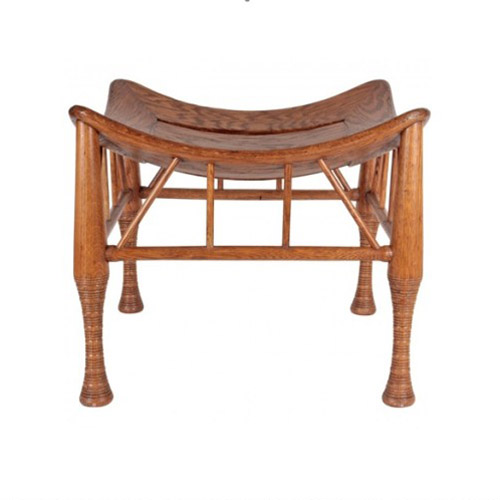
Liberty & Co. / Leonard Wyburd Egyptian Revival Four-Legged Oak Thebes Stool c. 1890-1895
Leonard Wyburd UK
Liberty & Company London
Four-legged Thebes stool circa 1890-95. Oak with highly figured grain, concave slat seat, turned details.
Marks: 4 (impressed on underside)
This design was registered by Liberty & Co. in 1884.
Related Liberty & Co. stools illustrated: Liberty’s 1875-1975 : An Exhibition to Mark the Firm’s Centenary (London: Victoria & Albert Museum, 1975) p. 35, illustr. C1, Liberty Design, 1874-1914 , Barbara Morris (London: Octopus Publishing Group:, 1989) p. 103; Egyptomania: Egypt in Western Art, 1730-1930 (Paris: Éditions de la Réunion des Musées Nationaux and Ottawa: National Gallery of Canada, 1994), pp. 465-66.
H: 15″ x D: 17″ x W: 17″
One of the driving influences of the Aesthetic Movement of the late 19th century was an informed interest in authentic ancient designs inspired by recent archaeological discoveries. Both the three and four-legged Thebes stool were inspired by actual furniture and wall paintings unearthed from royal tombs in the ancient Egyptian city for which they are named. Leonard Wyburd, who was one of the principal designers for Liberty, patented his designs for the Thebes stools in 1884. Liberty & Co. continued to make the popular stools into the early 1900’s.





 @hd_jewels