Product Description
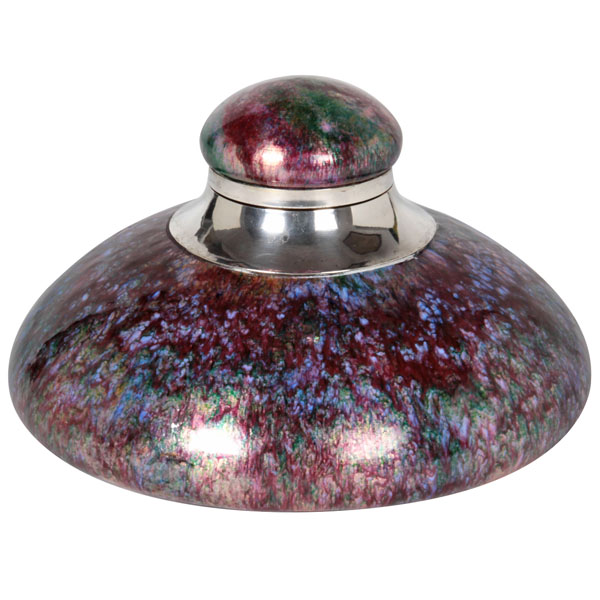
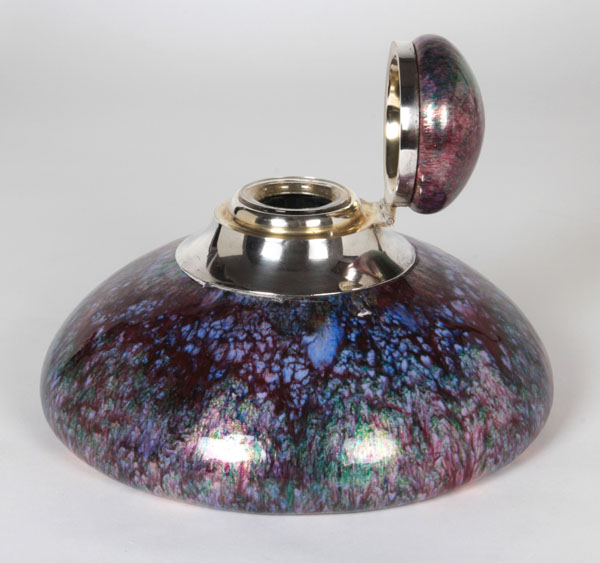
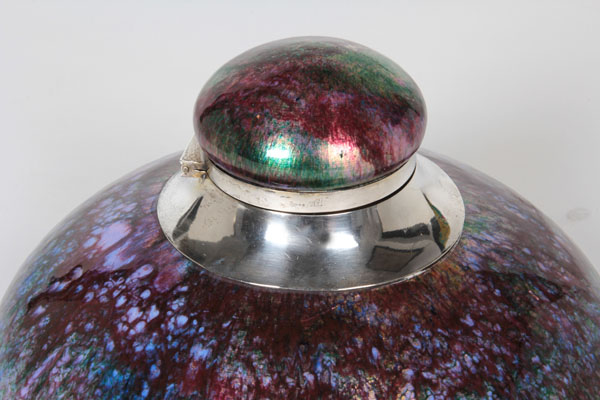
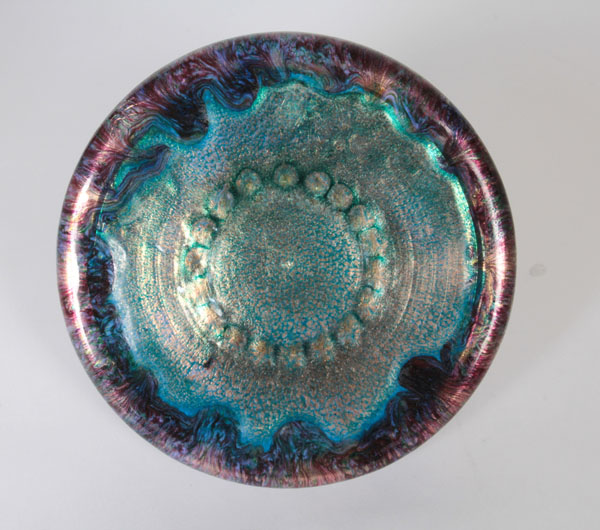
Paul Haustein Germany Rare Jugendstil enamel and silver inkwell c.1900

PAUL HAUSTEIN (1880-1944) Germany
HERMANN BEHRND (b. 1849) SILBERWARENFABRIK (silver) Dresden, Germany
JAKAB RAPOPORT (enamelist) Budapest, Hungary
Inkwell c. 1900
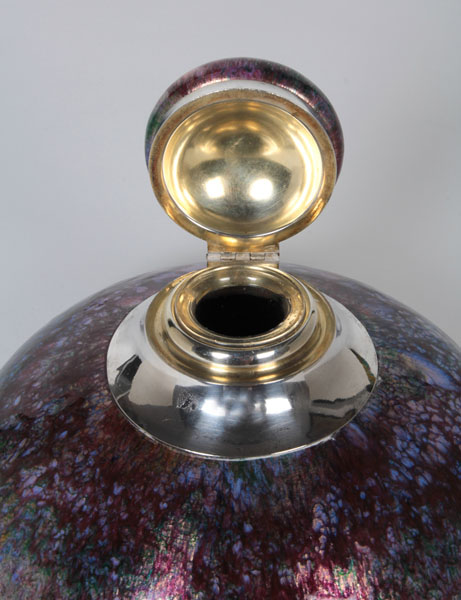
Multicolored burgundy, purple, blue and green enamel with silver mounts, glass insert
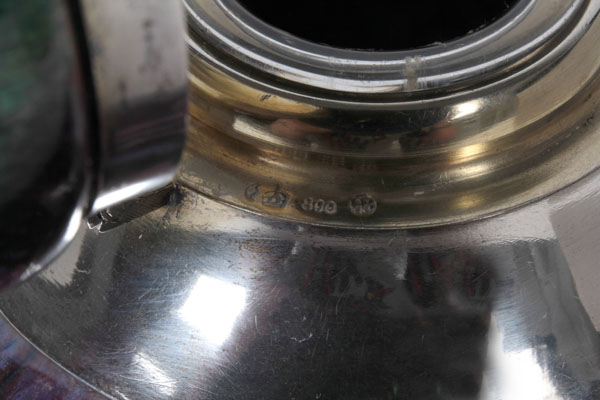
Marks: Moon, crown, 800, HB (Hermann Behrnd mark)
Same model with variant mount illustrated: Deutsche Goldschmiede-Zeitung, n.d. (circa 1903-05), p. 23
For related works and more information see: Art Nouveau in Munich: Masters of Jugendstil, ed. Kathryn Bloom Hiesinger (Philadelphia: Philadelphia Museum of Art, 1988) pp. 67-69; Jugendstil in Dresden, Aufbruch in die Moderne, Gisela Haase et al., exh. cat. (Dresden: Staatliche Kunstsammlungen Dresden; Wolfratshausen: Edition Minerva, 1999).
Dia: 7 1/4″ x H: 4 1/2″
Paul Haustein Germany Rare Jugendstil enamel and silver inkwell c.1900
LINDA LEE JOHNSON (1944-2018) Washington, DC
Sculpted silver bowl “Vessel XII” c. 2004
Irregular organic shaped lost wax cast silver bowl with an irregular shaped top and one pierced hole (3/4 inch). Approx. silver weight is 80 troy ounces.
Marks: Logo monogram, 5/20, initial monogram
H: 5 1/4″ x W: 8 1/2″ x D: 7 1/4″
At the age of three Linda Lee Johnson was given a handmade Native American bracelet from her father, a naval aviator, and subsequently another every time they crossed the country. By the time she was seven, she had seven bracelets which she never removed. She was an American field service exchange student to Greece in high school. It was here that she developed her love of theater, sculpture and ancient
jewelry. She graduated from the University of California, Berkeley, in English literature and dramatic art and immediately began to study sculpture making.
She was a founding member of the Berkeley Repertory Theatre, and a professional actress for nineteen years with many major roles in New York city and regional theaters around the country and abroad.
She studied jewelry making in New York City 1984-88.
In 1986, she was asked to place her pieces in Tiffany & Co. in all major stores. At the same time she had many featured pieces of jewelry, small sculpture and functional objects in the Museum of Modern Art design store.
Barney’s New York began to represent her in l989, where her jewelry and limited edition decorative art work are still found today.
She lived in Washington DC and the Adirondack Mountains where she continued to craft and sculpt her jewelry and decorative works of art until her passing in 2018.
MITZI OTTEN-FRIEDMANN (1884-1955) Austria
WIENER WERKSTÄTTE (1903-1932)
Brooch c. 1915
Reverse-painted glass depicting a couple set in a silver frame / back
Marks: M. OTTEN-FRIEDMANN on the front (right), the reverse stamped: WW, Vienna assay mark for 900 silver
D: 2 3/8”
Rosalia Marie Friedmann-Otten (“Mitzi”) * November 28, 1884 Vienna, † May 5, 1955 New York, NY
Student at the School of Applied Arts in Vienna (with Oskar Strnad), Friedmann-Otten participated in numerous exhibitions (including art shows in 1908, 1920; Neukunstgruppe 1909; German Women’s Art in 1925; Werkbundausstellung 1930). Member of the Austrian Werkbund, the Wiener Werkstätte and the Neukunstgruppe. One of the most versatile artists (commercial art, metalwork, jewelry, fashion, starting from 1920 mainly enamel works, including large-scale email pictures), Friedmann-Otten had to flee in 1938 to the United States.
ALFRED GRENANDER (1863-1931) Sweden / Germany
W. KUMMEL Berlin, Germany (cabinetmaker)
Cabinet (unique) c. 1904
Flamed mahogany, ebony, ivory and fruitwood inlays, brass hardware and details, textured glass
Marks: American import label (from Germany) for the St. Louis exhibition
Exhibited: The 1904 St. Louis Exhibition, German Section in the Herrenzimmer
Illustration of Grenander room: Deutsches Kunstgewerbe St. Louis 1904, Hugo Nachtlicht, 1904, p. 80.
Commentary on Grenander’s display at St. Louis Exhibition: Deutsche Kunst und Dekoration, Band XV Oktober 1904-Marz 1905, “Die Wohnungskunst auf der Welt –Austellung in St. Louis”, Dr. Hermann Muthesius, p. 213-16.
Related bookcase-cabinet illustrated: Deutsche Kunst und Dekoration, Band XVI April-September 1905, p. 426.
For other works by Grenander see: Deutsche Kunst und Dekoration, Band XVI April-September 1905, p. 395-407, 426, 427, 671-73, 694, 695; Das Deutsche Kunstgewerbe 1906, 111. Deutsche Kunstgewerbe-Austellung Dresden 1906, (München, Verlagsanstalt P. Bruckmann A.G., 1906) p. 129-133, 232, 261
H: 79 1/2” x W: 57” x D: 23”
Price: $95,000
Alfred Grenander was born in June 1863 in Skövde, Sweden, and came to Berlin in 1885 to study. The city became his home, and he built his first buildings here together with his brother-in-law Otto Spalding. In 1897 Grenander began teaching at the Unterrichtsanstalt des Berliner Kunstgewerbemuseums (college attached to Berlin’s Museum of Arts and Crafts). His involvement with underground railway architecture began in 1900 and came to dominate his life’s work, with more than 80 buildings. He died on 14 July 1931 in Berlin.
From the turn of the century through the early 1930s, Alfred Grenander provided the emerging metropolis of Berlin with an extensive net of subway stations. He was an architect, draughtsman, and city planner; as well as a remarkable furniture designer. Grenander was the celebrated German representative at the 1904 World’s Fair in St. Louis, where he was being honored as “the renewer of German art.” This mahogany cabinet inlaid with pewter, ebony and ivory was exhibited in the elegant Herrenzimmer of the German pavilion at the Louisiana Purchase Exposition, St. Louis, Missouri, 1904, was bought in 1904 by a Kansas City, Missouri family and the piece descended in the family.