Product Description
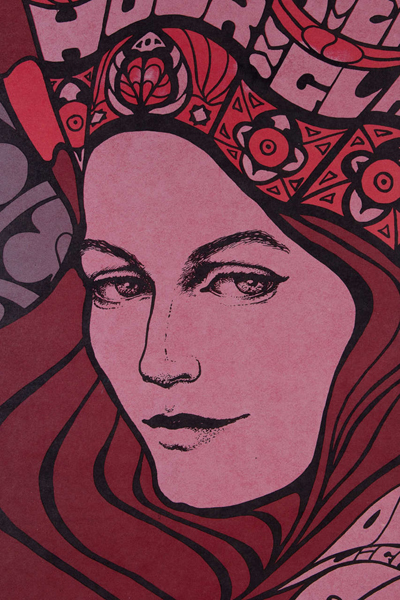
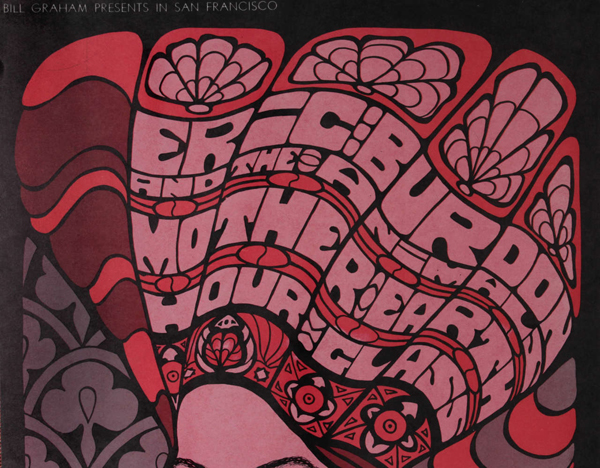
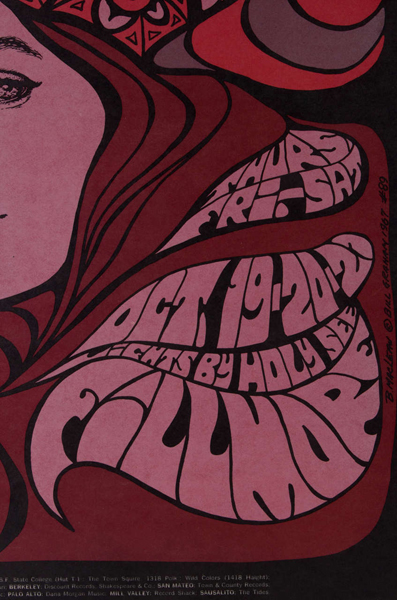
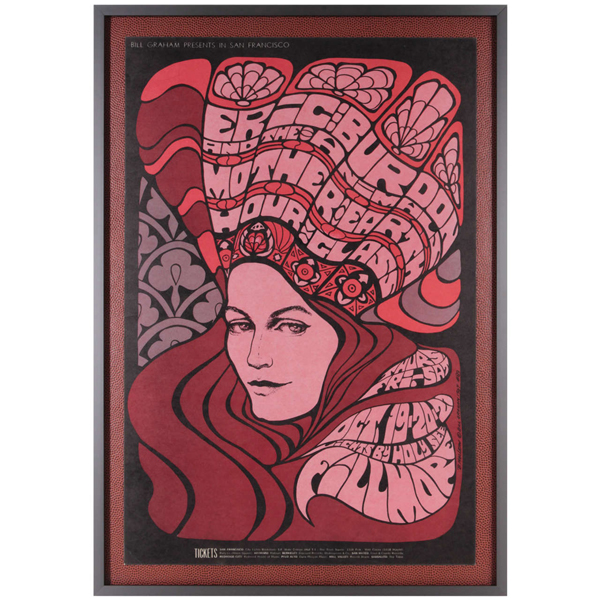
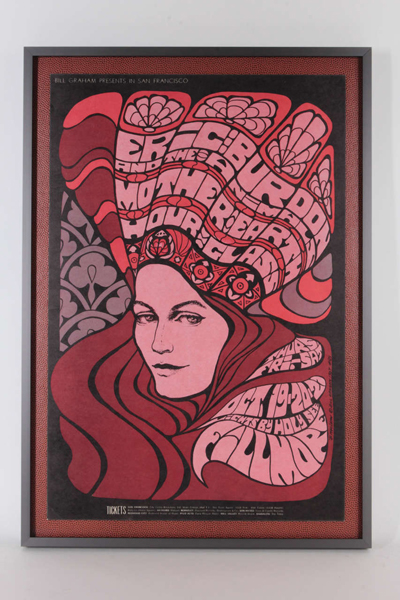
Bonnie Maclean, Eric Burdon & The Animals, Mother Earth, Hour Glass, Holy See at the Fillmore, October 19-21, 1967, 1st edition

BONNIE MACLEAN USA
Eric Burdon & The Animals, Mother Earth, Hour Glass, Holy See at the Fillmore October 19-21, 1967
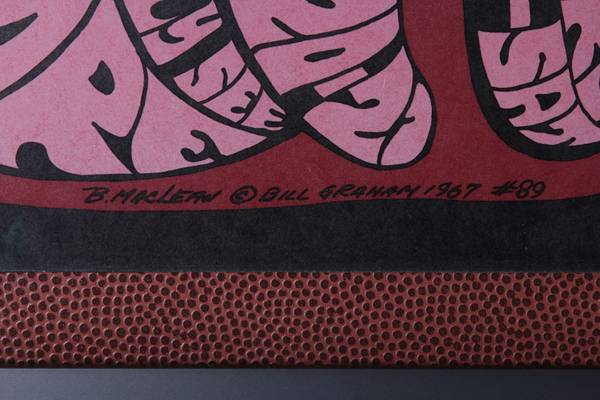
Marked: B. MacLean © Bill Graham 1967 #89
H: 21” x W: 14”
*** An example of this poster is in the permanent collection of the Museum of Modern Art in New York.
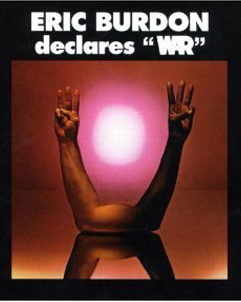
By 1967, Eric Burdon took the Animals into a harder, more psychedelic sound than the one listeners recognized from the band’s earlier incarnation. Burdon would later take this style even further when he teamed up with an obscure Los Angeles band known as War. The poster was printed only once before the concert
Bonnie Maclean, Eric Burdon & The Animals, Mother Earth, Hour Glass, Holy See at the Fillmore, October 19-21, 1967, 1st edition
RAYMOND BARGER (1906-2001) USA
Sculpture c. 1955
Polychrome contoured wood of interlocking circular forms in white, blue and pink on a bronze base.
Signed: RB (artist initials), USA, Z0I
H: 8 1/2” x L: 12 ¾” x D: 8
Price: $5,800
Raymond Granville Barger was a sculptor working in metal, plastelin, and bronze among other materials. Barger was educated at Carnegie Institute of Technology and Yale University School of Fine Art. He received a Winchester Fellowship from Yale, and a special fellowship from the American Academy in Rome. Barger moved to California, where he died in 2001.
JOYCE FRANCIS New York, NY
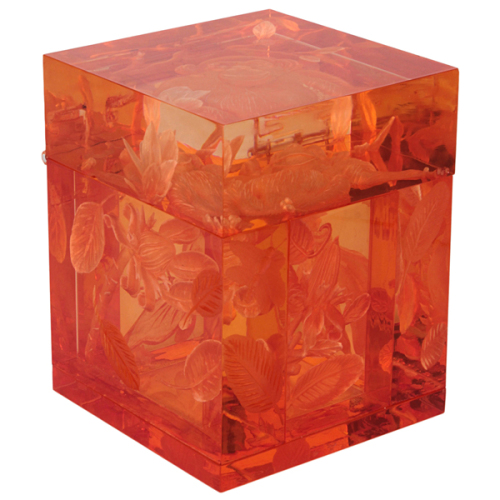
“Banana Land Flowers” box 2008
Cast and carved bright orange Lucite acrylic deeply incised and carved with three dimensional images of a monkey, a butterfly, a dragonfly and exotic flowers and foliage.
The top cover dimension is 1 3/4″ thick and the four sides of the box are 1 1/4″ thick.
Marks: Joyce Francis 08
H: 6″ x W: 4 3/4″ x D: 4 3/4″
Price: $3,750
Joyce Francis is a native Manhattanite artist who specializes in sculptured acrylic jewelry, purses, sculpture, tables and coveted collection of exciting, passionately carved decorative boxes. All pieces have been painstakingly hand carved, hand dyed, illuminated and sometimes hand painted as well. There are no embedded objects. Her purses are part of the permanent collections of the New York Metropolitan Costume Institute (New York), The Victoria and Albert Museum (London), The Fashion Institute of Technology (New York) and the Rock and Roll Hall of Fame (Cleveland).
Her work is in the collections of a number of stars and celebrities, including Hillary Swank, Phoebe Cates Kline, Emma Thompson, Cicely Tyson and Meryl Streep. Examples of her boxes and lamps are also owned by Paul Simon, Paul McCartney, Steve Martin and Tom Hanks.
1950’s ITALIAN DESIGN
Futurist pitcher c. 1950
Handwrought and hand hammered pewter in an overall footed ovoid form with a traingle form spout body and an elongated arching contoured handle
Marked: PELTRO with lion, MADE ITALIA
H: 15″ x W: 9″ x D: 4″
Price: $6,000
The 1958 classic film, Auntie Mame, starring Rosalind Russell, features this sculptural pitcher on the coffee table in the surrealist interior of Mame Dennis’ penthouse on Beekman Place #3, New York City.
ALEXANDER LIBERMAN (1912-1999) USA
MEYER SCHAPIRO PORTFOLIO 1974
Untitled 1973
Silkscreen, patinated bronze frame
Signed: A. Liberman 1973, Artist’s proof, 2RC (embossed on paper)
Canvas: H: 33” x W: 25 1/2”
Frame: H: 42 1/2” x W 33 1/2”
Portfolio of 12 works, Edition of 100
Price: $
Alexander Liberman’s family left the Soviet Union for London as exiles in 1921. Liberman studied there briefly before moving to Paris where he undertook philosophy and mathematics at the Sorbonne and architecture at the École des Beaux-Arts. In the 1930s Liberman designed stage sets, and worked on the staff of Vu, the first magazine illustrated with photographs. Although Liberman quickly earned the title of managing director, he left the magazine in 1936, and devoted himself to painting and writing. In 1941, he left Paris for New York. Again, he became involved in publishing after gaining employment at Vogue magazine. Twenty years later, in 1962, he became Editorial Director of all Condé Nast Publications, a position he held until he retired in 1994. During his time at Vogue, Liberman introduced 20th-century art to readers by using it as a backdrop for fashion shoots, as well as by profiling living artists in the magazine. As a painter, Liberman exhibited geometric circle paintings in galleries and museums around New York in the 1950s. Liberman also had an interest in sculpture, and began welding steel into public works in the late 1950s. These monochrome geometric sculptures are featured in over 40 cities worldwide.