Illustrated: Domestic Animals: The Neoprimative Style Andrea and Nicoletta Branzi, (London, 1987) n.p.; Designed by Architects in the 1980s, Julie Capella and Quim Larrea, Barcelona, 1987, p. 37; Anne Bony, Paris Les années 80, 1995, p. 520; Charlotte and Peter Fiell, 1000 Chairs, Cologne, 2000, p. 588
H: 42 3/4″ x W: 19 3/4″ x D: 24″
Price: $19,000
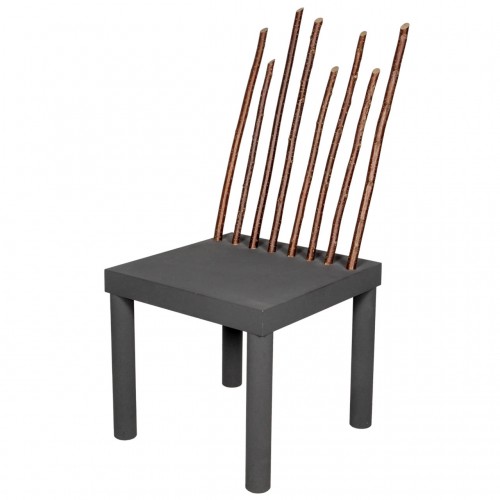
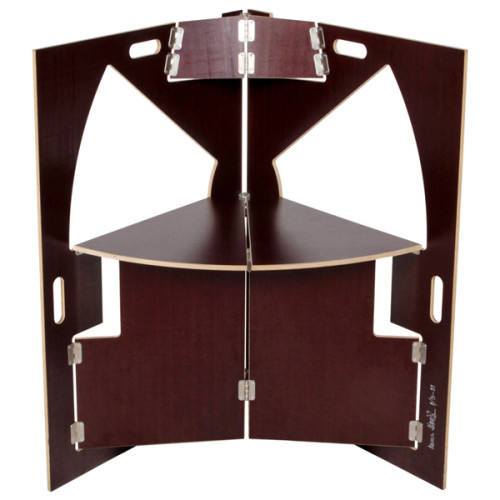
The “Cucus” chair was part of the “Domestic Animals” series
designed in 1985/86 by Andrea Branzi for Zabro.
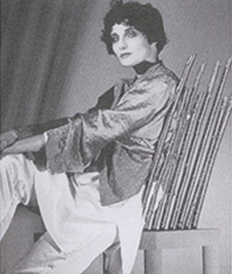
Andrea Branzi's “Domestic Animals” series was designed in 1985 and 1986 for the Italian firm Zabro. Designs were later also manufactured by Zanotta. Andrea Branzi created “Domestic Animals” in collaboration with Nicoletta Branzi, who produced limited edition art clothing for this series. The “Neoprimitive” style in which this collection has been rendered utilizes natural materials such as sticks to create an object that brings archetypal symbols into the home to produce emotional effects. These objects combine technology and nature and the symbols and codes that these entail demonstrating that “a hybrid love between different creatures is possible.” (Branzi, Domestic Animals, 1987, n.p.) With these objects Branzi aims to “domesticate” technological inventions so as to make them a positive presence in man's life.
“The difference between a domestic animal and a trained (or tamed) one lies in the fact that the latter is the outcome of an unnatural and violent attitude, while the domestic animal establishes the dream of a loving relationship with man.” (Branzi, Domestic Animals, 1987, n.p.)
Andrea Branzi, architect and designer, born in Florence in 1938, where he graduated in 1967, lives and works in Milano. From 1964 to 1974 he was a partner of Archizoom Associati, first vanguard group internationally known, whose projects are preserved at Centro Studi e Archivio della Comunicazione in Parma and at Centre Georges Pompidou in Paris.
Since 1967 he works in the fields of industrial and research design, architecture, urban planning, education and cultural promotion.He is Professor at the Third Faculty of Architecture and Industrial Design of Politecnico di Milano.
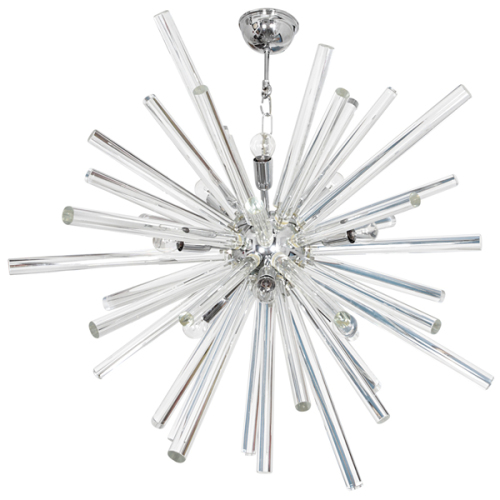
Bakalowits & Söhne Spectacular “Starburst” chandelier c. 1970’s
BAKALOWITS & SÖHNE (founded 1845 in Vienna)
“Starburst” chandelier c.1970’s
Crystal rods of varying lengths with nine lights,
chromium-plated metal ceiling cap and spherical chandelier parts.
Ceiling to drop length: 46 1/2″ x overall diameter: 33 1/2″
Price: $24,000
The Bakalowits Company was founded in Vienna, Austria in 1845 by Elias Bakalowits. After his son Ludwig joined the company, E. Bakalowits & Sons grew and became one of the foremost crystal chandelier manufacturers in the Austro-Hungarian Empire. In 1892 Ludwig Bakalowits received the order to manufacture the chandeliers for the Neue Hofburg Palace in Vienna for Emperor Franz Joseph I and was appointed Imperial and Royal Purveyor to the Court.
The company’s reputation for excellence grew outside Europe, and by 1885 the company was exporting its products to America and Asia. In 1900, Bakalowits & Sons displayed their crystal chandeliers at the World Exposition in Paris. Other exhibitions in St. Petersburg, London, Geneva and Turin followed and attracted more clients from around the world. In 1928, the company obtained patents for its crystal chandeliers. In 1955 Bakalowits was entrusted with the manufacture of new lighting fixtures for some of the Viennese buildings that had suffered damage during the Second World War. These included the Parliament, the State Opera House, the National theatre, City Hall, St. Stephan’s Cathedral, and others.




 @hd_jewels
Reviews
There are no reviews yet, would you like to submit yours?