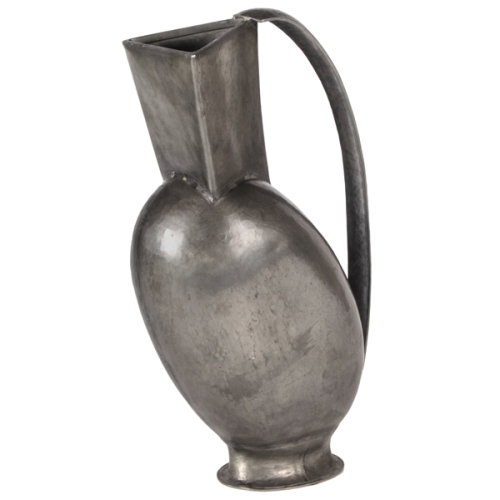
Italian Futurist 1950’s “Auntie Mame” Handwrought Pewter Pitcher c.1950
1950’s ITALIAN DESIGN
Futurist pitcher c. 1950
Handwrought and hand hammered pewter in an overall footed ovoid form with a traingle form spout body and an elongated arching contoured handle
Marked: PELTRO with lion, MADE ITALIA
H: 15″ x W: 9″ x D: 4″
Price: $6,000
The 1958 classic film, Auntie Mame, starring Rosalind Russell, features this sculptural pitcher on the coffee table in the surrealist interior of Mame Dennis’ penthouse on Beekman Place #3, New York City.
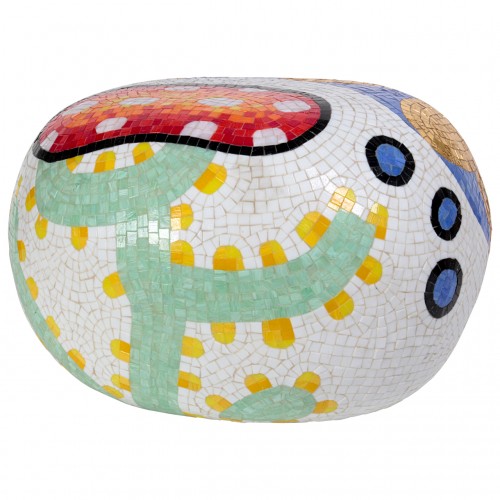
Marcel Wanders, One Morning They Woke Up, mosaic table/stool 2004
MARCEL WANDERS (1963-) The Netherlands
“One morning they woke up” mosaic occasional table or stool 2004
Gilt and lively colored glass mosaic, fiberglass body
H: 13″ x D: 17″
Price: $18,500
Marcel Wanders (1963) grew up in Boxtel, the Netherlands, and graduated at the School of the Arts Arnhem in 1988 with a cum laude certificate. He is now an independent industrial product designer operating out of Amsterdam where he has his own studio, Marcel Wanders studio. Marcel continues to work on diverse products and projects for Cappellini, Mandarina Duck, Magis, Droog Design and Moooi amongst others. For the latter he is associated as creative director. Marcel also co-operates in other design-related projects, such as the Vitra Summer Workshop where he was project leader for the second time. Also he was a juror for various prizes like the Rotterdam Design Prize (for which his own products were nominated several times) and the Kho Liang Ie prize. He lectured at SFMoMA, Limn the Design Academy and has taught at various design academies in the Netherlands. Marcel won the Rotterdam Design Prize (public prize) for the Knotted Chair, and received several other awards including the George Nelson Award (Interiors magazine) and Alterpoint Design Award 2000. In the 2001, Marcel has been nominated in the category ‘designer of the year’ in WIRED magazine’s 2001 wired rave awards. Designs of Marcel Wanders have been selected for the most important design collections and exhibitions in the world, like the Museum of Modern Art in New York and San Francisco, the Stedelijk Museum in Amsterdam, Museum Boijmans van Beuningen in Rotterdam, the Central Museum in Utrecht, and various Droog Design exhibitions. In the book ‘Wanders Wonders, design for a new age’ (1999) which accompanied a solo exhibition in Museum ‘t Kruithuis in Den Bosch, the most important products are shown, from the Knotted Chair to the Shadows lamps and from the Nomad Carpet to the Eggvase. Works of Marcel have been published in all leading design magazines.
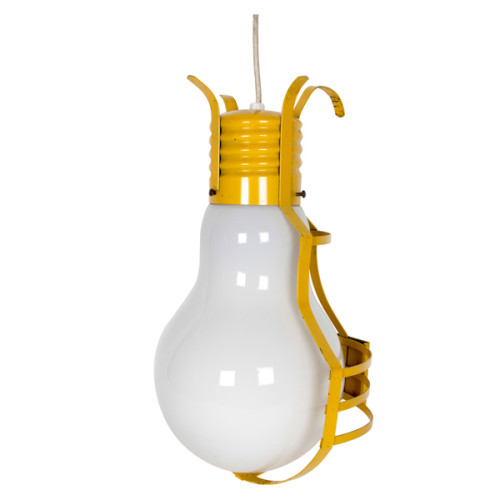
Italian Design “Pop-Art” Oversized “Anywhere” Lamp c. 1960’s-1970’s
ITALIAN DESIGN / POP ART
“Oversized “anywhere” lamp circa 1960’s-1970’s.
Real blown glass bulb with a yellow metal “protector” paying homage to the classic “anywhere” work light. It is interesting to note that at a later date Ingo Maurer who designed the famous “flying bulb lights” used this light as an inspiration and did a paired down simple version utilizing plastic rather than glass for the actual glass bulb part.



 @hd_jewels