Product Description
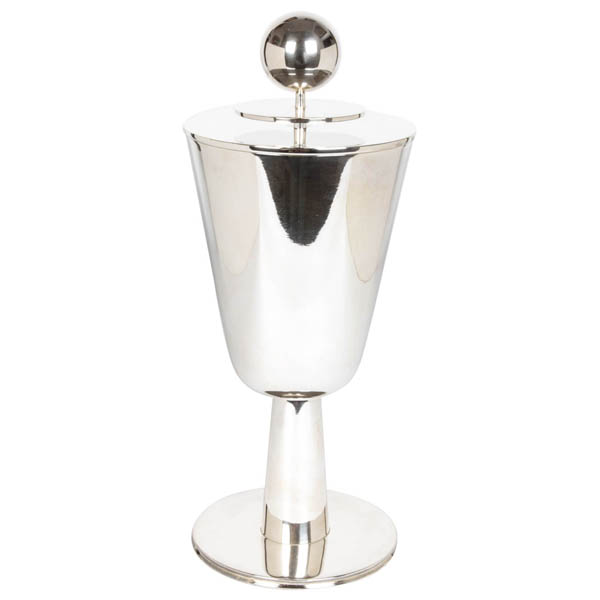
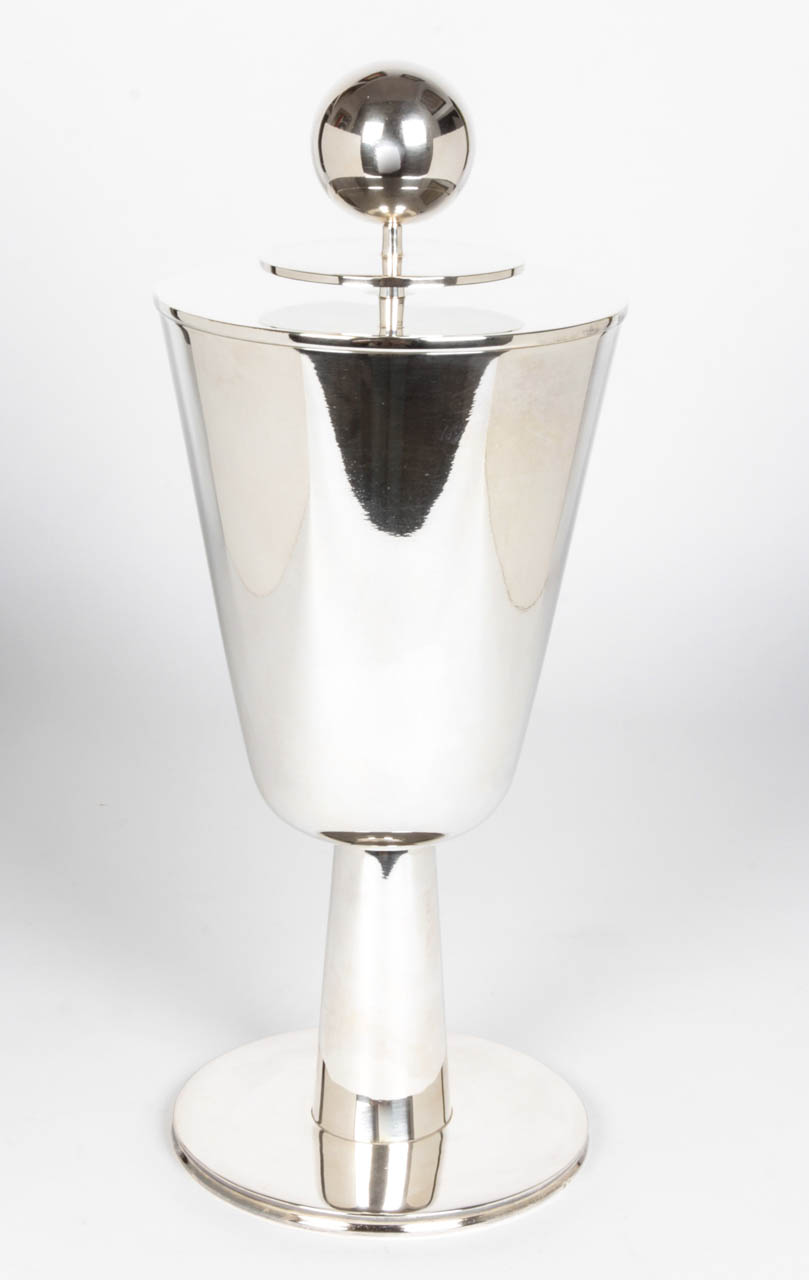
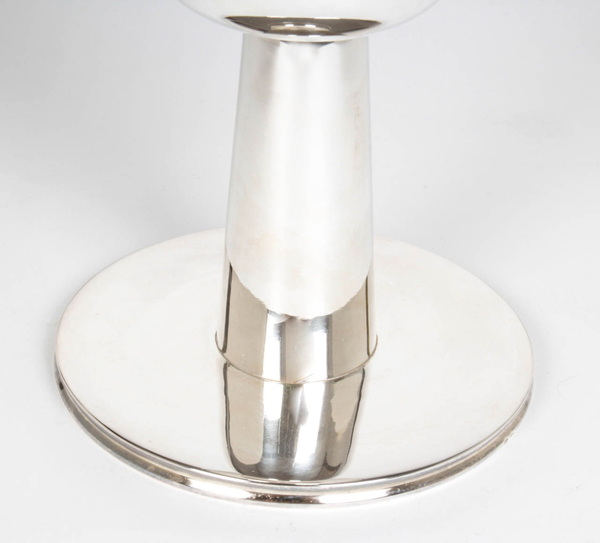
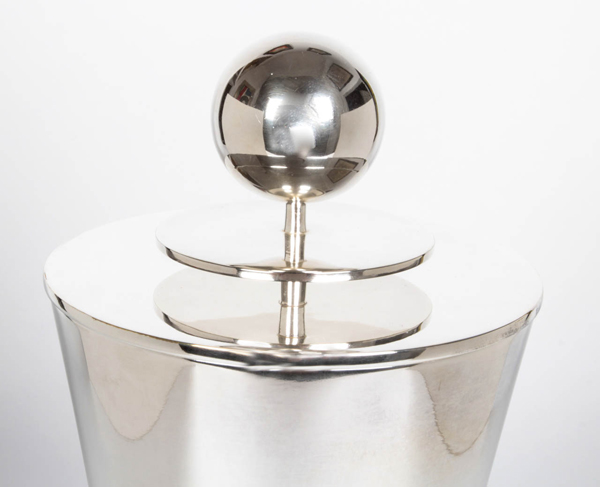
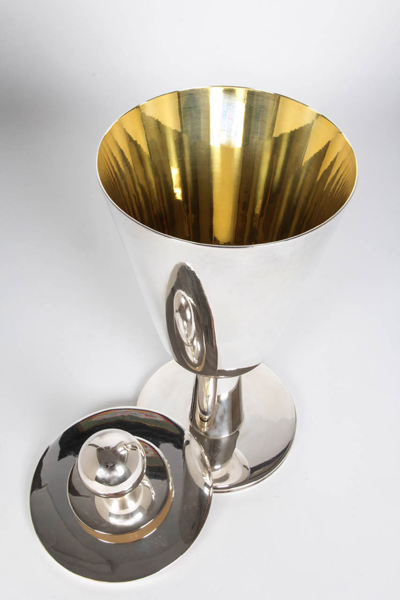
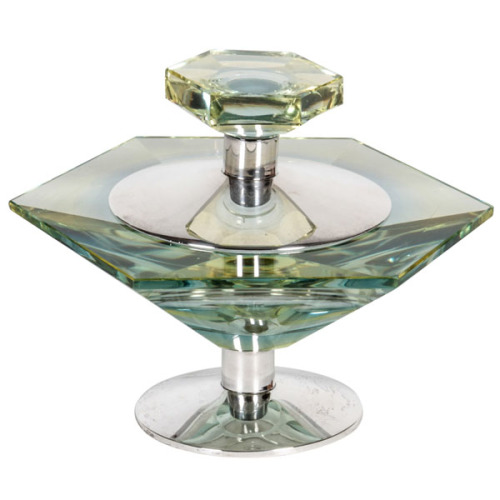
Breuhaus de Groot / WMF Ikora Germany Art Deco Rare “Pokal” Covered Footed Cup 1928

FRITZ AUGUST BREUHAUS DE GROOT (1883-1960) Germany
WMF [WÜRTTEMBERGISCHE METALLWARENFABRIK] Geislingen
“Pokal” Covered footed cup ( model no. Br 6 )1928
Silverplated brass, model no. Br 6
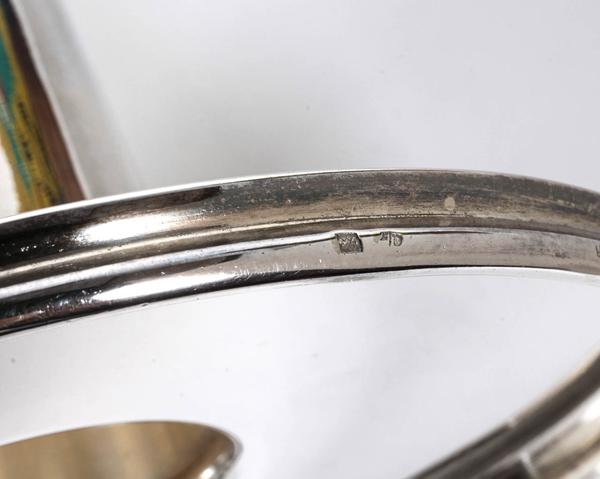
Marks: WMF insignia (touchmark), x/o
Illustrated: Goldschmiedekunst 49, (1928) m. Abb; Deutsche Kunst und Dekoration 63, (1928/29) Abb S 353; Metallkunst: Kunst vom Jugendstil zur Moderne (1889-1939), Karl H. Bröhan, Band IV (Berlin: Bröhan-Museum, 1990) n. 610, p. 571; WMF Ikora Metall / Metalwork, Carlo Burschel and Heinz Scheiffele (Stuttgart, Germany: ARNOLDSCHE, 2006) pp.12,19,34.
H: 13 ¼” D base: 5 ¼” x D top: 5 ½”
Breuhaus de Groot / WMF Ikora Germany Art Deco Rare “Pokal” Covered Footed Cup 1928
WALTER BOSSE (1904 – 1979) Austria
Bookends c. 1930
Hand-painted and glazed earthenware
For more information see: Walter Bosse: Leben, Kunst, und Handwerk, 1904-1979, Cherica Schreyer-Hartmann, Hans Hagen & Johanna Hottenroth (Vienna: Verlag Christian Brandstätter, 2000), Wiener Keramik: Historismus, Jugendstil, Art Déco, Waltraud Neuwirth, (Braunschweig: Klinkhardt & Bierman, 1974), pp. 114-115.
H: 5″ x D: 4 1/2″ x W: 5 1/4″
Price: $2,250
Walter Bosse (November 13, 1904–December 13, 1979) was a Viennese artist, designer, ceramist, potter, metalworker, and craftsman noted for his modernist bronze animal figurines and grotesques.
Walter Bosse, born November 13, 1904, in Vienna, was the son of artists Luise and Julius Bosse. His father worked as a portrait painter at the imperial court. Walter Bosse attended the Wiener Kunstgewerbeschule (Vienna School of Applied Arts) from 1918 to 1921, where he studied ceramics under Michael Powolny, and ornament under Franz Cižek. He then attended the Münchner Kunstgewerbeschule (Munich School of Applied Arts). During his schooling he was given the opportunity to sell his work at the Wiener Werkstätte by Josef Hoffmann, who became a mentor to Bosse. Bosse opened his own shop in Kufstein in 1923.
Bosse’s work grew in popularity and a number of his pieces were shown at the International Exposition of Modern Industrial and Decorative Arts in 1925. He started designing for Augarten Porcelain Works (1924) as well as Goldscheider (1926) and Metzler and Ortloff (1927). In 1931, to meet increasing demand (especially in America), Bosse opened up a bigger shop in Kufstein, but by 1933 he started to feel the effects of the economic depression. By 1937, the Kufstein works were closed.
In 1938, now divorced, Bosse moved back to Vienna where he founded Bosse-Keramik (Bosse Ceramics), which expanded under the new name “Terra” to include glass, toys, textiles. and a variety of craft items for the gift market. In the late 1940s, Bosse began experimenting with brass by giving his ceramic figures a metal coating to protect them from breakage. In the early 1950s, Bosse began his “Black Golden” line of brass figurines. He transitioned all of his efforts to brass. The figures became popular worldwide.
Despite Bosse’s success with his brass figures, it was still a difficult time for him financially. In 1953, partly fleeing from financial troubles, he moved to Iserlohn where he set up a new shop and continued production. Bosse also collaborated with Karlsruhe State Majolika Works on a number of pottery animal figures. In 1958, he designed for Achatit Schirmer in Cologne. Bosse also turned his efforts to small, everyday items such as letter openers, keyrings, corkscrews, and pencil holders, all of which bear his distinctive “black and gold” look. A number of these Bosse designs began to gain widespread popularity internationally.
MÜNCHNER WERKSTÄTTEN Germany
Vase c. 1928
Blue and white modeled glazed earthenware with orange red outlines
Marks: “M” over “W” mark, Germany
Provenance: Mr. Ernest L. King (Watkins) “Rockledge” Commission, Winona, MN c.1930’s Phillip Brooks Maher (interior architect), descended in the King Family to Bud (E. L. King Jr.) and Betty King, Winona, MN, Hollander Gallery, Milwaukee, WI, Private Collection, New York, NY
H: 9 ¾” x W: 8 ¼” x D: 8 ¼”
Price: $5,450
ROCKLEDGE, the summer home of Ernest and Grace King (the Watkins Family Company fortune was made from door-to-door sales of health potions and hygiene related products) was built and designed in its entirety from the expansive main home building with all of the furnishings to the custom silver service all the way down to the hand woven carpets and lace curtain designs, is arguably the most famous American Arts and Crafts commissioned home in America and was built and meticulously designed by George Washington Maher. It was finished in 1912, and was used by the Kings for the month of August only for a couple of decades before the interior was completely redone in the fashionable Art Deco design of the 1930’s. George Washington Maher’s son Phillip Brooks Maher, was hired for the project and went shopping for the best of the design of the period in both New York and Paris. He assembled a legendary collection of Art Deco design that comprised many important examples of both American and European Art Deco including the famous Donald Deskey square form telescope table, a Gilbert Rohde “Z” clock, a pair of Mies van der Rohe red lacquer and wicker armchairs, DIM furniture and rugs from Paris and rare Paolo Venini floor lamps and sculptural glass pieces among many other major 20th Century design works. This rare vase was indicative of the avant-garde furnishings throughout the King Home as well as the exquisite quality and attention to the detail of every single object that the Kings surrounded themselves with and became accustomed to enjoying and living with whether they were at their Daytona Beach resort, their lakeside property at Lake Tahoe or their plantation in Hawaii!
BAUHAUS Germany (1919-1933).
Gebrüder Thonet, Vienna.
Nesting tables, circa 1930.
Tubular chrome base with exotic wood and burl, glass inset half tops.
For more information see: Deutsche Stahlrohr Möbel, Alexander von Vegesack (München: Bangert Verlag, 1986), Bauhaus Furniture: A Legend Reviewed, exhibit. cat., Bauhaus-Archiv Museum für Gestaltung, Berlin, 2002.
Smaller table: 22″ H x 17″ D x 26 1/4″ W.
Larger table: 24 1/2″ H x 17 1/2″ D x 29 3/4″ W.
Price: $11,750
ALEXANDRE NOLL (1890-1970) France
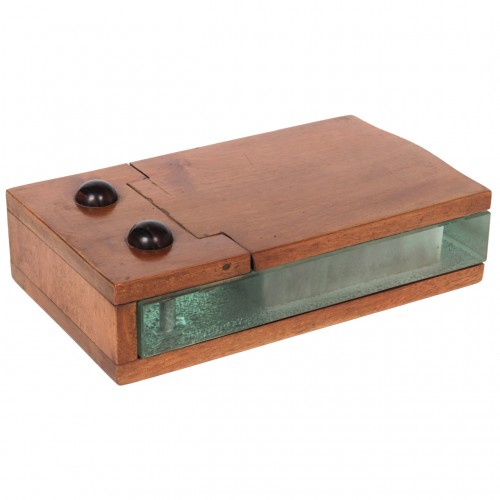
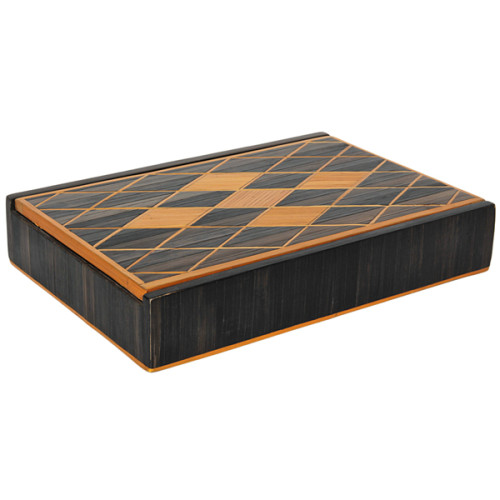
Covered box c. 1930
Mahogany with ebony peg details and 1 ¼ inch thick Saint-Gobain glass.
Marks: ANoll
Provenance: Private Collection New York, Galerie de Beyrie Paris, Odile Noll (A. Noll’s daughter), Alexandre Noll Estate
For more information see: Alexandre Noll, Olivier Jean-Elie, Pierre Passebon (Paris:Edition du Regard, 1999); Alexandre Noll: Les Matres de L’ Art Decoratif Contemporain, Collection dirigée par R. Moutard-Uldry edited by (Geneve: Pierre Cailler, 1954); Le Mobilier du Xxe Siécle: Dictionnaire des
Créateurs, Pierre Kjellberg (Paris: Les Éditons de l’Amateur, 1994) p. 455-456.
H: 2 1/2″ x D: 5 3/8″ x W: 8″