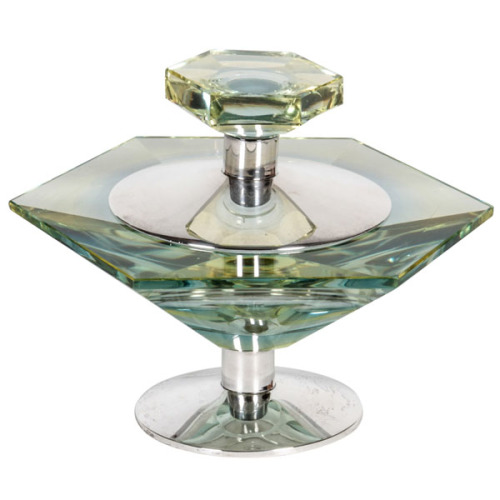
Hexagonal green-tinted lead crystal covered dish / tazza with lid in a stepped jewel-like form mounted with a silver lid and footed base silver
Marks: WMF logo, moon, crown, 800
For more information see: Wilhelm Wagenfeld und die Moderne Glasindustrie,Walter Scheiffele (Stuttgart: Verlag Gerd Hatje, 1994); WMF Ikora Metall / Metalwork, Carlo Burschel and Heinz Scheiffele (Stuttgart, Germany: ARNOLDSCHE, 2006).
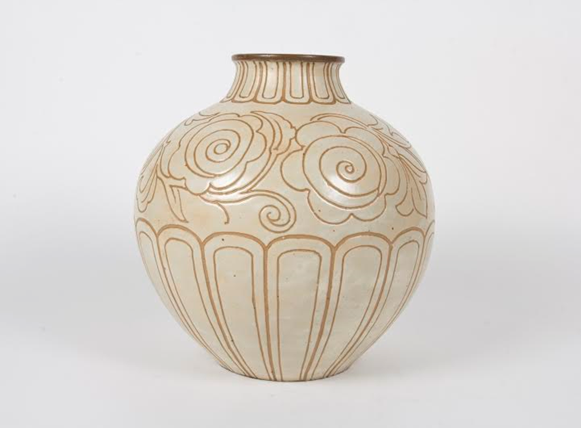
Georges Serré / Art Deco Warm ivory /sand colored glazed stoneware vase c. 1925
GEORGES SERRÉ (1889-1956) France
Vase c. 1925
Warm ivory /sand colored glazed stoneware with hand incised stylized leaf and floral motif with a top collar and lower half in a softened geometric repeat pattern all in a light brown tonality.
Marks: G Serre (hand incised signature)
For more information see: La Céramique Art Déco, Edgar Pelichet (Paris: Bibliothèque des Arts, 1988), p. 47.
For more information on Serré see: Georges Serré, exhib. cat. (Paris: Galerie Landrot, 1992).
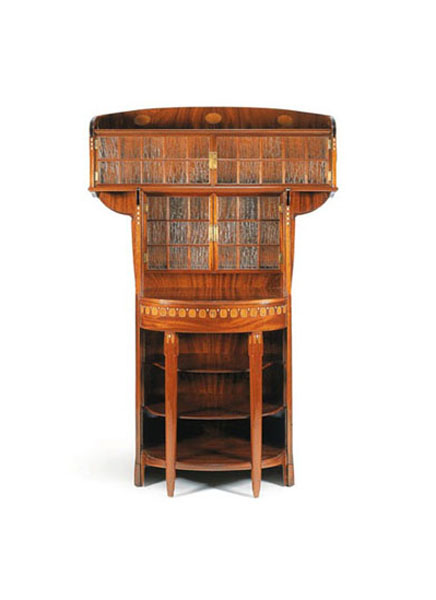
Alfred Grenander / W. Kummel 1904 St. Louis Exhibition cabinet, unique 1904
ALFRED GRENANDER (1863-1931) Sweden / Germany
W. KUMMEL Berlin, Germany (cabinetmaker)
Cabinet (unique) c. 1904
Flamed mahogany, ebony, ivory and fruitwood inlays, brass hardware and details, textured glass
Marks: American import label (from Germany) for the St. Louis exhibition
Exhibited: The 1904 St. Louis Exhibition, German Section in the Herrenzimmer
Illustration of Grenander room: Deutsches Kunstgewerbe St. Louis 1904, Hugo Nachtlicht, 1904, p. 80.
Commentary on Grenander’s display at St. Louis Exhibition: Deutsche Kunst und Dekoration, Band XV Oktober 1904-Marz 1905, “Die Wohnungskunst auf der Welt –Austellung in St. Louis”, Dr. Hermann Muthesius, p. 213-16.
Related bookcase-cabinet illustrated: Deutsche Kunst und Dekoration, Band XVI April-September 1905, p. 426.
For other works by Grenander see: Deutsche Kunst und Dekoration, Band XVI April-September 1905, p. 395-407, 426, 427, 671-73, 694, 695; Das Deutsche Kunstgewerbe 1906, 111. Deutsche Kunstgewerbe-Austellung Dresden 1906, (München, Verlagsanstalt P. Bruckmann A.G., 1906) p. 129-133, 232, 261
H: 79 1/2” x W: 57” x D: 23”
Price: $95,000
Alfred Grenander was born in June 1863 in Skövde, Sweden, and came to Berlin in 1885 to study. The city became his home, and he built his first buildings here together with his brother-in-law Otto Spalding. In 1897 Grenander began teaching at the Unterrichtsanstalt des Berliner Kunstgewerbemuseums (college attached to Berlin’s Museum of Arts and Crafts). His involvement with underground railway architecture began in 1900 and came to dominate his life’s work, with more than 80 buildings. He died on 14 July 1931 in Berlin.
From the turn of the century through the early 1930s, Alfred Grenander provided the emerging metropolis of Berlin with an extensive net of subway stations. He was an architect, draughtsman, and city planner; as well as a remarkable furniture designer. Grenander was the celebrated German representative at the 1904 World’s Fair in St. Louis, where he was being honored as “the renewer of German art.” This mahogany cabinet inlaid with pewter, ebony and ivory was exhibited in the elegant Herrenzimmer of the German pavilion at the Louisiana Purchase Exposition, St. Louis, Missouri, 1904, was bought in 1904 by a Kansas City, Missouri family and the piece descended in the family.
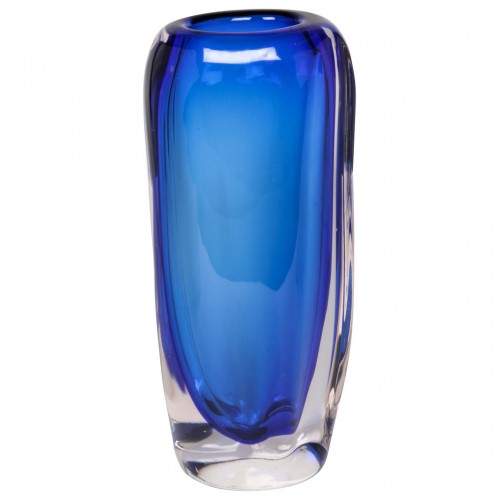
Flavio Poli / Seguso Vetri d’Arte Murano Mid-Century Modern art glass vase c. 1950’s
FLAVIO POLI (1900-1984) Italy
SEGUSO VETRI D’ARTE Italy
Vase c. 1950’s
Blue and clear Murano glass
H: 10″ x D: 3″ x W: 4 1/2″
Price: $1,850
Designer, businessman, ceramic artist. Born in Chioggia, he attended the Istituto d’Arte di Venezia and began work as a designer in ceramics. in 1929 he switched to glass and for Libero Vitali’s I.V.A.M. he designed animals, splendid Novecento-style nude figures in massiccio glass, as well as bowls and urns with figures resting on the inside, on lids or as handles. He subsequently collaborated with the Compagnia di Venezia e Murano, with the furnace of Mario and Lino Nason and with the engraver Gino Francesconi. in 1934 he accepted the artistic direction of Barovier, Seguso & Ferro, later to become Seguso Vetri d’Arte, and became partner three years later. Together with the master of the principal team Archimede Seguso, Poli was the author of grandiose lighting installations, of corroded vessels, of sculptures in bulicante glass, of animals in massiccio glass shaped while hot, productions which represented a milestone in the development of Murano glass. At the height of his artistic maturity, in the years between 1950 and 1960 he designed a series of sommerso glass pieces in a Nordic style, essential forms and sharp cold colors, which were awarded prestigious prizes (Compasso d’Oro). After leaving Seguso in 1963, between 1964 and 1966 he organized the artistic glass division at the Societˆ Veneziana di Conterie e Cristallerie.


 @hd_jewels