Product Description
David Simpson “Little Ibicenco” – California Hard-Edge Abstract painting 1979

DAVID SIMPSON (1928-) California, US
“Little Ibicenco” – California Hard-Edge Abstract painting 1979
Acrylic on canvas
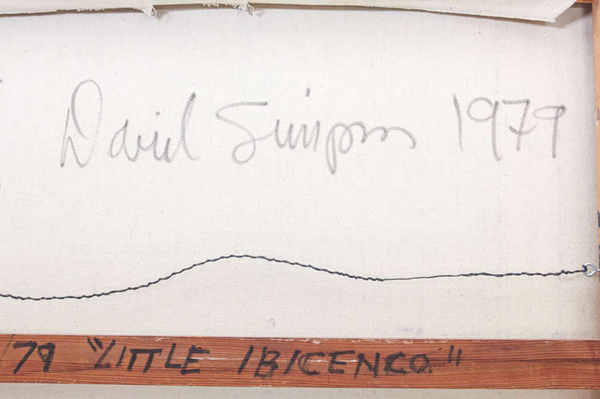
Marks: David Simpson (script signature) on back of canvas, 1979, #14/79 “Little Ibicenco”, two arrows
H: 29″ x W: 28 3/4″
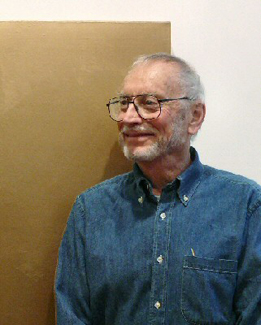
David Simpson has explored varieties of abstraction since the early 1950s, enjoying acknowledgement and success in the art world. In 1963 he was chosen by New York’s Museum of Modern Art curator, Dorothy Miller, to appear in what turned out to be the last in her legendary series of group shows of contemporary American art. In 1964 he appeared in Clement Greenberg’s famous exhibition Post Painterly Abstraction at Los Angeles County Museum of Art. At that time Simpson painted landscape-derived abstractions and, in the 70s, he practiced a reductive but relational mode of abstraction. But with his discovery of a new acrylic medium in 1987, he was able to embrace finally and successfully the monochrome’s radicality.
Simpson uses an acrylic paint with interference properties. The paint is composed of titanium dioxide electronically coated with mica particles. Simpson tends to mix complementaries, but admits that orange and blue also work together well. He also mixes black acrylic with the interference pigments, finding that a little bit of black helps the colour jump out. Interference pigments cause optical effects that are comparable to iridescence. When you look at the painting from one angle, you receive one set of colour sensations. When you shift your position, you get another. As you move back and forth in front of the canvas – and the paintings make you want to do so – the experience changes. The change of light also dramatically affects the optical experience, and the play of light across the canvas surface is subtly kinetic.
***David Simpson was associated with the California Hard-Edge Movement.
Hard Edge Abstraction:
It encompasses rich solid colors, neatness of surface, and arranged forms all over the canvas. The Hard-edge painting style is related to Geometric abstraction, Post-painterly Abstraction, and Color Field painting. Hard edge is also a simply descriptive term, as applicable to past works as to future artistic production. The term refers to the abrupt transition across “hard edges” from one color area to another color area. Color within “color areas” is generally consistent, that is, homogenous. Hard-edged painting can be both figurative or nonrepresentational.
Important solo exhibitions include: Studio la Città, Verona (2008); Light Wells +, Charlotte Jackson Fine Art, Santa Fe (2007-08); Sonta Roesch Gallery, Houston (2007); Light Wells, Haines Gallery, San Francisco (2007); Iridescent Interference, Gallery Sonja Roesch, Houston (2005); Surrealist Landscape and other Departures, Haines Gallery, San Francisco (2005); Cheryl Haines Gallery, San Francisco (2004); James Kelly Contemporary, Santa Fe (2003); Artotek, Köln (2002); Renate Schröder Galerie, Köln (2002); Renate Schröder Galerie, Köln (2001); Studio la Città, Verona (2001); Modernism Gallery, San Francisco (2001); University Art Museum, San Francisco (2000); Renate Schröder Galerie, Köln (2000); Haines Gallery, San Francisco (2000).
Important group shows include: Galerie Lausberg, Dusseldorf (2007); West Coast Abstraction, Modernism Gallery, San Francisco (2007); Fundamental Abstraction, Haines Gallery, San Francisco (2007); The Panza Collection – An experience in light colour, Albright Knox Gallery, Buffalo, with catalogue (2007); Inneres Leuchten-Farbe als Malerei, Kunstverein Lingen Kunsthalle, Lingen (2005); Recent Paintings, Galleria G7, Bologna (2005); Je ne Regrette Rien, Studio la Città, Verona (2005); The Forman Collection, Albright Knox Gallery, Buffalo (2005); Modernism Gallery, San Francisco (2004); San Jose Museum of Art, San Jose, CA (2004); Albright Knox Art Gallery, N.Y. (2003); La percezione dello spazio , Palazzo della Gran Guardia, Verona (2002); Le stanze dell’arte , MART, Rovereto (curated by Gabriella Belli) (2002); Artisti americani ed europei dalla collezione Panza , Palazzo Ducale, Sassuolo (2001); Nebeneinander III (Painting Today – Overseas and Here ), Galerie Renate Schröder, Köln, with catalogue (2001); La collezione Panza di Biumo: artisti degli anni ’80 – ’90 , Museo del Palazzo Ducale, Gubbio, with catalogue (1997).
David Simpson “Little Ibicenco” – California Hard-Edge Abstract painting 1979
OMAR KHAYYÁM (1048 – 1123) Persia
“Rubáiyát” 1884
128pp. First edition bound in brown flat-weave cloth over beveled boards; front cover with gilt lettering, dark brown-stamped ruled borders, symbolist design of vase, vine, swirl and stars, rear cover without decoration; spine with gilt lettering and dark brown-stamped ruled borders and ornaments; signed in gilt & dark brown-stamp on front cover. Collection of poems originally written in the Persian language, “Rubáiyát” (derived from the Arabic root word for 4) means “quatrains”: verses of four lines.
Translated by Edward Fitzgerald
54 drawings by Elihu Vedder reproduced by Albertype process on facing pages (printed one side only)
Published by Houghton Mifflin and Company, Boston
Dimensions:
Book: H: 16” x W: 13 ¼” x D: 1 ¾”
Custom leather box 2008: H: 17 15/16” x W: 14 3/4” x D: 2 7/8”
Custom silk slipcase: H: 19 1/8” x W: 15 ½” x D: 4”
From the moment of its publication, Elihu Vedder’s Rubáiyát of Omar Khayyám achieved unparalleled success. The first edition appeared in Boston on 8 November 1884; six days later, it was sold out. Critics rushed to acclaim it as a masterwork of American art, and Vedder (1836-1923) as the master American artist who set the standard for the artist-designed book in America and England.
Written ca. 1120 by Persian poet-philosopher Omar Khayyam (1048-1131), the Rubaiyat is a collection of quatrains, or poems of four lines, intended to prove the futility of mathematics, science, and religion in determining the meaning of life. First translated from Persian to English in 1859 by Edward Fitzgerald, editions of Khayyam’s Rubaiyat have since appeared in numerous forms and languages, thebest-loved, best-known, and most elaborate being the 1884 edition illustrated and designed by Elihu Vedder.
Vedder was one of the first artists of his generation to train in Paris where he developed his signature Academic style and focused on what would become his favored subject: the classically proportioned female nude. In the years 1883 and 1884, he created 54 compositions to accompany the 1884 edition of Khayyam’s Rubaiyat (published by Houghton, Mifflin) – drawings that serve as a harmonious frame for the text. Living in Rome at the time, Vedder also designed the book’s cloth-bound cover, lining papers and eccentric hand-drawn letters. With his Academic and yet “visionary” style, Vedder was the ideal artist to interpret the Rubaiyat; he reconciled the critics who called for accurate depiction of observed reality with those who argued for feeling and emotion over objective form.
Additionally, Vedder arranged the verses to express the three stages of existence explored in the Rubaiyat — happiness and youth; death and darkness; and rebirth — as well as to fit his own romantic interpretation of the verses. Vedder’s drawings for the book combine traditional Christian symbols, classical figures, and mystical imagery of his own invention to evoke the mood of Khayyam’s poems. A prevalent device is his “cosmic swirl,” which, according to Vedder, represented the “gradual concentration of elements that combined to form life; the sudden pause through the reverse of the movement which marks the instant of life; and then the gradual, ever-widening dispersion again of those elements into space.”
Vedder’s edition of Khayyam’s Rubaiyat was an instant success, selling out only six days after its debut in Boston on November 8, 1884. With the Rubaiyat, Vedder set the standard for artist-designed books in America and England. Critics rushed to acclaim it as a masterwork, and Vedder as a major American artist.
The Brandywine River Museum presents decorative drawings and paintings created by a master nineteenth-century American artist in Elihu Vedder and the Rubáiyát of Omar Khayyám, on view from March 15 to May 18, 2008. The exhibition features more than 50 drawings with hand-lettered poems created by Vedder for his illustrated version of Khayyám’s literary work. Exclusively at the Brandywine River Museum, the exhibition also features major paintings by Vedder related to the illustrations for the i>Rubáiyát.
Elihu Vedder’s Rubáiyát was published in Boston in 1884 and its sensuous, decorative drawings so captivated the public that the first edition of the book sold out in six days. Critics rushed to acclaim it as a masterwork of American art, and Vedder as the master American artist. Vedder’s designs for the book-its cover, lining paper, drawings, and hand-drawn letters-are all done in chalk, pastel, pencil, and ink. The drawings set the standard for an artist-designed book in America and England in the 1880s. They are part of the Smithsonian American Art Museum’s permanent collection and were last shown in 1996.
The Rubáiyát was written in 1120 by the Persian mathematician, astronomer, and poet Omar Khayyám (1048-1131). “Rubáiyát” is the plural form of quatrain, or a verse unit of four lines. Since the first English translation was published in 1859, hundreds of editions have been produced. The poem expounds on the transience of existence and the uselessness of science and religion to untangle the knotted meanings of life. Pre-Raphaelite and aesthetic-movement writers immediately embraced the poem as a touchstone of the spiritual and poetic in a time of strident materialism.
As an ardent admirer of the verses, Vedder’s interest in the book went beyond the aesthetic to the personal. The tragic deaths of his sons (in 1872 and 1875) and births of two more children (a daughter in 1873 and a son in 1875) were remarkably explained, it seemed to Vedder, by the poet’s message regarding death, undiscoverable fate, and the renewal of life. He included images of himself and his family in several of the drawings.
The exhibition also features paintings by Vedder, including some that pre-dated the Rubáiyát and provided the basis for illustrations in it. Following the success of the Rubáiyát , Vedder continued to explore its themes and imagery in a number of paintings that he exhibited and sold. Among these are The Cup of Death (1885/1911), The Pleiades (1885), The Fates Gathering in the Stars (1887), and The Cup of Love (1887). The paintings are on loan from museums and private collections.
Elihu Vedder has often been described as an artist of haunting and poetic imagination, who created works of strength, beauty, and fantasy. Born in New York City in 1836, Vedder began painting seriously after visiting Europe in 1856 to study in Paris and Florence. He briefly returned to New York and opened a studio, which failed due to the onset of the Civil War. It was during his years in New York that he produced some of his most imaginative works. He was elected to the National Academy of Design in 1865. Vedder returned to Europe in 1866 and settled in Rome, only occasionally returning to the United States to execute commissions for decorative works, murals, and mosaics. He died in Rome in 1923.
Peter Canty received his BA in art from the Chouniard Art Institute, Los Angeles (now California Institute of the Arts) and an MA from the University of California, Santa Cruz in 1969. Heavily influenced by the Post-Impressionist masters Van Gogh, Gauguin and Cezanne, in his own he words he describes his interest in landscapes, believing they are, “the best vehicle for motion, force, and color dynamics.” Although his work reference realistic subjects, Canty’s imagery is drawn strictly from his own imagination.
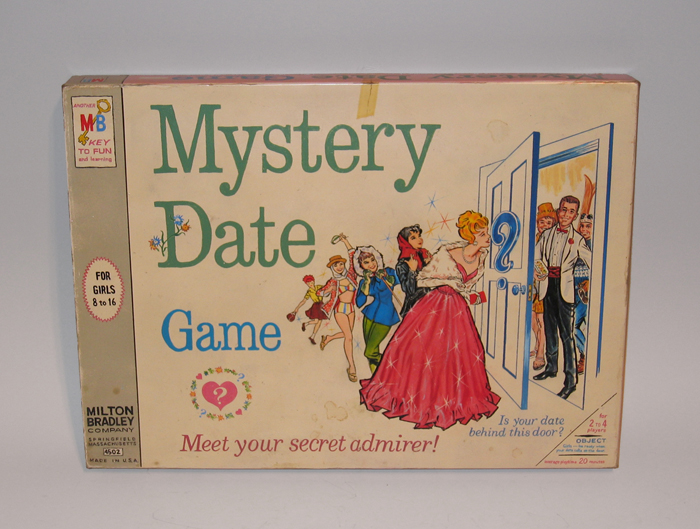
TIM LIDDY
“Who Can Beat Nixon” (1970) Presidential Sweepstakes 2006
Oil and enamel on copper, plywood back
Signed in script: Tim Liddy “circa 1970” 2006, red circular ring
Provenance: William Shearburn Gallery (St. Louis, MO)
H: 11 ¾” x W: 9” x D: 2”
With his recent paintings, Liddy has both reasserted the construct of hyperrealist painting and developed a thoroughly unique advancement of that mode by extending the cultural reality of the indexed original. Based on the illustrated box lids of vintage board games, Liddy has recontextualized a subject, which evokes the underlying rules of life. Painted on copper or steel in the precise dimensions of the original, the metal is then manipulated to demonstrate the exact rips and tears from years of usage and includes trompe-l’oeil renditions of the scotch tape that might be holding the cardboard box together, the assorted stains, or the various graffiti of time. Liddy leaves no possibility of ambivalence, these works speak to a concurrent understanding of their original object identity and to themselves as works of art engaged in historical and psychological dialogue.
ARCHIBALD KNOX (1864-1933) UK
LIBERTY & CO. London, UK
Hand mirror 1908
Sterling with large matrix cabochon turquoise
Marks: L & Co. cipher, Birmingham assay marks for 1908
Similar works with turquoise Illustrated: Archibald Knox, ed. by Stephen A. Martin (London: Academy Editions, 1995) ; Liberty Design 1874-1914, Barbara Morris (London: Pyramid Books, 1989) p. ; The Designs of Archibald Knox for Liberty & Co., A.J. Tilbrook (London: Ornament Press Ltd., 1976)
L: 11″