
Product Description
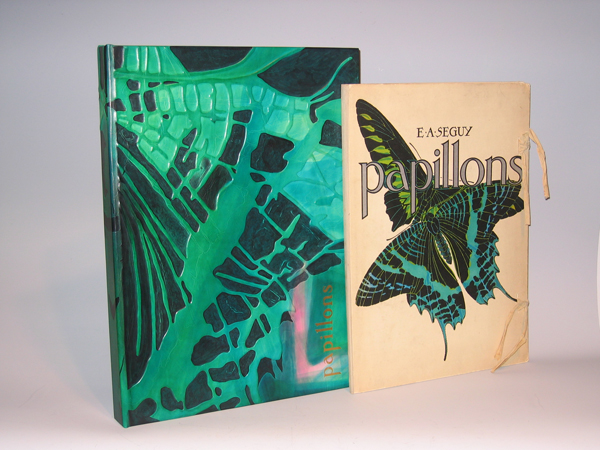
E. A. Seguy, “Papillons” portfolio c. 1925
E. A. SEGUY (1890-1985) France
“Papillons” portfolio c. 1925
Twenty pochoir over photogravure plates (hand painted collotypes) in paper portfolio with cotton ties
Pochoir is process by which rich color is applied layer by layer by hand with the aid of stencils, resulting in intense hues similar to those in stained glass windows.
Published by Editions Duchartre et Van Buggenhoudt, Paris, France
Dimensions:
Book: H: 18” x W: 13 1/8” x D: 1 ½”
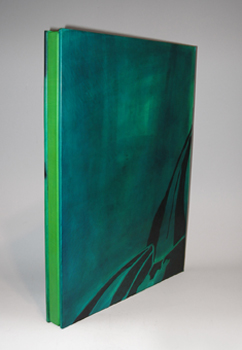
Custom leather box: H: 20” x W: 14 5/8” x D: 1 ¾”
Brilliantly and boldly colored butterflies from around the world are shown in interesting arrangements in pochoir prints from a set of 20 by the French designer and author E.A. Seguy. Plates 1 to 16 show large specimens in colorful arrangements, often overlapping, emphasizing colors, and patterns and shapes of wings and wing veins. Plates 17 through 20 are composite uses of butterfly patterns, in geometric boxes, like fabric or wallpaper designs.
In his foreword to Papillons, Seguy describes the prints as “un monde somptueux de formes et de couleurs” — a world of sumptuous forms and colors. He explains that they are intended to provide a record of rare, exotic specimens from museums and private collections, within an aesthetic context, thereby making them more widely accessible as inspiration for decorative arts designers. Nonetheless, Seguy based his images of butterflies and insects on illustrations in scientific publications, thereby maintaining scientific accuracy. They were enlarged up to 10 to 15 times to reveal intricacies of their design not visible without magnification. Also included with the set was a Table Des Noms Scientifiques [Table of Scientific Names], providing the technical species and genus names as well as the countries or regions of habitat for the species shown in Plates 1 through 16.
Eugene Alain Seguy produced eleven albums of illustrations and designs from the turn of the century to the 1930s, and his style reflected the influences of both Art Nouveau and Art Deco. His various color portfolios of visual ideas for artists and designers often featured motifs based on the natural world, including flowers, foliage, crystals and animals. Although his compositions were design oriented, he made the depictions scientifically accurate. His later works showed an increased interest in geometric and cubist designs. The prints in the portfolios were produced using the pochoir technique characterized by rich, intense color. This printing process, utilized in the early 20th century for high quality prints, involved applying colors to each plate with a number of stencils. Seguy’s works include Les Fleurs et Leurs Applications Decoratives (1900), Samarkande – 20 Compositions en Couleurs dans le Style Oriental (1914), Floreal (1920), Papillons (1924), Insectes (1924), Primavera –Dessins et Coloris Nouveaux (1929), Suggestions (1930), and Prismes – 40 Planches de Dessins et Coloris Nouveaux (1931).
Collections of prints like those produced by Seguy provided source material for designers of fabrics, wallpaper, ceramics, book illustrations, posters, and advertisements, and were popular in the late 19th and early 20th century. The leading Victorian publication of this type was Owen Jones’s Grammar of Ornament, first issued in a folio edition in London in 1856. Other trendsetting styles in art, design, decoration and fashion in the second half of the 19th century, and early 20th century, came from Paris, Austria, and Germany, and many such print collections were published there, including designs by Emile Belet, Armand Guérinet, Ernst Haeckel, Arsène Herbinier, and Anton Seder. To search our site for more Art Nouveau designs by such artists please type “Art Nouveau” into our search engine.
Editions Duchartre et Van Buggenhoudt was a publisher located at 15 Rue Ernest-Cresson, Paris. The series also was published by Tolmer Editeur, 13 Quai d’Danjou, Paris.
E. A. Seguy, “Papillons” portfolio c. 1925
ANDRE LANSKOY (1902-1976) France
MAURICE BEAUFUME
PIERRE LECUIRE
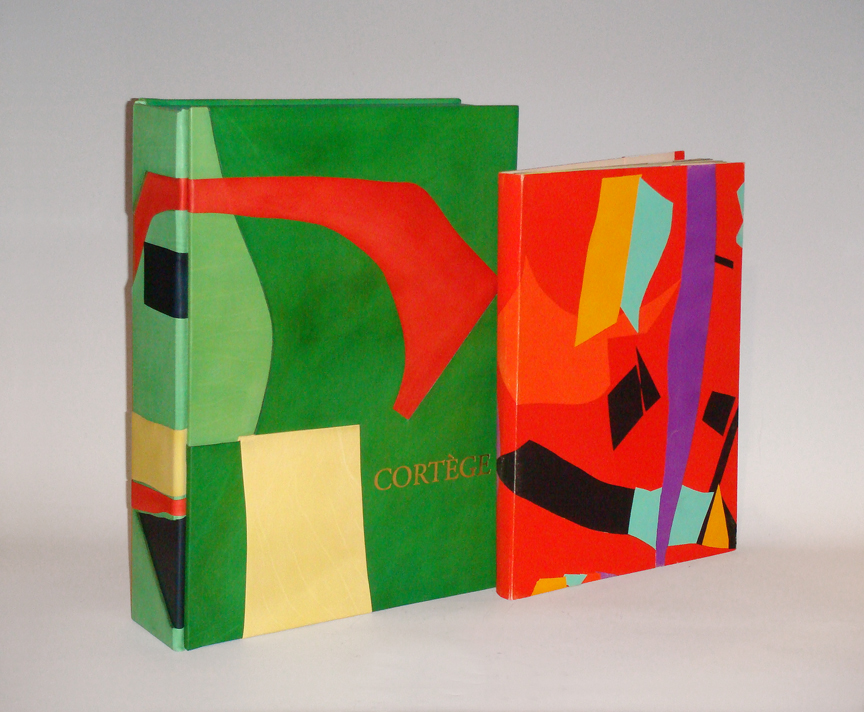
“Cortege” 1959
64pp, 25 illustrations by Andre Lanskoy and Maurice Beaufume
Cortège is now often compared to “Jazz” as perhaps the finest example of
pochoir in the postwar period. Printed on Arches Vellum paper.
Dimensions:
Book: H: 18” x W: 13 3/8” x D: 1 7/8”
Custom leather box 2008: H: 20 ¼” x W: 15” x D: 4 ½”
Custom silk slipcase: H: 21 ½” x W: 15 5/8” x D: 5 3/8”
The artworks of André Lanskoy (1902-1976) are more than abstractions—they are juxtapositions of shapes, assemblages of colors and studies that explore the interfacing of language with visual imagery. A pioneer of Tachism, an artistic movement of the 1940s and 1950s also known as Art Informel or Lyrical Abstraction, Lanskoy emphasized the spontaneous in his paintings, combining surges of pure color with more subtle modulations. His efforts to translate language into abstract visual messages are most evident in two of his bold projects: a rare screen-printed textile and his vivid collages for Pierre Lecuire’s book, Cortège.
Born in Moscow, Lanskoy spent his youth in Russia; in 1921, he moved to Paris and studied at the Académie de la Grande-Chaumière. His first non-figurative works were painted in 1937, with his first Parisian exhibition of abstractions in 1944. As a painter, Lanskoy gave primacy to color, and this holds true for his textile design, Egypte. In 1946, French industrialist Jean Bauret invited several Tachist artists—including Serge Poliakoff, André Beaudin and Henri Michaux—to experiment with designs for furnishing textiles. One of Lanskoy’s contributions to this series was an expressive interpretation of the complex pictorial characters of ancient Egyptian hieroglyphics. The relationship between the Egyptian writing system and his own glyphs is mainly conceptual: the symbols Lanskoy invented have no inherent meaning, yet their careful placement suggests a text that is meant to be read. Contrasting with the neutral ground, the centered, vertical column is a grid of rectangular cells containing six repeating compilations of mysterious, hieroglyphic-inspired shapes. These cartouche-like compartments are bordered on each side by narrow strips of color blocks with voided linear abstractions. The intense purple and teal hues and vibrant reds and yellow are typical of Lanskoy’s exaltation of color.
Working within the theme of synthesizing language, color and form, Lanskoy tried his hand at an exciting tradition: the livre d’artiste. His first project was a collaboration with poet Pierre Lecuire; their masterpiece Cortège, arguably one of the finest artist-books ever produced, is a dazzling symbiosis of literary and visual material. Lecuire first met Lanskoy in 1948; ten years later, he would enlist his friend to illustrate the long prose poem. At Lecuire’s suggestion, Lanskoy created a series of twenty-four compositions for the book in the papiers collés method; his challenge was to interpret Lecuire’s writing into bold, graphic statements. The author’s opening lines set the tone for Lanskoy’s luminous color harmonies: “This book is a cortège. It has its colors, action and animation. It blazes, it proclaims one knows not which passion, which justice; it flows like the course of a navigation….” As he achieved with Egypte, the vibrant, saturated tints of the abstractions on these particular plates create a language of their own, while the lively arrangement of crisp and jagged forms shows an affinity with the rhythmic cadence of communication.
Remarkable for their dense bursts of color and unfamiliar shapes, the series of collages was masterfully executed in pochoir by colorist Maurice Beaufumé under Lanskoy’s personal direction. The bold, oversized text was printed by Marthe Fequet and Pierre Baudier, and Cortège was released in Paris, December 1959
MAISON OSTERTAG (Place Vendome, Paris) 1920’s and 30’s
ARNOLD OSTERTAG (Jeweler / Designer)
VERGER FRERES (maker)
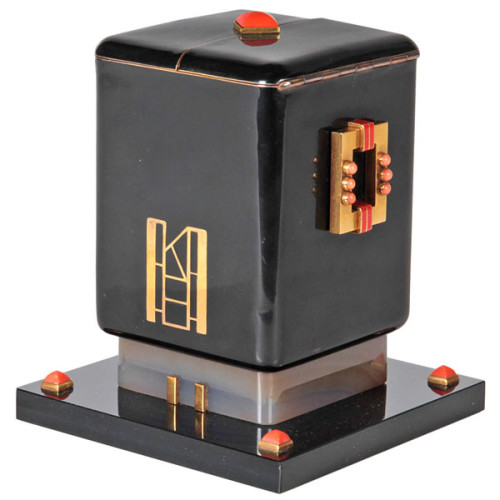
Art Deco jewel mounted mechanical covered box c. 1925
Of rectangular stepped form, the black enamel box hinged and accented at the top with a gold bezel mounted sugar loaf shaped coral; spring loaded to pull down and reveal a cinnabar red enamel interior, the exterior with gold champlevé set highly stylized geometric initials and further ornamented with geometric square cut out gold applied handles embellished with salmon coral beads and red enamel bands, all resting on a recessed agate base and conforming black onyx base punctuated with a gold bezel mounted sugar loaf shaped coral on each corner.
Marks: Ostertag (on a gold plaque inset into the underside of the onyx base)
H: 4″ x W: 3 1/2″ x D: 3 1/2″
Arnold Ostertag was a Swiss-born jeweler who became a dominant force in the creation of fine jewels and objects in Paris during the 1920s and 30s. After studying dentistry in Chicago, Ostertag embarked on a world tour and, while traveling through India, became fascinated by jewels. He later settled in Paris and opened a very successful salon on the Place Vendome. In design and quality, Ostertag’s jewels, which frequently featured Indian themes, rivaled the production of many of the most famous Parisian jewelry houses. In fact, the renowned clockmaker George Verger/Verger Freres, produced wonderful clocks and mechanical objects for Ostertag, as well as for many other world renowned jewelers and likely masterminded the mechanism of the Art Deco box above. In addition to making pieces for Ostertag, Maison Verger made pieces for Cartier, LaCloche, Marzo, Boucheron, Hermes, Van Cleef & Arpels, Chaumet, Mauboussin, etc. Arnold Ostertag was popular on the international front and made many trips to America spending time in both New York, as well as Los Angeles where he befriended many Hollywood stars. He also received commissions during his trips to make exquisite custom jewelry and precious jeweled objects such as this fine Art Deco box.
MULLER FRÈRES Lunéville, France
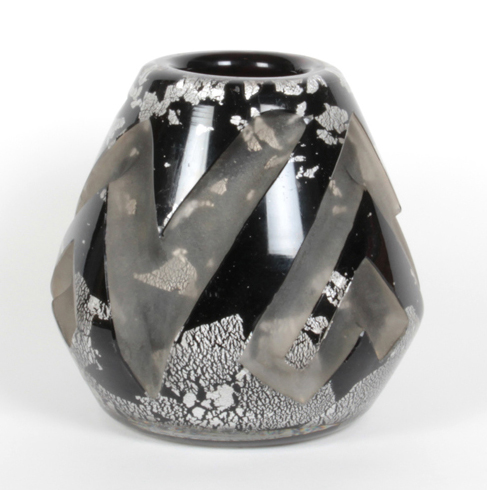
Vase c. 1925
Heavy cased clear glass over black glass with silver foil inclusions; acid-etched and deeply wheel-carved with a large zig zag motif
Signed: MULLER FRES LUNEVILLE (etched signature)
For more information see: Glass, Art Nouveau to Art Deco, Victor Arwas (New York: Harry N. Abrams, Inc., 1987) pp. 231-6;L’Europe de L’Art Verrier, des Precurseurs de l’Art Nouveau a l’Art Actuel 1850-1990, Giuseppe Cappa (Mardaga: Liège,1991) pp. 344-7.
H: 8” x Dia: 8″
 @hd_jewels