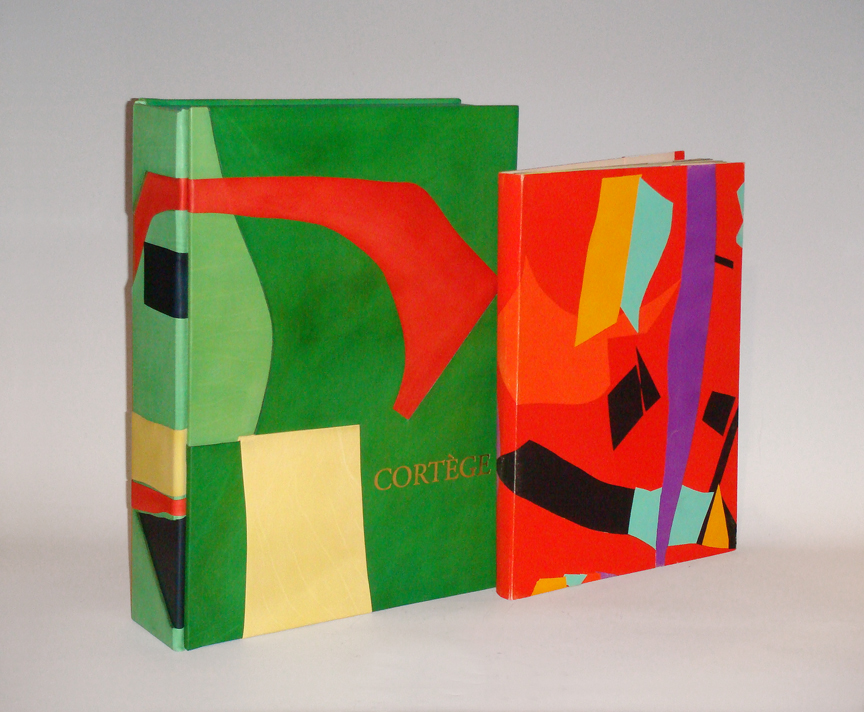
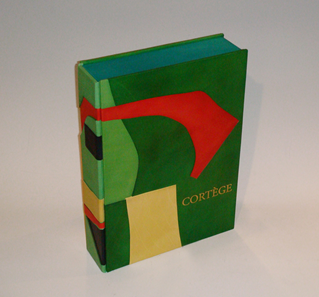
Andre Lanskoy, Maurice Beaufume, Pierre Lecuire, "Cortege" 1959
More Information
Andre Lanskoy, Maurice Beaufume, Pierre Lecuire, “Cortege” 1959
ANDRE LANSKOY (1902-1976) France
MAURICE BEAUFUME
PIERRE LECUIRE
“Cortege” 1959
64pp, 25 illustrations by Andre Lanskoy and Maurice Beaufume
Cortège is now often compared to “Jazz” as perhaps the finest example of
pochoir in the postwar period. Printed on Arches Vellum paper.
Dimensions:
Book: H: 18” x W: 13 3/8” x D: 1 7/8”
Custom leather box 2008: H: 20 ¼” x W: 15” x D: 4 ½”
Custom silk slipcase: H: 21 ½” x W: 15 5/8” x D: 5 3/8”
The artworks of André Lanskoy (1902-1976) are more than abstractions—they are juxtapositions of shapes, assemblages of colors and studies that explore the interfacing of language with visual imagery. A pioneer of Tachism, an artistic movement of the 1940s and 1950s also known as Art Informel or Lyrical Abstraction, Lanskoy emphasized the spontaneous in his paintings, combining surges of pure color with more subtle modulations. His efforts to translate language into abstract visual messages are most evident in two of his bold projects: a rare screen-printed textile and his vivid collages for Pierre Lecuire’s book, Cortège.
Born in Moscow, Lanskoy spent his youth in Russia; in 1921, he moved to Paris and studied at the Académie de la Grande-Chaumière. His first non-figurative works were painted in 1937, with his first Parisian exhibition of abstractions in 1944. As a painter, Lanskoy gave primacy to color, and this holds true for his textile design, Egypte. In 1946, French industrialist Jean Bauret invited several Tachist artists—including Serge Poliakoff, André Beaudin and Henri Michaux—to experiment with designs for furnishing textiles. One of Lanskoy’s contributions to this series was an expressive interpretation of the complex pictorial characters of ancient Egyptian hieroglyphics. The relationship between the Egyptian writing system and his own glyphs is mainly conceptual: the symbols Lanskoy invented have no inherent meaning, yet their careful placement suggests a text that is meant to be read. Contrasting with the neutral ground, the centered, vertical column is a grid of rectangular cells containing six repeating compilations of mysterious, hieroglyphic-inspired shapes. These cartouche-like compartments are bordered on each side by narrow strips of color blocks with voided linear abstractions. The intense purple and teal hues and vibrant reds and yellow are typical of Lanskoy’s exaltation of color.
Working within the theme of synthesizing language, color and form, Lanskoy tried his hand at an exciting tradition: the livre d’artiste. His first project was a collaboration with poet Pierre Lecuire; their masterpiece Cortège, arguably one of the finest artist-books ever produced, is a dazzling symbiosis of literary and visual material. Lecuire first met Lanskoy in 1948; ten years later, he would enlist his friend to illustrate the long prose poem. At Lecuire’s suggestion, Lanskoy created a series of twenty-four compositions for the book in the papiers collés method; his challenge was to interpret Lecuire’s writing into bold, graphic statements. The author’s opening lines set the tone for Lanskoy’s luminous color harmonies: “This book is a cortège. It has its colors, action and animation. It blazes, it proclaims one knows not which passion, which justice; it flows like the course of a navigation….” As he achieved with Egypte, the vibrant, saturated tints of the abstractions on these particular plates create a language of their own, while the lively arrangement of crisp and jagged forms shows an affinity with the rhythmic cadence of communication.
Remarkable for their dense bursts of color and unfamiliar shapes, the series of collages was masterfully executed in pochoir by colorist Maurice Beaufumé under Lanskoy’s personal direction. The bold, oversized text was printed by Marthe Fequet and Pierre Baudier, and Cortège was released in Paris, December 1959
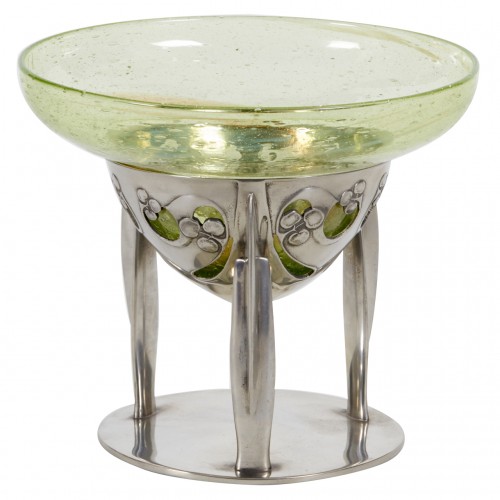
Archibald Knox / Liberty & Co. Clutha bowl on tri-leg Tudric stand c. 1902
ARCHIBALD KNOX (1864-1933) UK
LIBERTY & CO. London
JAMES COUPER & SONS Glasgow
Clutha bowl on tri-leg stand c. 1902
Clutha glass with inclusions of aventurine streaks and bubbles, polished tri-leg Tudric pewter stand.
Marks: Tudric, 0276
Illustrated: Liberty’s 1875-1975, An Exhibition to mark the Firm’s Centenary (London: Victoria & Albert Museum, 1975), p. 89, number D 250 A; The Designs of Archibald Knox for Liberty & Co., A.J. Tilbrook (London: Ornament Press Ltd., 1976), p. 114; Liberty Style, The Classic Years: 1898-1910, Mervyn Levy (New York: Rizzoli, 1986), p. 31; Archibald Knox, ed. by Stephen A. Martin (London: Academy Editions, 1995), p. 96.
BRASSAÏ (1899-1984) Austria-Hungary
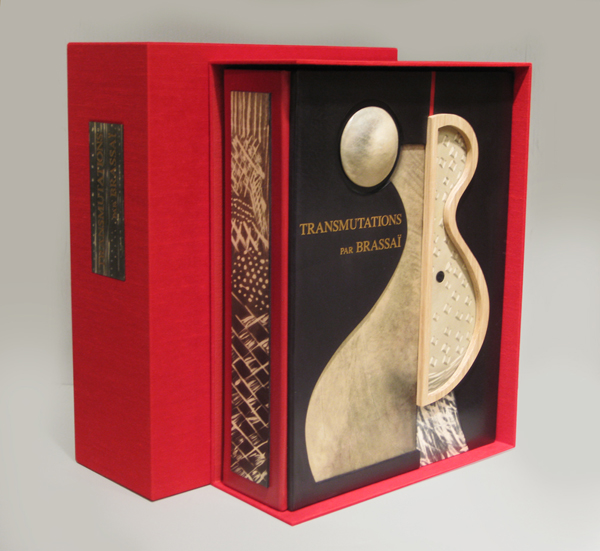
“Transmutations 1934-35” 1967
Published by Lacoste: Galerie Les Contards, France.
12 gelatin silver prints each flush-mounted to a presentation folder with printed sequential number and title, with colophon contained in a linen covered, velvet lined clamshell folio with gilt lettering on the spine.
Signed and numbered 32 in ink on the colophon. This work is from an edition of 100. The titles include: I. Femme-fruit; II. Sevillane denudee; III. Odalisque; IV. Femme-mandoline; V. Femme-amphore; VI. Fille de Joie se Deshabillant; VII. Visage mineral; VIII. Tentation de Saint Antoine; IX. Jeune fille revant; X. Offrande; XI. Femme aux voiles; XII. Fete foraine.
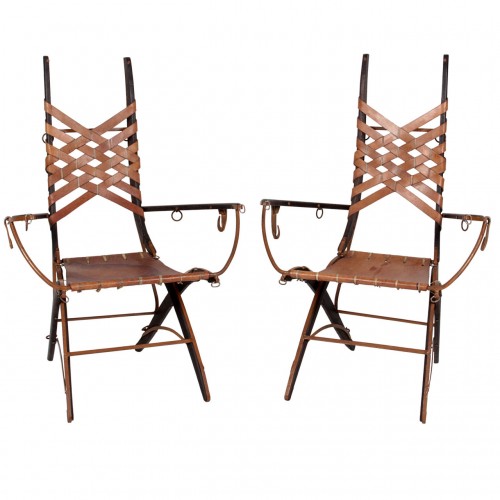
Alberto Marconetti / Italian Post-War Design Armchairs c. 1960’s
ALBERTO MARCONETTI Milan, Italy (active Argentina)
Armchairs (Two available) c. 1960’s
Oak, painted iron, leather strapwork and seat
Marks: by Alberto Marconetti (script signature)
H: 40 1/2” x W: 27” x D: 21”
Seat height: 19″
Price: $7,450 (each)
This pair of armchairs nods to the influence of such Italian designers as Carlo Bugatti and Carlo Mollino yet are their own unique creation. They have an unusual anthropomorphic quality in that the frame suggests a skeletal structure. In addition, the leather strapwork, iron loops and hooks allude to the equipage of the ancient Roman equestrian order.
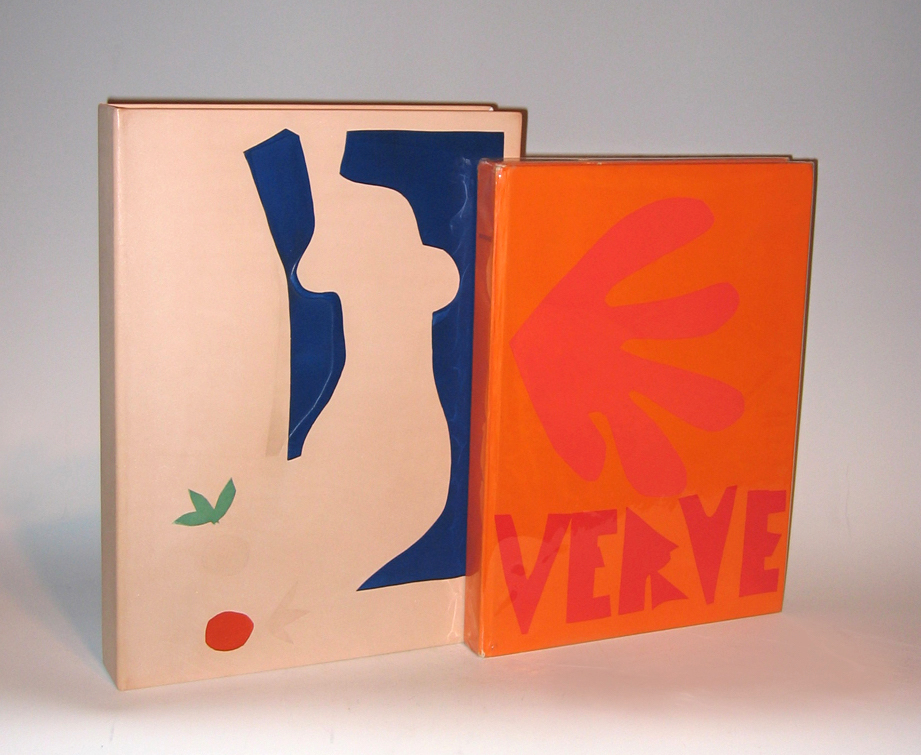
HENRI MATISSE (1869-1954) France
“Verve” Vol. IX No. 35 & 36 1958
Revue artistique et littéraire paraissant quatre fois par an
Created and editioned at the Mourlot Studio, Paris.
Published by E. Tériade, Paris 1958.
Dimensions:
Book: H 14 1/2” x W: 10 11/16”
Custom leather box: H: 15 13/16” x W: 11 5/8” x D: 2 1/16”
Custom linen case: H: 16 3/4” x 12 5/16” x D: 2 5/8”


 @hd_jewels