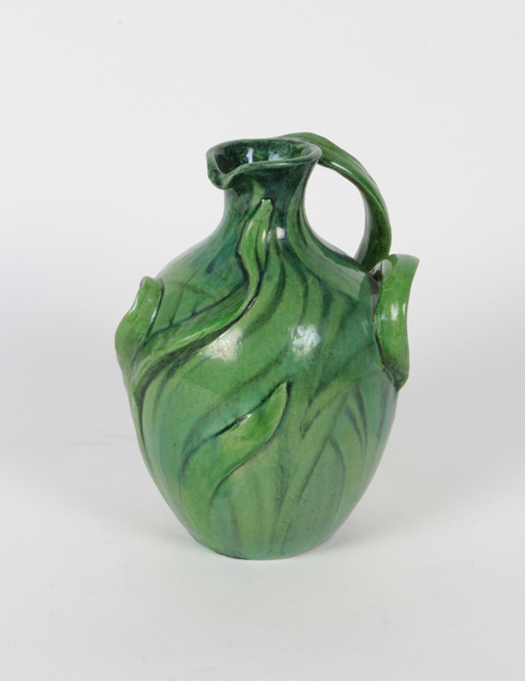
Edmond Lachenal French Art Nouveau Green glazed pitcher / vase form c. 1900
More Information
Edmond Lachenal French Art Nouveau Green glazed pitcher / vase form c. 1900
EDMOND LACHENAL (1855-1930) Paris, France
Green glazed pitcher / vase form c. 1900
Marks: E LACHENAL (impressed and glazed in a rectangle on base)
For information on Edmond Lachenal see:”Edmond Lachenal”, Fritz Minkus, Kunst und Kunsthandwerk, IV (1901) pp.390-98; La Céramique Art Nouveau, Edgar Pelichet and Michèle Duperrex (Lausanne: Les Éditions du Grand-Pont, Switzerland, 1976) pp. 66,71,74,78,83,112,115; “l’Atelier Lachenal à la galerie Georges Petit “ in Les Echoes d’Art” (1933), p. Vll; Art Nouveau: Belgium & France, exh. cat. Yvonne Brunhammer et al. (Houston, TX: Institute for the the Arts, Rice University, 1976), p. 48; Le Japonisme (Paris: Éditions de la Réunion des Musées Nationaux, 1988) cat no. 377, p. 321; Japonisme: the Japanese influence on western art in the 19th and 20th Centuries, Siegfried Wichmann (Parklane: New York, 1980) pp. 339, 349; cat. no. 920.
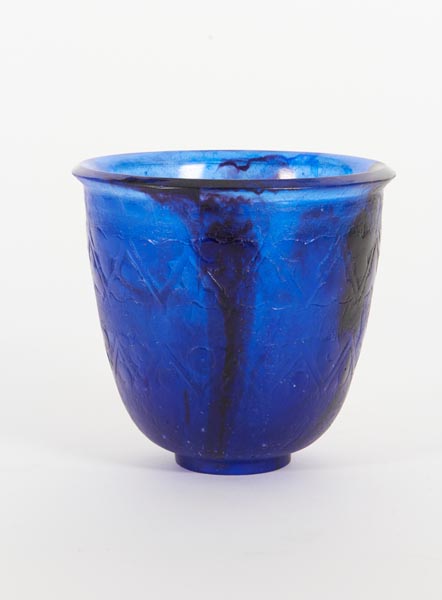
Francois-Emile Decorchement French Art Deco “Bleu” pâte-de-crystal vase 1926
FRANÇOIS-EMILE DECORCHEMENT (1880-1971) France
“Bleu” pâte-de-crystal vase c. 1926
Cobalt blue pâte-de-crystal (lost wax cast crystal) with mauve inclusions, two low-relief friezes of varying abstract vine motifs
Impressed: DECORCHEMENT in a lunette seal, numbered A 865
For more information on Decorchement see: Art Deco, Victor Arwas (New York: Harry N. Abrams,1980) pp. 268-69, 298.
H: 4 1/2″ x Dia: 4 3/4″
Decorchement, Francois Emile. (1880-1970) He set up a glass house in Conches in 1902 producing exquisite pate-de-verre, statuettes, bowls and vases. He extended this range to encompass a rougher hewn surface with motifs of flowers and sometimes insects. His designs became increasingly abstract during the 1930s toward the outbreak of the Second World War; these were often executed in pate-de-cristal. Later the production continued although in a more restrained manner with softer semi-opaque and translucent colors.
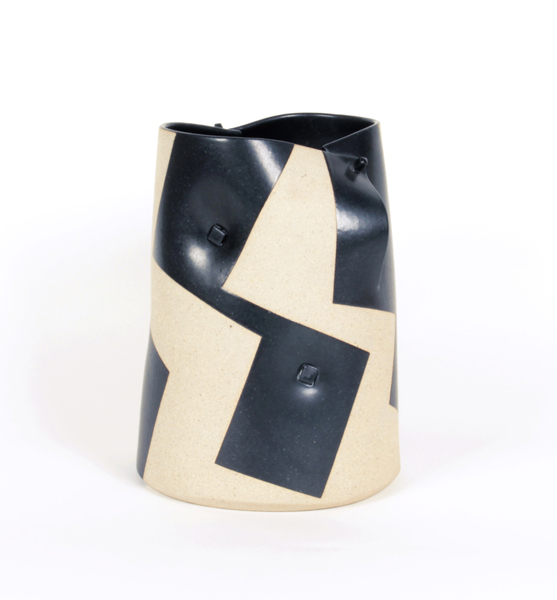
Black, randomly positioned rectangles on a cream / sandy base with a pinned overlap detail
Signed: GP 2000-68
H: 9 1/4″ x D: 6 1/2″
Price: $5,500
Gustavo Pérez makes vessels that are simple, smooth and symmetrical. Their elegance is due to the precision of the incised lines and other markings on the pots. While using the same clay body—sand colored stoneware—throughout his work, the artist achieves a wide range of form and pattern and includes slowly undulating walls beneath the subtly incised surfaces.
Gustavo Pérez works are incessantly experimental. There have been parallel lines, calligraphic traces, geometric cuts into the surface, minimalist vessels, recollections of pre-Hispanic vases and references to other ancient cultures.
The ceramics of Gustavo Pérez are distinguished by eliminating superfluous details, by synthesis of his elements. During the past two decades he has created a visual language that seems closely aligned with music. Pure in form, with a significant structure, completely abstract and without specific associations, his language of line, the bending of forms, and the definition of the vessel mark his work as a distinctive voice. The form is not just a container or a receptacle; it is architecture.
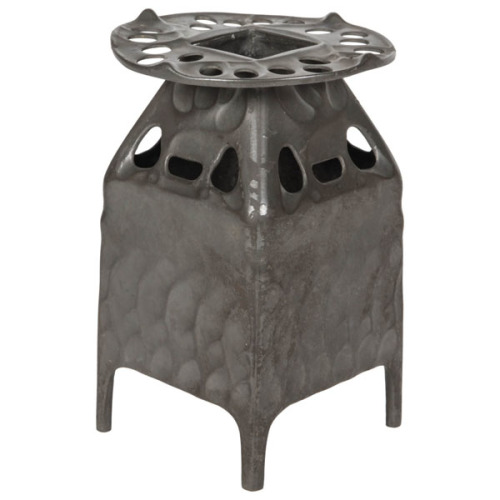
Karl Berghof / Kayserzinn Extremely Rare German Jugendstil Art Nouveau Pewter Vase 1904
KARL BERGHOF Germany
J. P. KAYSER SOHN Krefeld, Germany
Vase 1904
Pewter squared vase with round flange top, open work details
Marks: Kayserzinn 4541 7 (in a raised oval)
Illustrated: Zinn des Jugendstils, Eckard Wagner (Cologne: Rheinland-Verlag, 1978), p. 63, cat. no. 148; J. P. Kayser Sohn Krefeld: Fabrik kunstgewerblicher Metallgegenstände, Musterbuch 1907 (Munich: Verlag Dry, 1982) p. 46.
***This is an extremely rare, other worldly Kayserzinn form.




 @hd_jewels