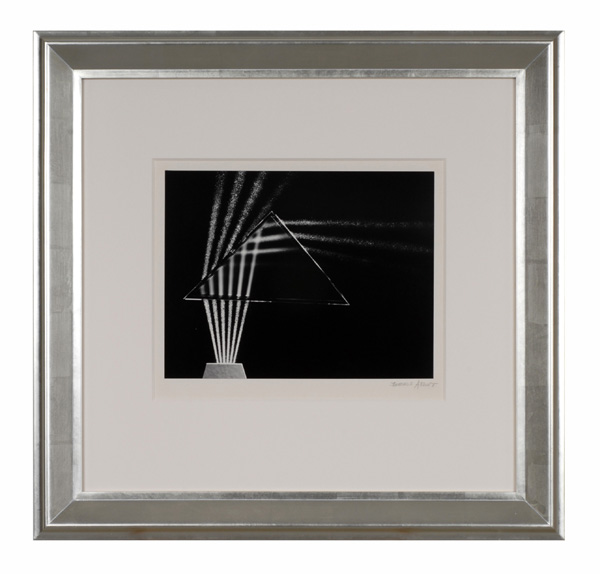
Product Description
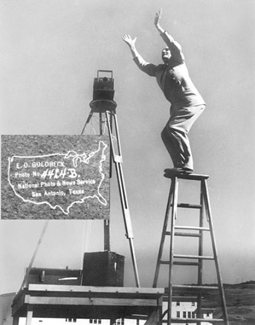
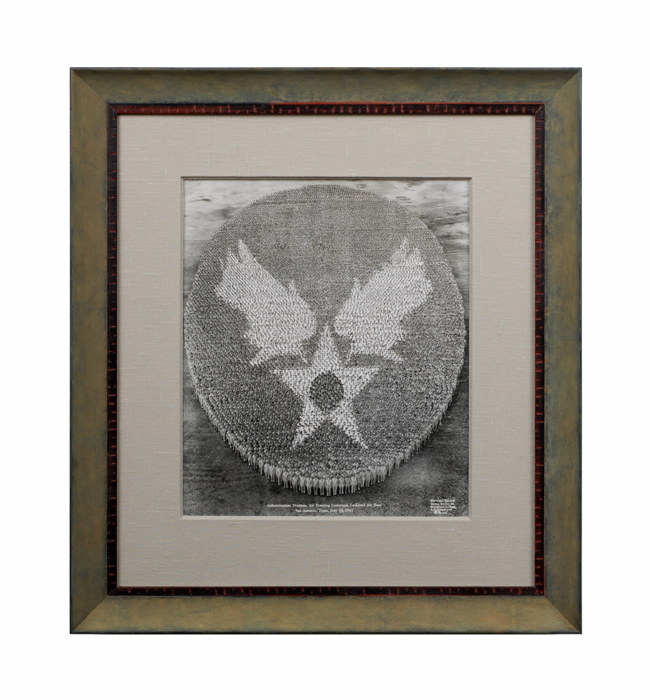
Eugene Omar Goldbeck, Indoctrination Division, Air Training Command, Lackland Air Base, San Antonio, Texas, July 19, 1947 , Gelatin silver print

EUGENE OMAR GOLDBECK (1892-1986) USA
Indoctrination Division, Air Training Command, Lackland Air Base, San Antonio, Texas, July 19, 1947
Signed: Natural Photo and News Service EO Goldbeck © photo (on matting); LR Conner EG 81
Size: H: 19” x W: 16 ½”; Size (with mat): H: 24” x W: 20”
Framed: H: 26 5/8” x W: 23 7/8”
Price: $6,500
Known as the “unofficial photographer of America’s military,” Goldbeck conducted three-year tours to all of the major military bases in and outside of the United States until demand diminished for military group photos after World War II. He pushed the limits of his craft by working with larger and larger groups in striking designs. For his record setting group shot, in which 21,765 men were arranged to represent the Air Force insignia, he spent more than six weeks building a 200-foot tower and making blueprints of the formation and attire of his subjects. The photograph was subsequently featured in Life magazine and became the most frequently reproduced of his prints.
Eugene Omar Goldbeck, Indoctrination Division, Air Training Command, Lackland Air Base, San Antonio, Texas, July 19, 1947 , Gelatin silver print

TIM GIDAL (Ignaz Nachum Gidalewitsch) (1909-1996) USA
Self-portrait 1930
Signed: Tim Gidal, self portrait 1930, photograph printed by photographer TG (script in ink on back)
H: 17 7/8” x W: 12 1/16” (framed)
German-born Israeli photojournalist and writer. Gidal studied law, history and art history in Munich and Berlin, and started photography as a Zionist student. His first published pictures appeared in the Münchener illustrierte Presse in 1929. After emigrating in 1933 he lived in Switzerland (where he wrote a doctoral dissertation on photojournalism), the Middle East, and India, contributing to numerous publications. Between 1938 and 1940 he worked for Picture Post, and 1942-5 for the British army magazine Parade. After moving to the USA in 1947 he was an editorial consultant for Life. He later held academic posts in America and Israel. His many books include Modern Photojournalism: Origin and Evolution 1910-1933 (1973).
ALFRED STIEGLITZ (1864-1946) USA
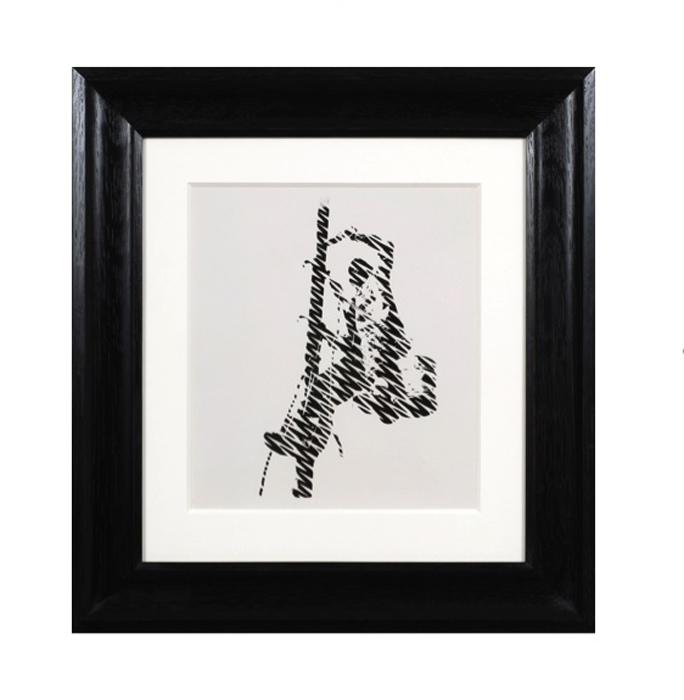
Old & New, New York 1910
Photogravure from Camera Work, Oak frame in the Arts & Crafts style
Signed: Alfred Stieglitz Old & New, New York, RMG #1081.30 (all in pencil on back)
Image: H: 8” x W: 6 1/4”
Page size: H: 11” x W: 7 7/8”
Framed: H: 15 ¼” x 11 ¼”
Price: $18,500
Alfred Stieglitz was an American photographer who was instrumental over his fifty-year career in making photography an acceptable art form alongside painting and sculpture. Many of his photographs are known for appearing like those other art forms, and he is also known for his marriage to painter Georgia O’Keeffe, most famous for her large-scale paintings of flowers.
Stieglitz was born the eldest of six children in Hoboken, New Jersey and raised in a brownstone on Manhattan’s Upper East Side. His father moved with his family to Germany in 1881. The next year, Stieglitz began studying mechanical engineering at the Technische Hochschule in Berlin and soon switched to photography. Traveling through the European countryside with his camera, he took many photographs of peasants working on the Dutch seacoast and undisturbed nature within Germany’s Black Forest and won prizes and attention throughout Europe in the 1880s.
From 1893 to 1896, Stieglitz was editor of American Amateur Photographer magazine; however, his editorial style proved to be brusque, autocratic and alienating to many subscribers. After being forced to resign, Stieglitz turned to the New York Camera Club (which was later renamed The Camera Club of New York and is in existence to this day) and retooled its newsletter into a serious art periodical known as Camera Notes. He announced that every published image would be a picture, not a photograph – a statement that allowed Stieglitz to determine which was which.
Big camera clubs that were the vogue in America at the time did not satisfy him; in 1902 he organized an invitation-only group, which he dubbed the Photo-Secession, to force the art world to recognize photography “as a distinctive medium of individual expression.” Among its members were Edward Steichen, Gertrude Käsebier, Clarence H. White and Alvin Langdon Coburn. Also in 1902 he ceased being editor of Camera Notes and in 1903 started a new independent journal of his own, Camera Work. Photo-Secession held its own exhibitions and its work was published Camera Work, which became the pre-eminent quarterly photographic journal of its day, although in later years its popularity declined markedly and it ceased publication in 1917.
From 1905 to 1917, Stieglitz managed the Little Galleries of the Photo-Secession at 291 Fifth Avenue (which came to be known as 291). In 1910, Stieglitz was invited to organize a show at Buffalo’s Albright Art Gallery, which set attendance records. He was insistent that “photographs look like photographs,” so that the medium of photography would be considered with its own aesthetic credo and so separate photography from other fine arts such as painting, thus defining photography as a fine art for the first time. This approach by Stieglitz to photography gained the term “straight photography” in contrast to other forms of photography such as “pictorial photography” which practiced manipulation of the image pre and/or post exposure.
In the 1930s, Stieglitz presided over two non-commercial New York City galleries, The Intimate Gallery and An American Place. It was at An American Place that he formed his friendship with the great 20th century photographer Ansel Adams. Adams displayed many prints in Stieglitz’s gallery, corresponded with him and also photographed Stieglitz on occasion. Stieglitz was a great philanthropist and sympathizer with his fellow human beings. He once received a phone call on one of Adams’s visits. A man wanted to show Stieglitz some work. He invited him over, looked at the prints, looked at the man in a rather disheveled state of affairs and looked at the work again. He then offered to buy one of the paintings, wrote him a check for $150, gave him five dollars and told him to get something good to eat.
RUBEN CHAMBERS USA
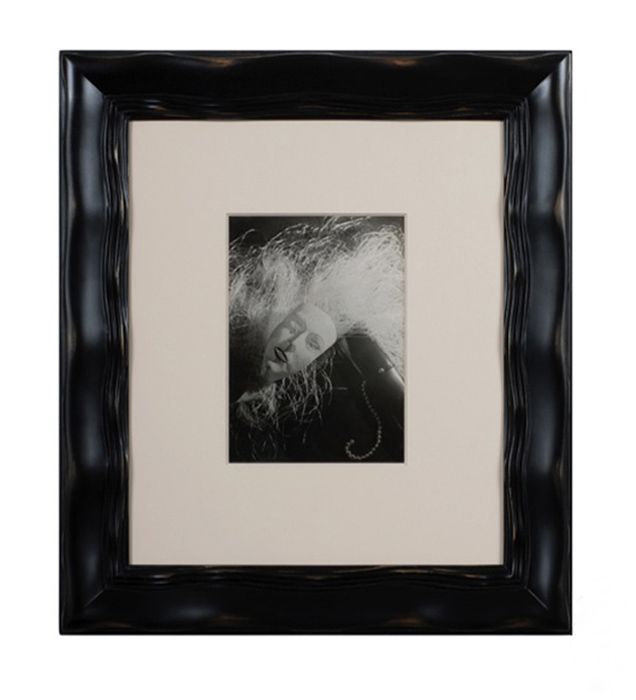
Torso 1945
Signed: Torso 1945, Ruben Chambers (in pencil on back) Ruben Chambers, 1945 (on back)
Size: H: 14” x W: 11”
Framed size: H: 17 13/16” x W: 14 13/16”
HERBERT BAYER (1900-1985) Austria
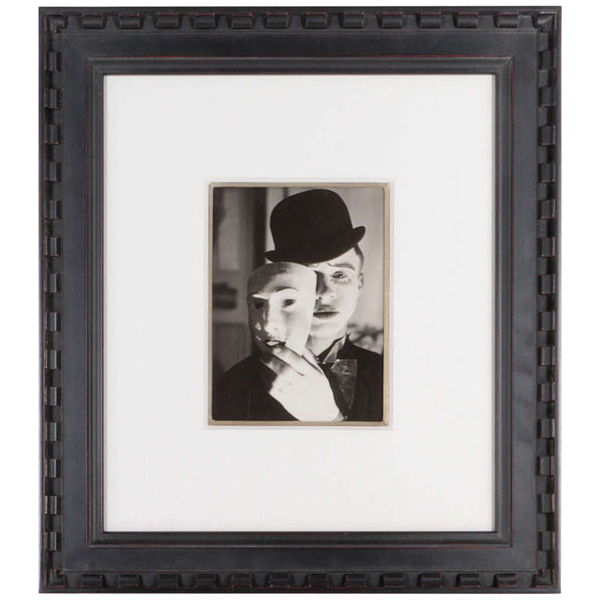
Self portrait 1932 (printed later)
Silver gelatin print
Edition: 28/40
Signed: bayer 32 (in ink on bottom right corner)
Provenance: Kennedy Gallery, New York
H: 13 7/16” x W: 9 ½”
Framed size: H: 21 ½” x W: 17 ½”
Price: $16,000
Herbert Bayer (1900 – 1985) was an Austrian graphic designer, painter, photographer, and architect. Bayer apprenticed under the artist Georg Schmidthammer in Linz. Leaving the workshop to study at the Darmstadt Artists’ Colony, he became interested in Walter Gropius’s Bauhaus manifesto. After Bayer had studied for four years at the Bauhaus under such teachers as Wassily Kandinsky and László Moholy-Nagy, Gropius appointed Bayer director of printing and advertising. In the spirit of reductive minimalism, Bayer developed a crisp visual style and adopted use of all-lowercase, sans serif typefaces for most Bauhaus publications. Bayer is one of several typographers of the period including Kurt Schwitters and Jan Tschichold who experimented with the creation of a simplified more phonetic-based alphabet. Bayer designed the 1925 geometric sans-serif typeface, universal, now issued in digital form as Architype Bayer that bears comparison with the stylistically related typeface Architype Schwitters.
In 1928, Bayer left the Bauhaus to become art director of Vogue magazine’s Berlin office. He remained in Germany far later than most other progressives. In 1936 he designed a brochure for the Deutschland Ausstellung, an exhibition for tourists in Berlin during the 1936 Olympic Games. In 1938 he left Germany and settled in New York City where he had a long and distinguished career in nearly every aspect of the graphic arts. In 1946 Bayer relocated again. Hired by industrialist and visionary Walter Paepcke, Bayer moved to Aspen, Colorado as Paepcke promoted skiing as a popular sport. Bayer’s architectural work in the town included co-designing the Aspen Institute and restoring the Wheeler Opera House, but his production of promotional posters identified skiing with wit, excitement, and glamour. Bayer would remain associated with Aspen until the mid-1970s. Bayer gave the Denver Art Museum a collection of around 8,000 of his works. In 1959, he designed his “fonetik alfabet”, a phonetic alphabet, for English. It was sans-serif and without capital letters. He had special symbols for the endings -ed, -ory, -ing, and -ion, as well as the digraphs “ch”, “sh”, and “ng”. An underline indicated the doubling of a consonant in traditional orthography.