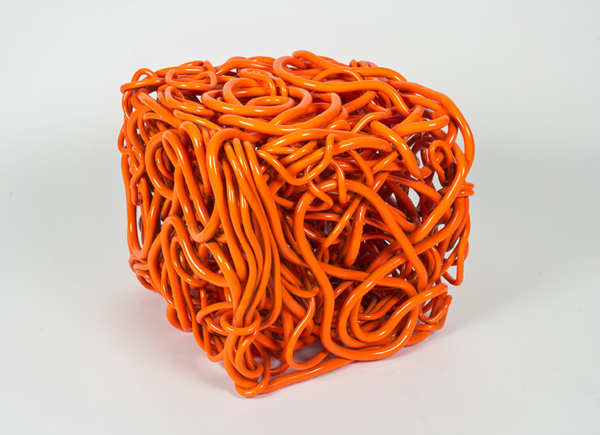
Orange anodized and contoured aluminum wire manipulated into a cube form
Signed: Orange Cube, 08, Forrest Myers (on plaque)
For more information see: Who Was Who in American Art(Madison, Conn.: Sound View Press, 2003-2004 25th Edition), Dictionary of American Sculptors: 18th Century to the Present, Glen Opitz (Poughkeepsie, NY: Apollo, 1984).
Dimension: 10 1/2″ cube
Price: $15,000
A sculptor and art teacher born in Long Beach, California, Forrest Myers settled in Brooklyn, New York. Myers studied at the San Francisco Art Institute. His teaching venues include the San Francisco Art Institute, School of Visual Arts in New York, Kent State University, and the Parsons School of Design. His studio is in Brooklyn.
In the early 1980s, Forrest Myers was applying Buckminster Fuller's principles of tensegrity and repeated tetrahedrons into his designs for furniture. This exploration culminated in the use of aluminum wire that becomes structural when bent and pressed into a dense tangle.
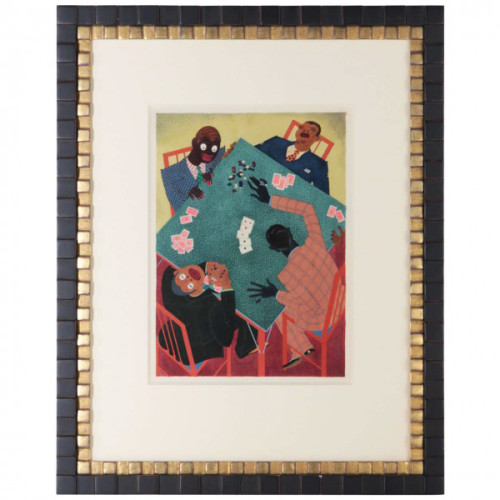
S O G A T A New York, NY “Harlem: Five Aces” Watercolor and pencil on paper 1931
S O G A T A New York, NY
“Harlem: Five Aces” 1931
Watercolor and pencil on paper
Signed: SOGATA, HARLEM 1931 (painted, lower right corner of image); HARLEM: FIVE ACES. (in pencil beneath image on left)
For contextual history and similar art see: Rhapsodies in black : art of the Harlem Renaissance, (Berkeley: University of California Press, 1997); Harlem Renaissance Artists. Jordan, Denise (Chicago: Heinemann Library, 2003).
Paper H: 14 7/8″ x W: 10 7/8 ”
Image H: 11″ x W: 7 1/2″
Frame H: 19” x W: 15 1/4”
*This SOGATA New York Watercolor and pencil on paper has been gifted to The Wolfsonian – FIU, Miami Beach, FL.
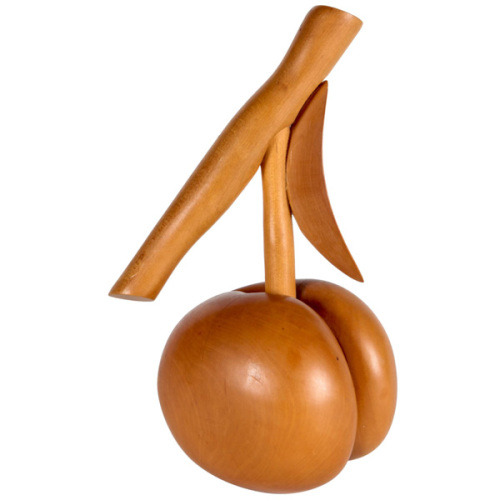
Jan de Swart, Handcarved “Peach” Sculpture, c.1970
JAN DE SWART (1908-1987) Netherlands / USA
Peach sculpture c. 1970
Hand carved and formed jelutong wood in a symbolic / erotic form of a peach
For more information see: Jan de Swart: A Day That Becomes a Lifetime, exhibition catalogue (California: Fine Arts Gallery at the San Fernando Valley State College, February 1972); Jan de Swart, Mike McGee and William G. Otton (Laguna Beach, California: Laguna Art Museum, 1986).
H: 7 ½” x D: 4”
Price: $7,500
Constantly seeking and inventing new materials Jan de Swart was a true modernist. He was influenced by artists such as Isamu Noguchi, Harry Bertoia, Charles Eames, and later Sam Maloof and Wendell Castle. Although he had been creating small sculptures since his arrival in California from Holland in 1929, he had not been widely recognized until being introduced to John Entenza, publisher of Arts & Architecture magazine in 1947. Soon thereafter, he was able to create larger works and began collaborating with architects such as Whitney Smith and Victor Gruen on special commissions. His work is in the permanent collection of Los Angeles County Museum of Art, The Smithsonian, and the Ford Foundation. He was honored with the American Institute of Architects Gold Medal for Sculpture in 1965.
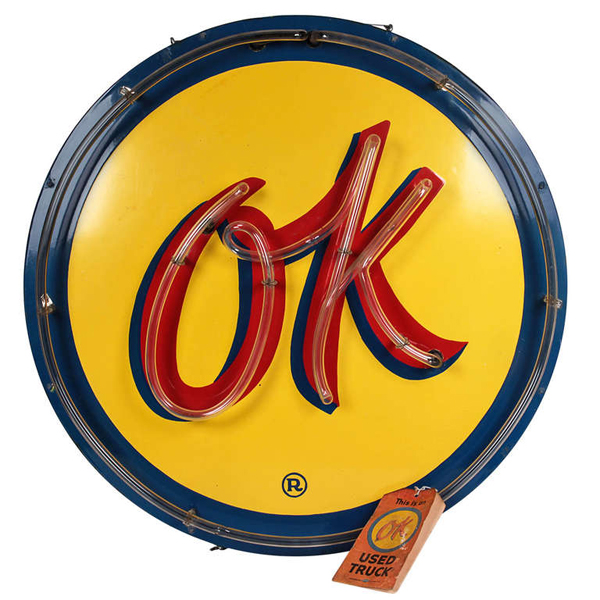
American Art Deco, Neon, OK Chevrolet Used Truck Sign c.1940’s
AMERICAN NEON DESIGN
OK Chevrolet Used Truck Sign c.1940’s
Blue, yellow and red baked enamel on metal with an orange neon tube spelling out “OK” encircled with a round blue neon border, original paper tag.
Marks: Registration Mark (in the enamel) Original paper tag, This is an OK Used Truck, Authorized Chevrolet Dealer, Chevrolet Motor Division, General Motors Corporation
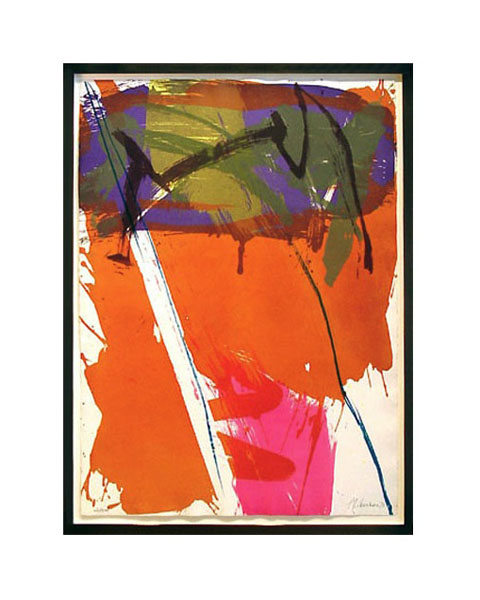
Alexander Liberman / Meyer Schapiro Portfolio Untitled 1973
ALEXANDER LIBERMAN (1912-1999) USA
MEYER SCHAPIRO PORTFOLIO 1974
Untitled 1973
Silkscreen, patinated bronze frame
Signed: A. Liberman 1973, Artist’s proof, 2RC (embossed on paper)
Canvas: H: 33” x W: 25 1/2”
Frame: H: 42 1/2” x W 33 1/2”
Portfolio of 12 works, Edition of 100
Price: $
Alexander Liberman’s family left the Soviet Union for London as exiles in 1921. Liberman studied there briefly before moving to Paris where he undertook philosophy and mathematics at the Sorbonne and architecture at the École des Beaux-Arts. In the 1930s Liberman designed stage sets, and worked on the staff of Vu, the first magazine illustrated with photographs. Although Liberman quickly earned the title of managing director, he left the magazine in 1936, and devoted himself to painting and writing. In 1941, he left Paris for New York. Again, he became involved in publishing after gaining employment at Vogue magazine. Twenty years later, in 1962, he became Editorial Director of all Condé Nast Publications, a position he held until he retired in 1994. During his time at Vogue, Liberman introduced 20th-century art to readers by using it as a backdrop for fashion shoots, as well as by profiling living artists in the magazine. As a painter, Liberman exhibited geometric circle paintings in galleries and museums around New York in the 1950s. Liberman also had an interest in sculpture, and began welding steel into public works in the late 1950s. These monochrome geometric sculptures are featured in over 40 cities worldwide.



 @hd_jewels